
Jul 31, 2026
Which fitting is used to connect pipes at a 90 degree angle?
When designing or fixing industrial piping systems, picking the right part to change the flow is an important choice that affects the safety and longevity of the system. To join pipes at a 90-degree angle, the elbow fitting is most often used, specifically the round face galvanized round edge 90° elbow pipe fittings. These parts are made of malleable iron and have precision fitting (NPT or BSPT), hot-dip galvanization, and a strengthened beaded rim. This design solves some of the most important problems: it stops threads from distorting under high power, stops rust in damp places, and makes sure that systems that handle water, gas, or oil under pressure don't leak.
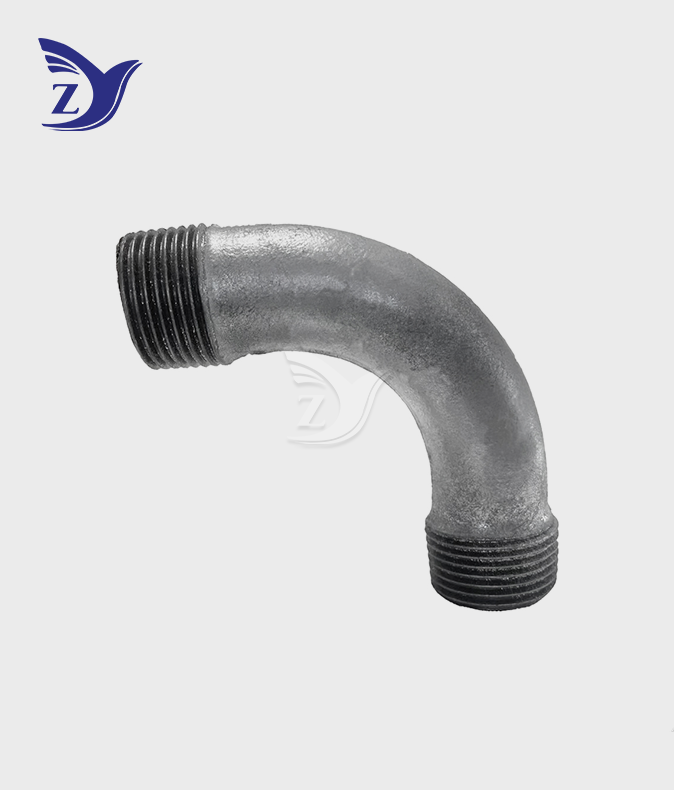
90° Elbow Pipe Fittings: Types and Specifications
Defining the Role of 90° Elbows in Piping Systems
The simple but important job of elbow fits is to change the flow direction by 90 degrees while keeping the hydraulic efficiency. Tees and crosses split the flow, but elbows keep the motion of the fluids or gases, which reduces noise and pressure loss. These fittings make it possible to use small layouts and efficient routing around structural obstacles in fire sprinkler networks, HVAC ductwork, and municipal water mains.
Material Selection and Manufacturing Standards
Most modern round face galvanized round edge 90° elbow pipe fittings are made from black malleable iron that meets the standards of ASTM A197 or EN 1562. This material is very flexible and doesn't easily break when it hits something hard. This is very important for systems that are heated and cooled or that vibrate. In the casting process, controlled heating takes place in ovens heated by natural gas. This turns brittle white iron into a matrix that can withstand pressures of up to 25 Bar (PN 20/25) and temperatures from -20°C to 300°C.
Round Edge Versus Square Edge Design
The outside support is what makes round-edge and square-edge (banded) knees different from each other. Round-edge fittings have a beaded collar around the edge of the female thread that spreads out the radial expansion forces during installation and keeps the fitting from breaking when the wrench pressure is high. Designs with square edges have a flat, strengthened band that gives heavy-duty pipe tools more surface area to grip. Both types meet the standards for size, but round-edge elbows are better in situations where room is limited and builders want fittings that are easy to handle.
Thread Standards: NPT and BSPT Compatibility
When buying things from other countries, thread compatibility is a must. ASME B1.20.1 says that NPT (National Pipe Taper) threads have a 60-degree flank angle and a 1:16 taper. Thread interference makes a mechanical seal. ISO 7-1 says that BSPT (British Standard Pipe Taper) threads have a 55-degree angle and the same taper ratio. Both NPT and BSPT make pressure-tight seals without gaskets, but different regions prefer one over the other. North American markets prefer NPT, while European and Asian projects require BSPT. Companies like Zhiyuan Malleable Steel make dual-standard stocks that can be easily integrated into a variety of transit networks.
Advantages and Applications of Galvanized Round Edge 90° Elbow Pipe Fittings
Superior Corrosion Resistance Through Hot-Dip Galvanization
Galvanization turns iron that can be shaped into something that won't rust. In the hot-dip process, parts are submerged in liquid zinc, which forms a coating with a minimum mass of 500g/m² (about 70 micrometers thick). This zinc layer acts as a cathode and gives up its own defence to keep the iron below from rusting. When it comes to coastal installations, underground pipes, and outdoor fire hydrant systems, galvanized elbows last decades longer than untreated ones. In normal situations, they last more than 50 years.
Durability Under Pressure and Thermal Stress
Galvanized round-edge elbows can usually handle pressures up to Class 150 (PN 20/25), which means they can be used in systems with 25 Bar of normal pressure or 20 Bar of pressure at high temperatures. The beaded rim that is reinforced makes the hoop stronger, so these fittings can handle being loaded and unloaded many times without fatigue cracking. Pneumatic leaking checks at 0.6 MPa while buried in water are part of the testing process. This makes sure that there are no microporosities or casting flaws before the product is shipped.
Cost-Effectiveness in High-Volume Procurement
Galvanized malleable iron elbows are a much better deal than similar products made of stainless steel or bronze. Material costs are still 30–40% lower, and manufacturing scalability lets people order in bulk without having to wait longer for their orders to be made. Here are the main benefits that make businesses decide to buy:
- Economic Efficiency: Lower costs for raw materials and processes mean lower prices, which is especially helpful for big projects that need thousands of fits.
- Supply Chain Reliability: Companies like Zhiyuan Malleable Steel, which can make more than 30,000 tonnes of steel a year, keep large stockpiles of more than 1,000 different specification types. This means that standard sizes can be delivered within two hours.
- Lifecycle Savings: Less frequent upkeep and a longer service life make galvanized fittings the best choice for corporate and municipal clients who want to lower their total cost of ownership.
All of these benefits make it easier to buy things in areas like fire protection engineering and industrial infrastructure, where strict quality standards must be met while budgets are tight.
Industrial Applications Across Sectors
Threaded galvanized elbows help fire safety systems get through tight places between sprinkler heads and main distribution lines. These fittings are used at junction points in municipal water supply networks where changes in direction keep excavation from blocking existing utilities. The fittings' ability to keep airflow efficient while allowing structural framing is helpful for HVAC installs. In petrol distribution, the leak-proof tapered threads make sure that safety rules for transporting flammable fuel are followed.
How to Measure and Install Round Edge 90° Elbow Pipe Fittings?
Accurate Measurement Techniques
With the right size, you can avoid leaks and system failures. Use calipers to find the current pipe's outer diameter (OD), and then look at thread specification charts to find the standard pipe size (NPS) that goes with it. For normal fittings, the most common sizes are from 1/8" to 6". Larger special sizes can be made through OEM services. Use a thread tester to check the thread pitch. Cross-threading and seal failure happen when the pitches of the fittings and pipes don't match.
Step-by-Step Installation Process
To start, use a wire brush to clean the ends of the pipes and get rid of any dirt or old sealer. Wrap PTFE tape or pipe dope around male threads in a clockwise direction, following the direction of the thread movement. Tighten the elbow onto the pipe by hand until there is more resistance. Then, use a pipe wrench to make two or three more turns. Do not tighten too much, as this can break the fitting or bend the threads. The round-edged bead lets you see if the pipe end is properly seated; gaps between the bead and pipe end show that they are not fully engaged.
Maintenance Best Practices
Check round face galvanized round edge 90° elbow pipe fittings once a year to see if the zinc coating is wearing off. This is especially important at the thread surfaces, where mechanical action can wear away protective layers. Put zinc-rich paint back on iron surfaces that are showing. Watch for changes in the system's pressure; quick drops can mean that there are possible leaks at the elbow joints. In systems that go through thermal cycling, look for loosening that could be caused by pipes and fittings expanding at different rates.
Selecting the Right 90° Elbow Fitting for Your Project: Criteria and Market Options
Material Compatibility and Environmental Factors
Use round face galvanized round edge 90° elbow pipe fittings materials that are right for the type of fluid and the conditions of use. Galvanized iron that can be shaped easily works well with drinkable water, natural gas, and oils that don't corrode, but it breaks down quickly in acidic or high-chloride environments. In petrochemical uses, changes to stainless steel may be needed to make it work with aggressive fuels. Extreme temperatures also affect choice; galvanized elbows work from -100°C to 300°C, but long-term exposure above 200°C speeds up the vaporization of zinc.
Pressure and Temperature Ratings
Compare the design forces of the system with the values for the fittings. Class 150 elbows are good for most home and business uses, but Class 300 or higher standards may be needed for industrial process lines. Think about safety margins. Engineers usually choose fittings rated 20–30% above the highest expected pressure to account for short-term spikes that happen when the pump starts up or the valve opens and closes.
Evaluating Manufacturers and Certifications
Reliable suppliers give a lot of paperwork, like ISO 9001 quality management certifications, material test reports that show they meet ASTM A197 standards, and records of the thickness of the galvanization. FM Global approval makes sure that fire safety applications are valid, and UL listings make sure that conduit fittings are compatible with electrical systems. Shanxi Taigu Zhiyuan Malleable Steel was founded in 2006 and is a star in its field. It has 26 years of experience in casting, is certified by CE, UL, and FM, and can make 30,000 tonnes of steel each year across more than 1,000 SKUs. Their building has 156 precision machining units, eight 3-ton medium-frequency electric ovens, and two 100-ton natural gas annealing kilns. These can be used for both standard output and special ODM/OEM projects.
OEM Customization and After-Sales Support
When makers offer R&D services, they help projects with unique needs. Custom thread pitches, thicker walls, or special coats (epoxy-lined for chemical protection) can be used to solve specific problems. Check the warranty terms and policies for replacing defective products. Reputable suppliers will replace defective products and keep responsive technical support teams that can be reached by email or direct phone calls.
Conclusion
Round face galvanized round edge 90° elbow pipe fittings are where metallic science, precision manufacturing, and real-world engineering all meet. Their corrosion-resistant coating, strengthened shape, and threading that meets standards make them essential for use in fire protection, public infrastructure, and industrial processing. Understanding thread compatibility, checking maker certifications, and balancing upfront costs against long-term performance are all important parts of a successful buying process. Procurement professionals build the foundation for reliable, long-lasting pipe systems by working with well-known suppliers who offer large inventories, technical support, and quality guarantees.
Partner with Zhiyuan Malleable Steel for Reliable Round Face Galvanized Round Edge 90° Elbow Pipe Fittings
Zhiyuan Malleable Steel can help you with your next project by making high-strength threaded elbows that are approved and made to ISO 9001 standards. Our 30,000-ton yearly capacity, inventory of more than 1,000 specifications, and normal two-hour product delivery keep your schedules on track. We have been experts in malleable iron casting and hot-dip galvanization for 26 years, and the parts we make are corrosion-proof and have CE, UL, and FM standards to back them up. Our ODM/OEM customization services can handle non-standard sizes, thread patterns, and coating needs, with the help of quick-responding tech teams and promises for replacing any problems. Get in touch with us at q1236800000@gmail.com to talk about your buying needs with a reliable supplier of round face galvanized round edge 90° elbow pipe fittings that is dedicated to quality, dependability, and low prices.
FAQ
What Distinguishes Round Edge From Square Edge Elbow Fittings?
Round-edge elbows have a beaded rim that spreads the stress of installation evenly, making it less likely that they will crack when they are tightened. Square-edged (banded) versions have a flat support band that makes it easier to hold a wrench. Round-edge versions work best for small setups and manual handling, while square-edge versions are best for heavy-duty uses that need the most power.
How Does Galvanization Enhance Fitting Durability?
Hot-dip galvanization adds a layer of zinc-iron alloy that is mechanically attached to the base iron. This coating acts as a sacrifice anode, corroding faster than the metal underneath to protect it. Coatings that meet EN 10242 or ASTM A153 standards (minimum 500g/m²) make things last longer than 50 years in normal conditions, for many decades longer than painted or untreated options.
Are Galvanized Elbows Suitable for High-Pressure Systems?
Class 150 galvanized elbows can handle up to 25 Bar of pressure at room temperature and 20 Bar of pressure at high temperatures (up to 300°C). Systems that need more than these ratings need Class 300 or higher requirements. Tensile strengths of more than 350 N/mm² and elongation rates of more than 10% make sure that the material can be used safely when there are pressure surges and changes in temperature.
References
- American Society of Mechanical Engineers. (2020). ASME B1.20.1: Pipe Threads, General Purpose. New York: ASME Press.
- International Organization for Standardization. (2019). ISO 5922: Malleable Cast Iron - Technical Specifications. Geneva: ISO Publications.
- ASTM International. (2021). ASTM A197: Standard Specification for Cupola Malleable Iron. West Conshohocken: ASTM Standards.
- European Committee for Standardization. (2018). EN 10242: Threaded Pipe Fittings in Malleable Cast Iron. Brussels: CEN Publishing.
- Smith, R. J., & Thompson, L. M. (2022). Corrosion Protection in Industrial Piping Systems: Materials and Coatings. Boston: Technical Engineering Press.
- National Fire Protection Association. (2023). NFPA 13: Standard for the Installation of Sprinkler Systems - Pipe and Fitting Requirements. Quincy: NFPA Publications.
Online Message