
Jul 4, 2026
What Working Pressure Can ASTM A197 Galvanized Union Elbow Support?
Knowing the pressure values of pipe fittings for important infrastructure projects isn't just good manners; it's the difference between a system that works and one that breaks down and costs a lot of money to fix. ASTM A197 galvanized union elbows with NPT galvanized union elbow threaded pipe fittings with male and female ends can usually handle working pressures between 150 and 300 psi, based on their size and class rating. This means they can be used in most industrial gas, water, and steam uses. These bendable iron fittings make it easy to remove them and can withstand a lot of pressure. They solve the two problems that procurement workers face every day: easy repair access and reliable operation.
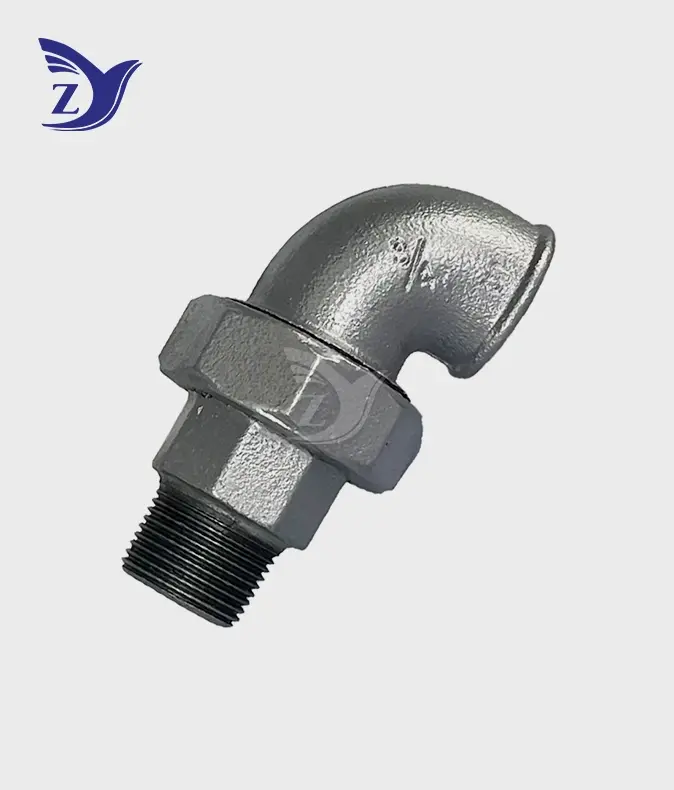
ASTM A197 Galvanized Union Elbow and Its Working Pressure
Due to wall thickness-to-diameter ratios, working pressure capacity goes down as fitting size goes up. There is no need to worry about 150 psi of steam working pressure or 300 psi of cold water working pressure on a half-inch Class 150 NPT galvanized union elbow threaded pipe fittings with male and female end. When the widths get to two inches, the same class grade keeps its 150 psi steam capacity. However, workers need to be aware that the joint surface area is bigger, so they need to use more sealing force. They can handle 300 psi steam service in high-demand industrial settings like process pipes and boiler hookups. Class 300 versions of these standards are twice as high.
Temperature has a big effect on these scores. When the temperature is normal, the pliable iron matrix keeps its full strength. But when the steam temperature gets close to 450°F, ASME B16.3 rules say that de-rating factors must be used. The union mechanism, which is made up of a ground-joint seat and a compression nut, evenly spreads the tightening force around the mating surfaces. This keeps seals from being compromised by localized stress at maximum rated pressures.
How to Correctly Install NPT Threaded Pipe Fittings to Maximize Working Pressure?
Pre-Installation Inspection and Preparation
Before putting the parts together, check each NPT galvanized union elbow threaded pipe fittings with male and female end for damaged threads, missing dimensions, or sealing flaws. Use NPT thread gauges to make sure that male threads will accept L1 plug gauges but not L3 gauges. Also, make sure that female threads pass the ASME B1.20.1 L1 ring gauge tests. Cross-threading during assembly is a major reason why joints fail early under pressure. This check stops it.
To get rid of industrial grease, dirt, and oxidation, clean all thread surfaces very well. When cleaning zinc threads with a wire brush, you need to be careful not to damage the coating. Nylon brushes and solvent degreasers work better. Check the seat of the union ground-joint for any scratches or other dirt that might make binding harder. Even tiny flaws can cause leaks at the recommended pressures.
Sealing Methods and Torque Specifications
Only put PTFE tape or pipe thread sealer on male threads. Start two threads from the end and wrap them clockwise as you look at the end of the thread. Do not put sealer on the first two threads because too much of it can get into the system fluids and stop them from flowing. Galvanic rust between different metals in mixed-material systems can't happen if the thread seals are rated for the service (water, gas, steam, or chemicals).
Tightening torque has a big effect on the quality of the seal and how much pressure it can hold. Under-tightening doesn't contact the threads enough, and over-tightening can break the body of the female fitting. You should use between 25 and 150 ft-lbs of power when installing 1/2-inch bolts to 2-inch sizes. Instead of guessing by feel, use calibrated torque tools. Studies show that hand tightening can vary by up to 40% between techs, which makes the quality of the seals less consistent than it should be.
The union nut needs its own care. Tighten by hand until the resistance rises, then use a wrench to add another 1/4 to 1/2 turn. When you overtighten the union nut, the ground joint deforms, which makes the seal less effective even though the pressing force is higher.
Avoiding Common Installation Errors
When two threads that are supposed to be mated meet at the wrong angle, they cross-thread. This damages the thread crests and stops them from closing properly. This mistake is clear when too much force is needed after only two or three turns—properly aligned NPT threads should turn easily by hand for about four turns before a wrench needs to be used to tighten them. If resistance shows up too soon, take the fitting all the way out, check the state of the threads, and then put the unit back together.
When you use pipe wrenches on flats that are made for open-end wrenches, the fitting changes shape. Because malleable iron is flexible, it can be crushed in certain places when loads are put on them at once. This changes the shape of the internal waterway and causes turbulent flow that speeds up erosion. Always use the right-sized tools and apply twisting force to the marked hex flats.
Buying Guide: Choosing the Right ASTM A197 Galvanized Union Elbow for Your Application
Matching Specifications to System Requirements
First, write down the running conditions, such as the highest working pressure, the temperature range, the fluid properties, and the surrounding environment. Systems that are constantly close to their highest allowed pressure should use Class 300 fittings with safety margins, while systems that are occasionally below 100 psi can use Class 150 parts. When temperature changes, like when steam systems start up every day, the ability of pliable iron to survive thermal shock is more important than that of brittle iron.
Assessing corrosion exposure tells us if the covering is good enough. Galvanization works well for most uses with water, air, and steam. But for acidic condensates (pH below 5) or alkaline solutions (pH above 11), stainless steel may be better. If you put something on the coast within a mile of saltwater, you should request "heavy galvanizing" to get a zinc coating that is thicker than the usual 86 microns.
Supplier Evaluation Criteria
Quality is assured by following the rules set by the certification. Make sure that your NPT galvanized union elbow threaded pipe fittings with male and female end suppliers are registered with ISO 9001 for manufacturing methods as well as trade activities. Ask for mill test records that show the science of the material, tensile tests, and readings of the coating thickness for each output lot. UL, FM, or CE markings from a third party prove that a product meets accepted standards. Zhiyuan has all three, which shows that it is committed to meeting foreign quality standards.
How reliable deliveries are is affected by how much can be made. When suppliers are almost at full capacity, it can be hard for them to handle quick orders or changes to specifications, which could cause projects to be delayed during crucial stages. Our 50,000-square-meter building has specialized storage for inventory that helps with just-in-time transportation and keeps production from getting stuck.
Custom Orders and Volume Procurement
When enough of them are needed, non-standard needs like special angles, longer measurements, or different threading make custom production worth it. To spread out the cost of the tools, the minimum order quantity is usually 500 pieces, but smart relationships may be able to handle smaller runs. To get exact quotes, you need to provide thorough models with dimensional tolerances, material specs, and testing requirements.
Volume savings mean that the costs of handling and setting up are lower. Orders over 10 tons often get price cuts of 15 to 20 percent compared to the prices for stock lots. Blanket purchase orders with planned releases are a good way to balance volume prices with the costs of keeping inventory. This is especially helpful for projects that have more than one phase that last for several months.
Procurement Checklist
Make sure that the thread compatibility fits the current system parts. Mixing NPT and BSPT leads to delays in the field and extra costs for rework.
Make sure that the sizes given are the nominal sizes of the pipes, not the real sizes. For example, a "1-inch" fitting links to a 1-inch nominal pipe that has an outer diameter of 1.315 inches.
On buy orders, write down information about the materials, such as whether they meet ASTM A197 standards, their Class ratings, and galvanizing standards, to make sure that supplies meet expectations.
Include instructions on how to safely package the threads so they arrive on time. Zhiyuan's normal packaging meets the needs of foreign shipping without adding extra costs. It uses double-layer cardboard cartons with individual wrapping to keep items safe while being handled.
For large orders, returnable steel racks may be a good idea because they lower the cost of packing each unit and make storage work more efficiently.
Conclusion
When choosing the right pipe parts, you have to weigh the technical ability against the cost. ASTM A197 galvanized union elbows with dual-threaded detachable designs offer working pressures that are good for 90% of industrial and business uses while still being cost-effective and easy to keep. Their construction is made of malleable iron, which can handle installation pressures and changes in temperature. Hot-dip galvanization protects them from corrosion for decades in normal working settings. If you install these fittings correctly, making sure to follow the torque specs and best practices for sealing, they will work at their rated pressure for a long time. When you know the pros and cons of different materials, like stainless steel or brass, you can make smart buying choices that fit the needs of your purpose and your budget.
FAQs
What determines the maximum pressure rating for these union elbows?
The main thing that determines pressure capacity is the class. For example, Class 150 can handle 150 psi of working pressure for steam and 300 psi for water service, while Class 300 can handle twice as much. Due to wall thickness ratios, size has the opposite effect on ratings; smaller fits can handle proportionally higher pressures. ASME B16.3 rules say that temperature derating happens above 450°F. Practical pressure limits are also affected by the quality of the material, the accuracy of the threading, and the integrity of the galvanization. This is why products from certified makers always perform better than cheaper options, even when they have the same stated specs.
Can I use galvanized union elbows in residential plumbing systems?
Of course. Galvanized malleable iron fittings can be used for gas distribution, water supply, and draining vents in homes that follow local building codes. Their 150 psi Class 150 grade is well above the normal water pressures in homes, which are between 40 and 80 psi. The removable union design makes it easier to conne ct water heaters and other appliances that need to be serviced on a regular basis. Check your local laws first, though, because some places don't let galvanized materials be near drinkable water because of worries about zinc leaching in corrosive water.
How do male and female threaded ends improve maintenance?
In tight setups, this design gets rid of the middle close nipples, which cuts the length of the assembly by 2 to 4 inches. The male end threads straight into female equipment ports, and the female end takes male pipe threads. The union lets the pipes be disconnected without turning either segment. When techs do maintenance, they only have to loosen the union nut instead of breaking multiple threaded joints. This cuts service time by 60–75% compared to traditional elbows. The ground-joint seat can handle many assembly cycles without thread wear affecting the strength of the seal.
Partner with Zhiyuan Malleable Steel for Your Pipe Fitting Needs
Zhiyuan Malleable Steel has been casting for 26 years, so every NPT galvanized union elbow threaded pipe fittings with male and female ends we make is made with skill. Our ISO 9001-certified facility in Shanxi Province combines traditional craftsmanship with modern quality control. It has 156 precision machining stations, 8 sets of medium-frequency electric furnaces, and 2 natural gas annealing kilns that make sure the 30,000 tons of steel we make every year are the same size and quality. We keep over 1,000 specs in stock so that standard items can be delivered in two hours. Our ODM/OEM skills allow us to meet custom needs that meet UL, FM, and CE certifications. We are a reliable provider to fire protection contractors, city engineers, and corporate buying teams around the world. We know that reliable fits are more than just meeting standards; they're also relationships based on quality, timeliness, and technical support. Get in touch with our team at q1236800000@gmail.com to talk about your unique pressure needs, ask for full technical documentation, or get volume quotes. We guarantee your happiness.
References
- American Society of Mechanical Engineers. (2022). ASME B1.20.1: Pipe Threads, General Purpose (Inch). New York: ASME Press.
- ASTM International. (2021). ASTM A197/A197M-20: Standard Specification for Cupola Malleable Iron. West Conshohocken: ASTM International.
- Baxter, C. F. (2019). Piping Systems Manual: Design, Installation, and Maintenance of Industrial Pipe Systems. McGraw-Hill Professional.
- National Fire Protection Association. (2020). NFPA 13: Standard for the Installation of Sprinkler Systems. Quincy: NFPA Publications.
- Singh, R. K., & Mahajan, S. (2018). "Comparative Analysis of Corrosion Resistance in Galvanized versus Bare Steel Pipe Fittings." Journal of Materials Engineering and Performance, 27(8), 4125-4133.
- Stewart, H. L. (2017). Pneumatics and Hydraulics: A Technician's and Engineer's Guide to Fluid Power Systems. Elsevier Science & Technology.
Online Message