
Sep 28, 2026
What Does Hot-Dip Galvanizing Add to Steel Elbows?
Hot-dip galvanizing transforms an ordinary steel elbow into a long-service pipeline component built for demanding environments. When a hot-dip galvanized round edge 90° elbow leaves the zinc bath, it carries a metallurgical zinc-iron alloy bond — not just a surface coat — that guards against moisture, soil acids, and industrial pollutants for decades. According to the American Galvanizers Association, properly applied hot-dip coatings average 72–85 years of corrosion protection in rural atmospheres and 21–34 years in severe industrial settings. That kind of durability directly protects your downstream customers' projects and keeps return-goods claims off your desk.
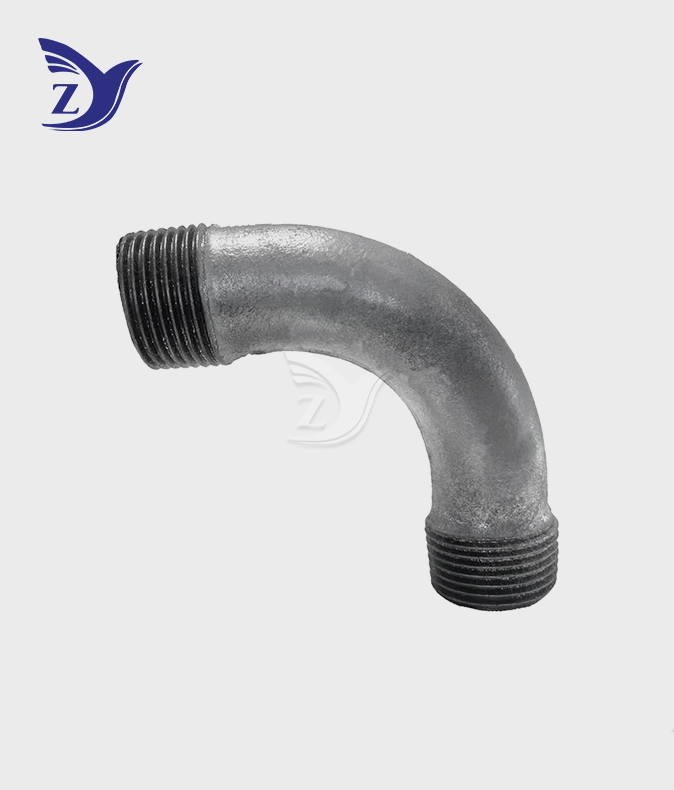
Understanding Hot-Dip Galvanized Round Edge 90° Elbows
What the Round Edge Design Actually Means
"Round edge" refers to a beaded reinforcement rim at the opening of the fitting. This is a structural feature that sets this fitting apart from styles with a plain rim or flat bands. The rolled bead adds mass right where the wrench force and internal pressure are highest. This makes a female opening that doesn't bell-mouth when the temperature changes, which is a common place where steam and hot water lines break. This design feature is important for people who buy NPT/BSPT round-edge male-female 90° elbows for a variety of project types because it lets them use more installation force without breaking the iron body.
Manufacturing Process and Quality Control
The hot-dip galvanized round edge 90° elbow is made from black heart malleable iron that was cast to meet the requirements of ASTM A197 and ASME B16.3 Class 150. After heating, which turns the soft white iron into tough, ductile iron that can be shaped, each fitting is carefully threaded to meet NPT (ASME B1.20.1) or BSPT (ISO 7-1) standards. Before the piece goes into the galvanizing line, go/no-go gages are used to check the thread geometry. At Zhiyuan Malleable Steel, 156 sets of machining tools and quality checking sites handle this process for 30,000 metric tons of steel that is made every year.
How the Zinc Coating Bonds to the Iron
Parts of iron that have been cleaned are put into liquid zinc that is about 450 °C during hot-dip galvanizing. At the surface, the zinc reacts with the iron to make three alloy layers: Gamma, Delta, and Zeta. On top of these layers is a pure Eta zinc layer. It's not paint; it's a diffusion bond. The finishing weight is usually between 1.3 and 2.0 oz/ft², which is much higher than the 0.2 to 0.4 oz/ft² weight of electro-galvanized finishes. It is because the metal layers are harder than the base iron that the covering doesn't wear away easily.
Benefits and Performance of Hot-Dip Galvanized Steel Elbows
Corrosion Protection That Outlasts Surface Coatings
Paint and cold-galvanized coats only work as a barrier; if the film is scratched, the metal below starts to rust right away. A coat of hot-dipped zinc acts as both a barrier and a sacrifice for protection. Zinc oxidizes more quickly than iron, protecting exposed iron at cuts or scratches. This is what makes the difference between goods that sell and goods that rust before they even leave the shelf in coastal or humid warehouses. That difference is worth money for large distributors who keep months' worth of stock on hand.
Mechanical Durability Under Real Pipeline Conditions
Here are the basic performance numbers for a standard hot-dipped, precision-threaded malleable hot-dip galvanized round edge 90° elbow:
- Pressure rating: As per ASME B16.3 Class 150, the pressure limit is 300 psi WOG (Water, Oil, and Gas) at room temperature and 150 psi for full steam.
- Temperature range: -20 °F to 150 °F for normal use; malleable iron stays flexible in this temperature range without the risk of breaking during installation.
- Thread engagement: Both the NPT 60° taper and the BSPT 55° taper make metal-to-metal interference seals. The round-edge body can handle the stress of tightening without breaking.
- Tensile strength: At least 40,000 psi according to ASTM A197, which means it can handle the high-torque wrench installation that happens in the field.
This number means that the fitting can withstand the mechanical stress of working on water and gas pipelines in factories without breaking down too soon.
Cost-Versus-Performance Comparison with Alternatives
While stainless steel elbows are very resistant to rust, they cost three to five times more per unit of the same size. Electro-galvanized valves are less expensive at first, but they usually need to be replaced every five years outside. There is a good price range for hot-dip galvanized round-edge fittings that have been tested by the factory to last 20 to 50 years in moderate environments without rusting. This gives distributors a good profit margin. That balance brings back orders from contractors further down the line for buyers who are looking to sell to the U.S. building and industrial repair markets.
How to Choose the Right Hot-Dip Galvanized 90° Elbow for Your Needs?
Check Thread Standard and Size Compatibility
There is a chance of a quiet leak when you mix NPT and BSPT threads. BSPT threads are 55°, while NPT threads are 60°. At ½" and ¾" sizes, they look the same, but at other sizes, their pitches are different. Before you place a large order, make sure you know if the pipes in your end market use American (NPT/ASME B1.20.1) or British/international (BSPT/ISO 7-1) thread standards. You can combine your purchases into one container shipment if you buy round-edge fittings from a supplier that has more than 1,000 SKUs that are compatible with both NPT and BSPT.
Evaluate Certifications and Documentation
Accept only hot-dip galvanized round edge 90° elbow suppliers who can show they have ISO 9001 certificates, material test reports (MTRs) that reference ASTM A197, and records of dimensional inspections that can be linked to each production batch. If your final buyers are U.S. cities or business companies, you may need to meet NSF/ANSI 61 standards for potable water contact. The CE mark shows that the pressure equipment meets European standards. Certifications aren't just extra paperwork; they're the audit trail that keeps you safe if a later worker makes a guarantee claim.
Factor in Bulk Pricing Structures and MOQ Flexibility
Buying directly from the factory usually gives you 30–40% better margins than buying from a domestic wholesaler. Look for tiered pricing that rewards 20GP and 40HQ container volumes and gives you more options for MOQ on sizes that don't move as quickly. Private labeling and custom packing are examples of OEM and ODM services that help your brand stand out and lower direct price competition in your local market.
Purchasing and Supply Chain Insights for Hot-Dip Galvanized 90° Elbows
Direct Factory vs. Local Distributor
When you buy directly from a producer like Zhiyuan Malleable Steel, you get prices from the production floor, can see your stock in real time, and can ask for custom markings or export packing. Local wholesalers make things easier, but they also add more costs and markups. When buying more than $200,000 a year, the savings from direct sourcing cover the costs of managing an import relationship in the first or second shipment.
Lead Times and Logistics Planning
Zhiyuan ships standard goods within 48 hours of having them in stock, and full production runs for special orders usually end within 15–25 working days. Getting 40HQ containers from Tianjin or Shanghai to ports on the West Coast of the United States by sea takes about 18–22 days. By building a moving inventory buffer of 60–90 days around these lead times, you can avoid stock-outs that cost bulk accounts their most profitable contracts.
Verifying Quality Before Full Commitment
Ask for sample pieces that cover your top five SKUs, like a 1" NPT round-edge 90° elbow and a 2" BSPT version. Then, check the threads with a thread gage and look over the zinc finish before giving the go-ahead for production. A reputable manufacturer will pay for the shipping of samples to people who qualify. This one-week investment keeps a much bigger container order from having quality problems after it gets there.
FAQ
Does hot-dip galvanizing affect thread dimensions?
Yes. The zinc layer makes threaded surfaces thicker in a way that can be measured. To keep sizes within ASME B1.20.1 or ISO 7-1 standards, good makers either machine threads a little too big before dipping them or chase them again after galvanizing. Ask for thread gage test certificates at all times.
What is the real difference between round-edge and banded elbows?
Both of them make the Class 150 fitting stronger where it opens. The round-edge (beaded) profile makes the rim heavier and smoother, which better distributes wrench torque and protects against mechanical impact than the flat-topped banded style. When there is a lot of vibration or a steam cycle, round-edge is the better standard.
Can I use these fittings for potable water?
Yes, in most places in the U.S. as long as the product meets NSF/ANSI 61 and the producer uses high-purity zinc (≥99.99%). Before making a specification for a drinking water system, you should always check with the local plumbing code.
Are custom sizes available?
Yes, both OEM and ODM production runs can include custom sizes, thread combinations, and packages with your own brand name on it. For custom orders, the minimum quantities depend on the details.
How does PTFE tape help if NPT is already a self-sealing thread?
Metal-to-metal interference makes NPT threads shut, but there are still tiny holes on the surface. PTFE tape or anaerobic pipe caulk can be used to fill in those gaps, keep the assembly from sticking, and act as a second barrier against leaks. This is a common practice in industrial water and gas systems.
Get Your Hot-Dip Galvanized Round Edge 90° Elbow Quote from Zhiyuan Malleable Steel
Since 2006, Zhiyuan Malleable Steel has been sending industrial-grade malleable iron pipe fittings. Each package is backed by ISO 9001, CE, UL, and FM certifications. We are a company that makes direct hot-dip galvanized round edge 90° elbows. We offer tiered container pricing, free samples for qualified buyers, and OEM packaging to keep your brand safe. To get a catalog of our products and a price list for large orders, go to zymalleablepipefitting.com or email q1236800000@gmail.com right now.
Conclusion
The hot-dip galvanized round edge 90° elbow can withstand high-torque installation and thermal cycling without breaking. Paint or cold-galvanized coating can't match this metallurgical zinc-iron bond. When distributors and purchasing managers need consistent quality on a large scale, they should request hot-dipped, precision-threaded malleable iron elbows. This cuts down on returns, protects margins, and builds a good image for the product that makes people want to buy it again. Getting the right fix from the right factory is not a matter of choice; it's a matter of space.
References
- American Galvanizers Association. Hot-Dip Galvanizing for Corrosion Protection: A Specifier's Guide. 2023.
- ASTM International. ASTM A197: Standard Specification for Cupola Malleable Iron. 2023.
- American Society of Mechanical Engineers. ASME B16.3: Malleable Iron Threaded Fittings, Classes 150 and 300. 2021.
- American Society of Mechanical Engineers. ASME B1.20.1: Pipe Threads, General Purpose (Inch). 2022.
- NSF International. NSF/ANSI 61: Drinking Water System Components — Health Effects. 2023.
- International Organization for Standardization. ISO 7-1: Pipe Threads Where Pressure-Tight Joints Are Made on the Threads — Part 1: Dimensions, Tolerances and Designation. 2020.
Online Message