
Sep 28, 2026
What Does a Beaded Edge Mean in a Duct Coupling?
A beaded edge in a duct coupling refers to a rolled, reinforced collar or ridge formed at the open end of the fitting. This structural feature prevents the rim from deforming under torque, distributes wrench pressure evenly, and creates a tighter mechanical seat when two pipe sections join. In a beaded galvanized round edge male-female reducing coupling, this ridge works together with hot-dip galvanization and precision-machined threads to produce a water/gas pipeline diameter transition fitting that holds pressure, resists corrosion, and stays leak-free across decades of service.
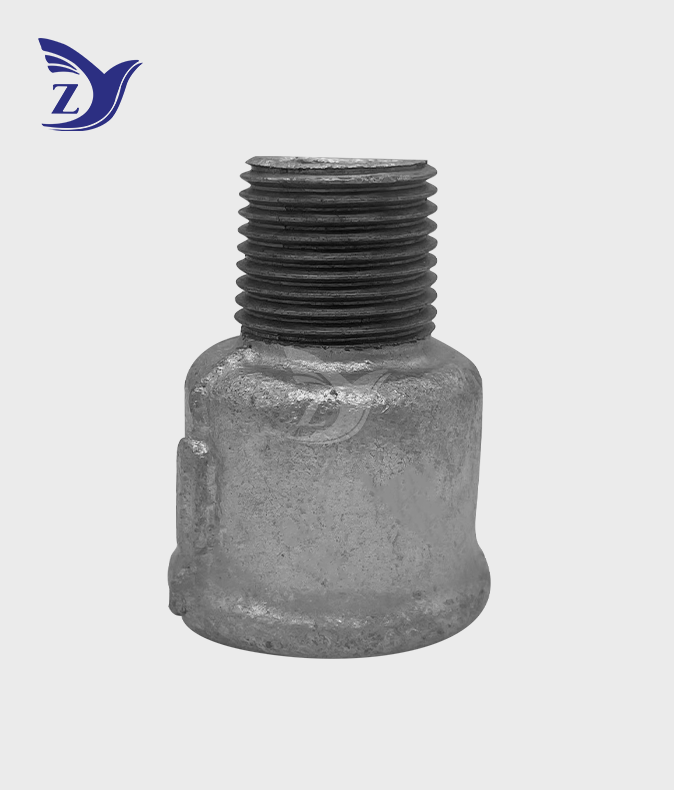
Understanding Beaded Edge in Galvanized Reducing Couplings
What the Bead Actually Is
The bead is a raised, rounded ring that is pressed or cast right into the fitting's mouth when it is being made. In no way does it look nice. Its job is to make the wall thicker right where pipe wrenches grip the pipe the tightest and where pressure inside the pipe pushes out the most. Without it, sides with thin walls would split or become oval when there was a lot of pressure.
How It Differs from Non-Beaded Designs
A coupling without beads has a flat, plain rim. It works in lines with low pressure and vibration, but it bends more easily and gives tools less surface area to grab. The beaded version, which follows ISO 49/EN 10242 size rules, keeps its round opening even after being put together and taken apart many times, which is useful when replacing a fitting on the job site.
Thread Standards That Work With Beaded Edges
Industrial-grade beaded galvanized round edge male-female reducing coupling comes in either NPT (60° flank angle, 1:16 taper per ASME B1.20.1) or BSPT (55° flank angle, 1:16 taper per ISO 7-1) thread types. The sealing shape is based on the thread standard, so the first step in any design check is to match the bead-reinforced fitting to the right thread family.
Advantages and Performance Benefits of Beaded Edge Couplings
Corrosion Resistance Through Hot-Dip Galvanization
As per ASTM A153 or ISO 1461, a hot-dipped galvanized, precision-threaded iron fitting has a zinc layer that is usually thicker than 70 microns (≥ 500 g/m²). Zinc doesn't just mechanically stick to the base iron; it also bonds to it in a way that makes it stronger. This makes the fitting a real corrosion-proof male-female diameter converter that can be used for gas lines underground, outdoor water supplies, and damp workplaces.
Structural Strength Under Pressure and Heat
Controlled annealing turns brittle white iron into a flexible core in Grade KTH300-06 or KTH350-10 black malleable iron. The finished beaded galvanized round edge male-female reducing coupling can work with PN25 (25 Bar) pressure and temperatures between -20 °C and 120 °C. It only takes a few thermal expansion cycles to break a pliable connector, but they can break brittle cast iron.
In terms of performance, beaded edge connections are better than normal reducers in the following ways:
- Wrench grip security: The raised bead gives pipe wrenches a defined seat, reducing slip events during installation in confined spaces such as gas meter boxes or boiler rooms.
- Edge integrity: The reinforced collar keeps the orifice circular under installation torque, preventing oval deformation that causes thread cross-loading and leaks.
- Extended service life: Uniform zinc coverage on rounded profiles lasts longer than on sharp-edge designs where coating thins at corners.
These performance traits directly lead to fewer field calls, lower replacement costs, and happier customers further down the line. All of these things protect a distributor's profit margin on bulk sales.
Comparison and Selection Guide for Reducing Couplings
Beaded vs. Non-Beaded Fittings
Non-beaded reducers cost a little less per unit, but they have hidden costs: they are more likely to fail inspection, they have a higher risk of leaks in the field, and their zinc coating lasts less long on rims that aren't protected. Even though they cost a little more per unit, beaded galvanized round edge male-female reducing coupling patterns lower the total cost of ownership for distributors who sell a lot of them to building companies or government projects.
Galvanized Iron vs. Stainless Steel
Stainless steel reducers are better at resisting corrosion in harsh chemical environments, but they cost three to five times more per unit and need different tools to work with. A lot of water, gas, and HVAC uses can be done with hot-dip galvanized malleable iron for a lot less money. Galvanized iron is the best choice for most SKUs if you are a wholesaler who wants to sell to hardware shops and construction teams.
Round Edge vs. Sharp Edge Profiles
Instead of putting all the stress at one spot, round sides spread it out over a curved surface. As a result, the zinc will not thin as much at the edge, it will be safer to handle when picking items in a warehouse, and there will be fewer tiny cracks that allow corrosion to begin. The round profile is also why ISO 49 recommends it for general-purpose fittings; it is safer for people working in the field who are wearing gloves.
Procurement Insights for Beaded Galvanized Round Edge Male-Female Reducing Couplings
Identifying a Qualified Manufacturer
Look for ISO 9001 approval, the ability to galvanize in-house, and written processes for thread gaging. When a supplier uses certified Ring and Plug gages on every batch, you can be sure that the NPT/BSPT threads meet the tolerances for taper and lead. Sand-hole porosity in castings can be found before they are shipped only when they are tested under 0.6 MPa of pneumatic pressure.
Bulk Pricing and Lead Times
Tiered pricing systems help sellers who sell a lot of goods. A plant that can produce 30,000 tons per year can guaranty stable lead times even during busy building periods. This is a big organizational benefit for wholesalers who manage just-in-time inventory in several regional warehouses. Standard items that are kept in stock can be shipped within hours of an order being confirmed.
OEM and Customization Options
Some purchasing teams need private-label packages, reducing ratios that aren't standard, or coating weights that are just right for warm markets. A factory that does ODM/OEM work can match thread standards (NPT for the US and Latin American markets, BSPT for Southeast Asia and the Middle East) and pack in either double-layer cardboard or export-grade woven bags, depending on the needs of the destination.
FAQs
What pressure can a beaded galvanized reducing coupling handle?
A Class 150 NPT/BSPT round-edge male-female reducing coupling can handle 300 psi at room temperature (WOG) or 150 psi at 366 °F when it is used with steam. Fittings made of malleable iron that are labeled PN25 can handle 25 Bar of constant pressure. Before fitting, you should always look at the manufacturer's raised marks to see what pressure class it is.
Can I use a beaded galvanized coupling for potable water?
Non-potable water, air, and gas lines always have galvanized iron joints. If the water is potable, make sure the fitting meets NSF/ANSI 61 standards and is made from materials that don't contain lead. In many parts of the US, plumbing rules say that brass or stainless steel without lead can't come into direct touch with potable water.
How do I tell a reducing coupling from a hex bushing?
A female fitting has a hex nut that sits fully inside it. A dual-threaded reducer, also known as a male-female reducing coupling, makes the assembly longer along its length. It's used to make space between parts or when the receiving fitting is too shallow for a bushing.
What quality checks should I request from my supplier?
Ask for proof of thread gage testing (Ring and Plug gauges), magnetic zinc thickness measurement (at least 70 microns), air pressure test records (0.6 MPa), and a ductility flattening test that proves the process of heating pliable iron.
Can this fitting be welded to steel pipe?
No, you shouldn't weld malleable iron because the carbon nodule structure makes the joints weak. During welding, the zinc layer also turns into dangerous zinc oxide fumes. Only use threaded connections with this type of fitting.
Get Beaded Galvanized Round Edge Male-Female Reducing Couplings from Zhiyuan Malleable Steel
Since 2006, Zhiyuan Malleable Steel has been making pipe fittings out of malleable iron. They can make 30,000 tons of them each year and have more than 1,000 current specs. Our catalog of beaded galvanized round edge male-female reducing coupling suppliers has NPT and BSPT thread standards, sizes from ⅛" to 4", and PN25-rated pressure performance. All of these products are certified by ISO 9001, CE, UL, and FM. Products that are broken are always replaced. To get a tiered price list or product catalog, email us at q1236800000@gmail.com or go to zymalleablepipefitting.com.
Conclusion
A beaded edge is not just for looks; it is a load-bearing design feature that keeps a reducing coupling round, tight, and usable when it is installed under real-world stress. It makes the difference between a beaded galvanized round edge male-female reducing coupling that lasts ten years and one that breaks after the first season when used with hot-dip galvanization and precision NPT/BSPT threading. For wholesalers who sell to hardware shops, builders, and public works projects, asking for beaded galvanized round-edge fittings from a plant with proven quality controls helps protect their image and encourages customers to buy from them again. You only need to specify the right thing once, and the delivery chain will take care of itself.
References
- American Society of Mechanical Engineers. ASME B1.20.1: Pipe Threads, General Purpose (Inch). ASME, 2013.
- British Standards Institution. BS EN 10242: Threaded Pipe Fittings in Malleable Cast Iron. BSI, 1995.
- ASTM International. ASTM A153/A153M: Standard Specification for Zinc Coating (Hot-Dip) on Iron and Steel Hardware. ASTM, 2016.
- International Organization for Standardization. ISO 49: Malleable Cast Iron Fittings Threaded to ISO 7-1. ISO, 1994.
- International Organization for Standardization. ISO 1461: Hot Dip Galvanized Coatings on Fabricated Iron and Steel Articles. ISO, 2009.
- NSF International. NSF/ANSI 61: Drinking Water System Components — Health Effects. NSF, 2020.
Online Message