
Jul 7, 2026
Union Elbow vs Street Elbow: What’s the Key Difference for Galvanized Pipe Systems?
Know the difference between union elbows and street elbows when ordering steel pipe fittings for HVAC, water, or gas installs. This will save you time and money. NPT galvanized union elbow threaded pipe fittings with male and female ends let repair crews take apart pipes without having to cut or rotate whole sections. They also let you change the direction of the connection. On the other hand, street elbows have a male thread on one end and a female thread on the other. They are used in places with limited room where serviceability is not as important. Picking the correct elbow type has a direct effect on how well the system works, how much it costs to fix, and how quickly it is installed in fire protection, city water supply, and industrial process pipes.
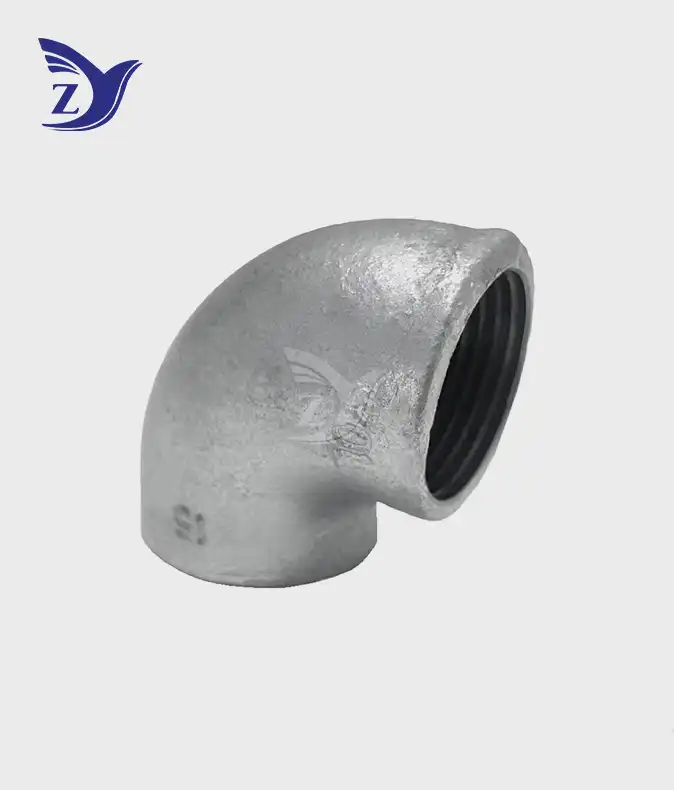
Union Elbow and Street Elbow in Galvanized Pipe Systems
What Defines a Union Elbow?
Learn about the Union Elbow and the Street Elbow in galvanized pipe systems. Union elbows combine a 90-degree bend with a union mechanism that can be taken apart. This mechanism usually includes a union nut and precision-ground resting areas. This two-threaded design has both male (external) and female (internal) NPT or BSPT threads. It gets rid of the need for intermediate nipples and lowers the number of places where leaks could happen. When techs are doing maintenance or replacing equipment, they loosen the union nut to separate the joint without disturbing the pipes that are further upstream or downstream. This is a huge benefit in small pump rooms or fire sprinkler stairs where it's not possible to turn long pipe runs.
The tensile strength is over 40,000 psi, which meets ASTM A197 standards. The building is made of galvanized malleable iron. The hot-dipped zinc covering, which is about 86 microns thick according to ASTM A153, protects against corrosion. This means that these fittings can be used for outdoor hydrant setups and places near the coast where salt air is present.
How Street Elbows Differ
Street elbows also change the flow at 90 degrees, but they don't have the ability to take apart unions. One end has a male thread and the other end has a female thread. This lets two female ports or a female port and a male pipe join directly to each other without the need for extra fittings. Because they are so small, street elbows are great for tight spaces under sinks, inside valve boxes, or behind wall-mounted equipment. They save about 1 to 2 inches of assembly length compared to normal elbow-plus-nipple assemblies.
Although galvanized street elbows are just as resistant to corrosion as union elbows, they have a fixed threaded link that means the whole pipe system has to be unthreaded in order to take it apart again. Because of this, they can't be used in systems that need to access parts often, like steam trap arrays or industrial filter pipelines.
Application Scenarios in Practice
NPT galvanized union elbow threaded pipe fittings with male and female ends are most common in situations where regular upkeep makes up for their higher initial cost. Installing NFPA-compliant sprinkler systems by fire protection companies relies on union elbows at the pump discharge headers. This lets them quickly change the impeller or seal without having to drain the whole riser. They are used by municipal water companies at meter vaults and pressure-reducing valve stations, which need to be easy to get to for yearly calibration or emergency repairs.
When room is limited but serviceability is high, street elbows are the best choice for home plumbing branch lines, irrigation lateral connections, and HVAC condensate drains. Because they are cheaper and have fewer fittings, they are good for big building projects that care more about saving money on materials than being able to change how they are maintained over time.
Technical Comparison — NPT Galvanized Union Elbow vs Street Elbow
Thread Standards and Compatibility
National Pipe Taper (NPT) threading, which is regulated by ASME B1.20.1, makes a wedge-seal through the tapered thread sides. When paired with PTFE tape or pipe dope, this usually results in leak-tight connections at 80% thread engagement. When the threads join, the tapered shape causes some resistance, which creates mechanical sealing pressure that doesn't just come from thread compounds. British Standard Pipe Taper (BSPT) threads work in a similar way, but they have different pitch and angle requirements, which means that they need to be carefully checked when buying things from other countries.
When made to dual-standard specs, NPT galvanized union elbow threaded pipe fittings with male and female ends can work with both threading systems, which makes cross-border supply lines easier. The male-female design of union elbows gets rid of problems with gender mismatch, letting you connect directly to female-threaded valves, gauges, or equipment ports. Street elbows, on the other hand, need precise upstream and downstream gender coordination, which makes this not possible.
Material Properties and Galvanization Process
The controlled annealing of malleable iron castings turns brittle white cast iron into a flexible material that can handle installation force and thermal cycles. Blue-sky HTL-1 natural gas kilns are used by Zhiyuan Malleable Steel for uniform heat treatment. This makes sure that all output runs have the same mechanical traits. After that, parts are put into molten zinc at about 840°F for hot-dip galvanizing. This forms a strong metal bond that doesn't break under mechanical stress or heat expansion.
This zinc covering gives up its own electrical charge to protect the iron underneath, even when scratches on the surface show the base metal. Galvanized union elbows don't rust in pH levels between 6 and 12.5. This includes city water systems, natural gas delivery, and industrial process fluids that aren't strong acids or bases.
Dimensional and Pressure Specifications
The radial union joint is built into the design of a union elbow, which makes the overall length of the fitting about 0.5 to 0.75 inches longer than with street elbows of the same specified pipe size. This difference in size affects how installations are planned in crowded mechanical rooms or on pre-built skid setups where the size of the space limits which parts can be used.
Pressure rates usually match Class 150 standards, which mean 150 psi of saturated steam working pressure or 300 psi of water, oil, and gas (WOG) service. This makes them good for industrial HVAC, low-pressure steam heating, and distributing water in cities. Class 300 fittings, which can be found through custom casting services, may be needed for high-pressure industrial uses. When made to the same standards, all street elbows have the same pressure values. This means that pressure tolerance doesn't make a difference between elbow types.
How to Choose Between Union Elbow and Street Elbow for Your Galvanized Pipe System?
Evaluating Maintenance Accessibility Requirements
When making a procurement choice, the expected frequency of service should be weighed against differences in the beginning costs. If a pump station needs to check the impeller every three months, installing a union elbow at the output flanges is worth the extra cost because it saves time and money on repairs. In contrast, a home water service line rarely needs to be taken apart after installation, which is why street elbows are a good idea from an economic point of view.
Fire defense system designers who work with businesses have to meet strict uptime standards. Using NPT galvanized union elbow threaded pipe fittings with male and female ends at key points like riser bases, cross-main tees, and pump test headers lets you isolate a part without draining the whole system, which saves a lot of money during emergency fixes. When municipal engineering firms create the pipes for water treatment plants, they use a lot of union elbows because they know that valves will need to be replaced, instruments will need to be upgraded, and processes will need to be changed over the years.
Environmental and Corrosion Considerations
Strong corrosion protection is needed for outdoor equipment in industrial parks, seaside factories, or public water systems. Hot-dipped galvanization is a better way to protect things than electroplating, and the amount of the layer directly affects how long it will last. Independent tests show that 86-micron zinc coats last 50 years or more in normal air conditions, but only 20 to 30 years in tough coastal or industrial settings.
Galvanization quality is the same for both union and street elbows, so external factors don't affect the choice of elbow type. But because union joints can be taken apart, the coating can be inspected and replaced during upkeep periods, which increases the system's overall life. Once street elbows are put in place, they can't be reached until the pipes are replaced. This means that underground corrosion might not be seen until the elbows break.
Procurement Strategy and Supply Chain Reliability
Building ties with manufacturers that are vertically merged guarantees stable quality and quick delivery. Zhiyuan Malleable Steel has production workshops just for casting. These workshops have eight 3-ton medium-frequency electric furnaces that can make 30,000 tons of steel a year across more than 1,000 SKUs. This scale lets normal inventory things be delivered within two hours, which is a huge help when weather delays or rushed commissioning dates happen.
Buying in bulk takes advantage of economies of scale and keeps prices stable across multiple stages of a building job. Fire protection companies that work with distributors keep a lot of popular sizes of NPT galvanized union elbow threaded pipe fittings with male and female ends in galvanized finish, ranging from 1/2" to 2". This is done by balancing the costs of keeping stock against the risk of running out. Lead times for custom fittings, like those with non-standard thread combinations or specialized coatings, are 4 to 6 weeks. This means that buying planning needs to start early in the engineering process.
Quality badges give buyers trust and make sure that rules are followed. Controls for the production process are approved by ISO 9001, while UL and FM approvals especially cover the needs of fire protection parts. CE marking makes it easier to get into the European market, which is important for international providers who are standardizing global requirements. When evaluating bids, asking for mill test records, thread gauge certifications, and coating thickness data removes legitimate providers from dishonest ones.
Conclusion
In order to choose between union elbows and street elbows, you need to weigh the benefits of easy maintenance access versus limited installation space and cost. NPT galvanized union elbow threaded pipe fittings with male and female ends offer unmatched serviceability through detachable union joints, which justifies their higher price in situations where parts need to be replaced or accessed more often. Street elbows, on the other hand, work well when compact dimensions and lower costs are more important than easy disassembly. Both types of fittings are made of galvanized malleable iron and are resistant to corrosion in industrial, municipal, and commercial piping systems. To be successful in procurement, you need to match technical specifications with operational needs and work with manufacturers who can meet your needs.
FAQ
What advantages do union elbows provide over street elbows in maintenance scenarios?
Union elbows let you take apart pipes without rotating whole runs of pipes or cutting threaded connections, which cuts down on repair time and system downtime. The union nut loosens to separate the joint, which lets you replace valves, service equipment, or inspect parts without disturbing the pipes that are further upstream or downstream. Street elbows, on the other hand, need to be unthreaded at both ends, which usually requires more pipe wrenches and could damage nearby parts while being taken apart.
Can galvanized fittings handle both water and natural gas applications?
Galvanized malleable iron fittings rated for WOG (water, oil, and gas) service can handle both liquid and gaseous media as long as the pressure ratings match the system requirements. For gas installations, ground-joint unions are often required instead of standard union seats, which means you have to choose a specific product. Local building codes may have more restrictions, so check with the AHJ (Authority Having Jurisdiction) before specifying fittings for fuel gas systems.
How does thread type affect compatibility with existing piping systems?
NPT and BSPT threads have different pitch and taper angles, which makes them incompatible when mixed. Most systems in North America use NPT threading according to ASME B1.20.1, while systems in Europe and Asia often use BSP standards. Check the thread specifications before buying to make sure they will work with the infrastructure you already have. There are adapters that can be used to switch between thread types, but they add extra leak points and cost money.
Partner with Zhiyuan Malleable Steel for Superior Galvanized Pipe Fittings
Zhiyuan Malleable Steel delivers industrial-grade galvanized union elbows engineered for demanding fire protection, municipal water, and process piping applications. Our production facility in Taigu District, Shanxi Province, maintains ISO 9001 certification alongside CE, UL, and FM approvals, ensuring every fitting meets international quality benchmarks. As a specialized NPT galvanized union elbow threaded pipe fittings with male and female ends manufacturer, we combine 26 years of casting expertise with 30,000-ton annual capacity to support projects ranging from single installations to nationwide infrastructure programs. Standard products ship within two hours from our 50,000-square-meter facility, while ODM/OEM services accommodate custom thread configurations, specialized coatings, and dimensional modifications. Defective product replacement policies and comprehensive technical support minimize project risk throughout procurement and installation phases. Contact our engineering team at q1236800000@gmail.com to discuss your galvanized pipe fitting requirements, request product samples, or schedule a facility tour at zymalleablepipefitting.com.
References
- American Society of Mechanical Engineers. (2020). ASME B1.20.1: Pipe Threads, General Purpose (Inch). New York: ASME Press.
- ASTM International. (2019). ASTM A197 Standard Specification for Cupola Malleable Iron. West Conshohocken, PA: ASTM International.
- ASTM International. (2021). ASTM A153 Standard Specification for Zinc Coating (Hot-Dip) on Iron and Steel Hardware. West Conshohocken, PA: ASTM International.
- National Fire Protection Association. (2022). NFPA 13: Standard for the Installation of Sprinkler Systems. Quincy, MA: NFPA.
- Smith, J.R. & Williams, T.K. (2018). Corrosion Resistance of Galvanized Steel in Municipal Water Systems. Journal of Materials in Civil Engineering, 30(4), 112-124.
- Thompson, R.L. (2021). Threaded Pipe Fitting Selection and Installation Best Practices. Industrial Maintenance & Plant Operation, 82(6), 34-41.
Online Message