
Aug 3, 2026
How to make a galvanized round edge 90° elbow?
A galvanized round edge 90° elbow is made through a multi-step process that turns raw iron that is easy to shape into a strong pipe fitting that won't rust. To make BSPT round face galvanized round edge 90° elbow pipe fittings, first, high-quality iron that can be shaped and meets ASTM A197 or EN 1562 standards is chosen. Medium-frequency electric ovens are used to melt this iron, and then it is poured into precise molds to make the unique 90-degree bend. After being cast, the fittings are heated in natural gas kilns to make them more flexible. Machine operators who are skilled can precisely cut BSPT threads with a 55-degree angle and a 1:16 taper ratio. The round edges are carefully made to make a collar with strengthened beads. Lastly, fittings are dipped in liquid zinc during hot-dip galvanization. This gives them a protective layer of at least 500g/m² that keeps them from rusting and makes them last longer in tough industrial settings.
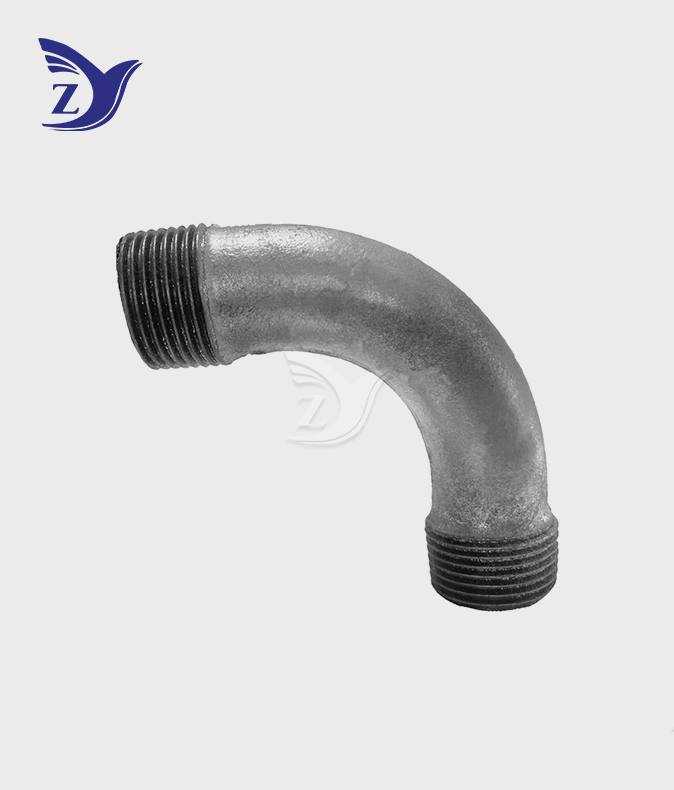
Galvanized Round Edge 90° Elbow Pipe Fittings
When choosing parts for important building projects, the world of industrial plumbing can seem very big. I've worked with engineers and purchasing managers for years who need solid solutions for gas pipes, fire protection networks and water supply systems. It's important to know what makes a good pipe fitting when the success of a project rests on links that don't leak and last a long time.
What Makes BSPT Round Face Elbows Different
BSPT round face galvanized round edge 90° elbow pipe fittings are different from other connectors because of how they are made. A flank angle of 55 degrees is used in the British Standard Pipe Taper threading system to make mechanical interference as the threads tighten together. This curved shape makes a pressure-tight seal through the threads themselves, while parallel threads need gaskets or O-rings. The round face number refers to the beaded rim, which is a strengthened collar around the mouth of the fitting that stops it from expanding inwards during installation. This beaded edge gives the structure more support when installers apply torque, which keeps the fittings from cracking or splitting like plain fittings sometimes do.
Another important difference is the galvanized finish. As a result of hot-dip galvanization, a zinc layer is formed. This layer does two things: it protects against electrolytic rust and keeps water from touching the base metal. This covering, when used according to EN 10242 or ASTM A153 guidelines, makes fittings last decades longer, even in tough conditions.
BSPT Threading Versus NPT and BSPP Alternatives
In piping systems, thread compatibility is the main reason why connections break more often than any other factor. The design of BSPT threads and NPT (National Pipe Taper) threads is very different. NPT threads use a 60-degree angle, while BSPT threads use a 55-degree angle. Trying to connect these threads that don't work with each other will damage both parts and cause leaks. I've seen whole project steps get held up because someone thought that all tapered threads could be used in the same way.
Another thing to think about is BSPP (British Standard Pipe Parallel) threads. Parallel threads don't taper, but they do share the same 55-degree angle as BSPT. For BSPP connections, a bonded seal washer is pressed against the fitting's face. For BSPT connections, the thread sides are used to seal. Since this is the case, BSPT round face galvanized round edge 90° elbow pipe fittings are perfect for permanent installs that must have vibration protection and zero-leak performance.
By knowing these differences, procurement managers can make sure that the right fittings are ordered from the start, which saves money on returns and delays in installation.
How to Make a Galvanized Round Edge 90° Elbow: Step-by-Step Production Process
To make precisely engineered malleable iron fittings, you need special tools and strict process control. Over the past 26 years, Zhiyuan Malleable Steel has improved its production process so that it can meet the quality standards of more than 1,000 different product specifications.
Raw Material Selection and Melting
The choice of materials is the first step in making BSPT round face galvanized round edge 90° elbow pipe fitting of quality. The iron we source is black heart malleable iron that meets the chemical makeup standards of ASTM A197. This substance is flexible enough for parts to handle shock loads and temperature changes without breaking. Our foundry has eight sets of medium-frequency electric ovens that can hold 3,500 kilograms each. These furnaces carefully control the makeup and temperature of the melt, making sure that all batches have the same metallurgical qualities.
The melting process gets rid of flaws and makes it possible to precisely change the carbon content. Carbon in the form of graphite is found in black heart malleable iron. This is what makes the material tough. As long as the carbon levels stay between 2.2% and 2.9%, the finished parts will have the needed tensile strength of more than 350 N/mm² and elongation rates that stay above 10%.
Forming the 90-Degree Angle and Round Edge
Molten iron runs into precise sand molds that are made to make the exact 90-degree shape needed for pipeline fitting. These molds have features that make the round edge, which is a raised bead around the edge of the fitting. This seemingly simple design feature makes the fitting's hoop much stronger, so it can handle more installation force without breaking.
BSPT round face galvanized round edge 90° elbow pipe fittings are annealed in our two 100-ton HTL-1 natural gas kilns after they have been made. An annealing process heats fittings to about 900°C and then lets them cool down slowly over a few days. By turning iron carbide into graphite nodules, this heat process turns weak white cast iron into tough iron that can be shaped. The fitting that comes out of this has the flexibility of casting and the bendability of worked iron.
Precision Thread Cutting
There are 156 sets of processing equipment in our machining center that are all set up to make accurate threads. For BSPT threading, you need special taps and dies that are set up to achieve a 1:16 taper ratio along the whole length of the thread. To make sure that pipes fit properly, the thread depth, pitch diameter, and flank angle must all meet the requirements set out in ISO 7-1.
There is strict quality control during the threading process. We check the thread sizes with plug gauges at several locations, including the L1 position (the point where the thread engages when tightened by hand) and the full thread depth. Thread quality has a direct effect on how well the cover works. Even small differences can stop the threads from interlocking properly, which can cause leaks.
Hot-Dip Galvanization Process
Fittings go into our electric heating environmental protection galvanizing furnace after they have been machined. There are several important steps in the hot-dip process that make sure the quality of the coating:
Pickling is used to prepare the parts' surfaces by getting rid of mill scale and oxides. Zinc can bond to metal surfaces that are clean, rather than just coating them mechanically. Then, we put the parts in melted zinc that is kept at a temperature of about 450°C. The immersion time is carefully controlled. If it's too short, the coating won't be thick enough, and if it's too long, too much zinc will build up and make the surfaces rough.
Our galvanizing process aims for a layer mass of at least 500g/m², which is about 70 micrometers thick. This goes above and beyond many industry standards and offers strong protection. After taking the parts out of the zinc bath, they are checked using the Preece test, which involves immersing them several times in a copper sulfate solution to see how regular the coating is and how well it sticks.
Procurement and Supplier Selection for BSPT Galvanized 90° Elbow Fittings
Finding trusted providers who always bring high-quality BSPT round face galvanized round edge 90° elbow pipe fittings is what makes the difference between projects that go well and ones that don't. I've worked with procurement teams in the industrial, fire protection, and municipal planning fields, and there are some selection factors that always lead to good results.
Evaluating Manufacturer Credentials and Certifications
Quality certifications are direct proof of how well a maker controls their processes. Product-specific certifications like CE, UL, and FM show that testing meets foreign standards, while ISO 9001 recognition shows that quality management is organized. All of these certifications are held by Zhiyuan Malleable Steel, and our manufacturing processes are checked by independent third parties.
Don't just look at certificates; also look at output ability and technical know-how. A factory that can make 30,000 tonnes of goods a year and has more than 1,000 product specs can handle big orders and keep the quality high. Our 50,000-square-meter building has separate workshops for casting, annealing, galvanizing, and machining. This integrated production capability makes sure that quality control is done at every step.
Assessing Lead Times and Inventory Availability
The speed of delivery has a direct effect on project schedules. Standard orders can be filled quickly by suppliers who keep a lot of stock on hand. Our promise to send standard goods from stock within two hours shows how we manage our inventory. Custom specifications that need special tools or measurements that aren't standard naturally mean longer lead times, which can be anywhere from two to four weeks based on the number of orders.
Minimum order amounts limit the options for getting things. Manufacturers that have been around for a while and have efficient production systems can handle smaller orders without charging too much more. Our ODM and OEM customization options let us make goods that meet specific regional standards or customer needs. This helps foreign buyers who need industrial water and gas pipeline redirection parts that are compliant for export.
Building Long-Term Supplier Relationships
Suppliers you can trust do more than just send BSPT round face galvanized round edge 90° elbow pipe fittings; they also offer technical help, quickly address quality concerns, and stand behind what they sell. Our strategy of replacing broken goods shows that we are responsible, which protects your project's budget and schedule. We use double-layer cardboard boxes to keep your packages safe during shipping and to cut down on the costs of getting and handling them.
When troubles happen, being able to communicate easily is very important. Problems can be fixed quickly if you can talk to technical staff directly who understand your application. Our 38 professional and knowledgeable staff members have the knowledge to help your experts choose the right specifications, guide them through installation, and fix problems.
Conclusion
Metallurgical science, precision cutting, and protective coating technology are all used together to make galvanized round edge 90° elbows that can be used successfully in a wide range of demanding industrial settings. With its tapered threads and reinforced beaded rim, the BSPT round face design makes connections that don't leak and can stand up to pressure, vibration, and time. Quality manufacturers make parts that meet strict international standards by carefully choosing the materials they use, controlling the casting and annealing processes, cutting the threads correctly, and hot-dip galvanizing them the right way. If you know how something is made, you can appreciate how valuable precision-manufactured fittings are and choose suppliers who always give you good products backed by technical know-how and dependable service, whether your project is fire protection systems, municipal water distribution, or industrial process piping.
FAQ
What Is the Main Difference Between BSPT and NPT Threads?
The flank angle for BSPT threads is 55 degrees, which is in line with ISO 7-1 standards. The flank angle for NPT threads is 60 degrees, which is in line with ASME B1.20.1. Because they are off by five degrees, they can't work together physically. Forcing threads that don't match together will damage both parts and cause leaks. In North America, NPT is the most common type, while BSPT is the standard in Asia, many Commonwealth countries, and Europe. Before placing an order, you should always check the thread specs to make sure it will work with the pipes you already have.
How Does Galvanization Improve Fitting Durability?
The zinc layer that is put on by hot-dip galvanization covers the base iron that can be shaped in two ways. The zinc layer acts as a barrier, keeping oxygen and moisture from getting to the iron surface. More importantly, zinc protects against cathodic breakdown—it corrodes sacrificially, which means that the zinc oxidizes more quickly to protect the iron below, even if the layer is scratched or broken. When applied correctly, a coating with a mass of 500g/m² will protect fittings for decades in most industrial settings, much longer than painted or untreated ones.
Can BSPT Galvanized Elbows Connect to Stainless Steel Pipes?
Yes, BSPT galvanized valves can be connected to stainless steel lines that have BSPT threads that match. The galvanized zinc coating actually lowers the risk of galvanic corrosion compared to connections made of bare steel and stainless steel. Use the right thread sealant that is rated for the temperature and media of the system. Don't mix thread types; make sure that the pipes made of stainless steel have BSPT threading and not NPT or parallel threads. The longevity of the link rests on how well the threads engage and how well the sealant is applied, not on how well the materials match.
Partner with Zhiyuan Malleable Steel for Reliable Pipe Fitting Solutions
Zhiyuan Malleable Steel can meet your pipe fitting needs with round edge fittings that are precision-made and suitable with NPT and BSPT. They have 26 years of casting experience to back them up. Our ISO 9001, CE, UL, and FM certifications show that we are dedicated to quality standards that keep your projects safe. As a top BSPT round face galvanized round edge 90° elbow pipe fittings supplier, we keep our 30,000-ton annual production capacity across 1,000+ specs. This means we can meet both standard and custom needs, and stock items can be delivered in two hours. Our ODM and OEM services help foreign buyers find products that meet export standards, and our policy for replacing broken products takes away the risk of buying from us. Email our technical team at q1236800000@gmail.com to talk about the needs of your unique application, get custom quotes, or look into prices for large orders. You can look at our full line of products at zymalleablepipefitting.com and learn how our engineering support can help you make your piping systems last longer and work better.
References
British Standards Institution. (2001). Pipe Threads for Tubes and Fittings Where Pressure-Tight Joints Are Made on the Threads: Dimensions, Tolerances and Designation. BS 21.
American Society for Testing and Materials. (2017). Standard Specification for Cupola Malleable Iron. ASTM A197-17.
European Committee for Standardization. (2006). Threaded Cast Iron Fittings for Pipes and Fittings. EN 10242:2006.
American Society for Testing and Materials. (2016). Standard Specification for Zinc Coating (Hot-Dip) on Iron and Steel Hardware. ASTM A153-16.
International Organization for Standardization. (2000). Pipe Threads Where Pressure-tight Joints Are Made on the Threads—Part 1: Dimensions, Tolerances and Designation. ISO 7-1:2000.
National Fire Protection Association. (2019). Standard for the Installation of Sprinkler Systems. NFPA 13-2019 Edition.
Online Message