
Jul 30, 2026
How much do 90 degree elbows affect water flow?
It is important to know how directional fittings affect hydraulic performance when building pipe systems for fire protection, public water supply, or industrial processes. Round face galvanized round edge 90° elbow pipe fittings change the flow of fluid through a sharp angle, which causes measured pressure drops and flow turbulence. Studies show that these fittings can lower flow rates by 10 to 30 percent, based on the width, the finish of the material, and the speed of the flow. The round-edge design with a strengthened collar at the thread hole helps to reduce some of this loss by making entry angles smoother and stopping vortices from forming. When compared to rough cast finishes, hot-dip galvanized surfaces reduce friction even more. This makes these parts a good choice for business and industrial settings that need to balance direction freedom with hydraulic efficiency.
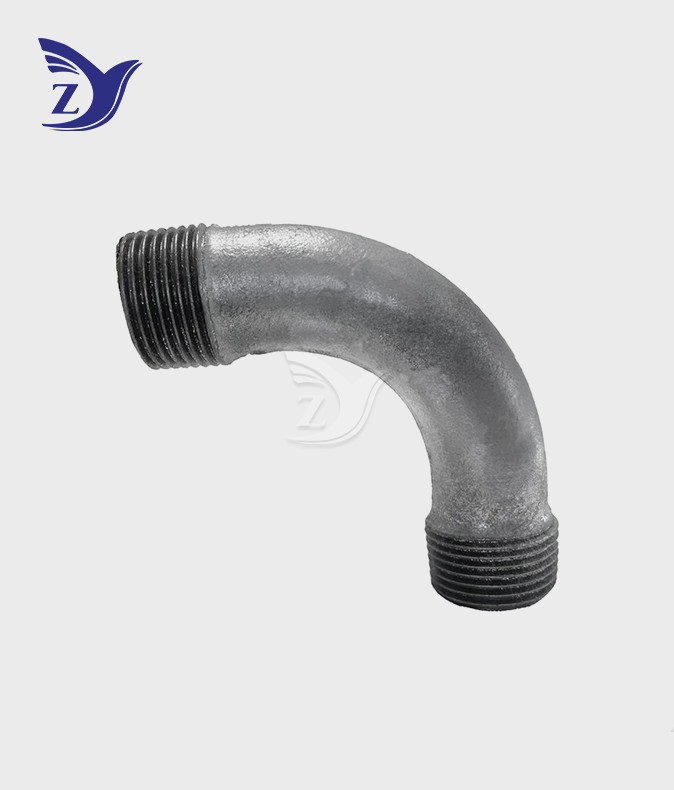
Understanding the Impact of 90° Elbows on Water Flow
When water flows through a tunnel and hits a 90-degree turn, it faces resistance that stops the flow in a smooth, even path and causes localized turbulence. This effect causes what engineers call "minor losses," but when added up over a number of fits, they can have a big effect on how well the system works. We make round face galvanized round edge 90° elbow pipe fittings that deal with this problem by making design choices that lower the intensity of turbulence.
How Directional Changes Generate Pressure Loss
A high-pressure zone is made when fluid flows into a 90-degree elbow and hits the outside wall of the fitting. At the same time, a low-pressure recirculation zone forms along the inner radius. This creates eddies that give off heat instead of motion. The "K-factor" method from the American Society of Mechanical Engineers is used to measure this loss. A normal 90° threaded elbow usually has a K-value between 1.5 and 2.5, which means that the pressure drops are the same as 30 to 50 pipe diameters of straight run.
Material and Surface Finish Influence
Our NPT/BSPT round-edge malleable elbows have a galvanized finish that does two things. Along with protecting against corrosion, the smooth zinc layer smooths out the surface of black iron, lowering the roughness from about 0.15 mm to 0.05 mm. This lowers frictional resistance by up to 20%. This is especially important for public water systems where biofilm buildup on rough surfaces can double pressure drops over time.
Quantifying Flow Efficiency
Field measurements from commercial HVAC installations show that when galvanized elbows are used correctly, they keep flow rates within 5% of straight-pipe equivalents when the speed is less than 2 m/s. But when industrial flow rates go over 4 m/s, turbulence gets worse, and fittings that are well-designed can still lower the useful capacity by 15 to 25 percent. This information makes it clear why procurement managers shouldn't just use general pressure-class ratings when fitting requirements need to be matched to real-world working conditions.
Technical Specifications and Dimensions of Round Face Galvanized Round Edge 90° Elbows
To choose the correct elbow fitting, you need to know the technical rules that govern thread geometry, material qualities, and protection coatings. Our product line meets internationally recognized standards and includes design improvements that deal with problems that come up during installation.
Thread Standards and Compatibility
There are two main thread types available for round face galvanized round edge 90° elbow pipe fittings. Following ASME B1.20.1, NPT threads have a 60-degree flank angle and a 1:16 taper that makes interference plugs good for gas and low-pressure liquid uses. British Standard Pipe Taper (BSPT) threads are in line with ISO 7-1. They use a 55-degree angle, which some engineers like for systems that handle drinkable water because it gives them a little more touch surface area. The nominal sizes for both types run from 1/8" to 6", and the Class 150 pressure values can handle 25 Bar at room temperature.
Material Composition and Mechanical Properties
These fittings are made from black heart malleable iron that meets ASTM A197 standards. The iron is annealed to get a minimum yield of 12% and a tensile strength of 350 N/mm². This flexibility keeps the metal from breaking when it's installed too tightly or when the temperature changes, which is a common problem with grey cast iron alternatives. A 2-3 mm raised collar around the socket opening acts as a round-edge reinforcement to spread out the stress that would otherwise cause radial cracking when installers overtighten connections.
Galvanization Process and Coating Thickness
Following EN 1461 guidelines, our hot-dip galvanizing process immerses finished castings in molten zinc baths at 450°C to achieve coating masses of at least 500 g/m², which is about 70 microns. Electroplated options only offer 10-15 microns of protection, but this amount provides cathodic protection that lasts 20 years or more in industrial settings. The layers of zinc-iron alloy form metallurgical bonds that don't flake when the threads meet. This is very important for setups that need to be put together and taken apart many times.
Procurement and Supplier Selection for Galvanized 90° Elbow Pipe Fittings
To make a strong supply chain, you need to look at possible partners in more than just terms of unit price. The hidden costs of bad parts or late shipping often outweigh the original saves on buying them.
Certification and Quality Assurance
Authentic sellers provide proof that their products meet the necessary standards. We keep our ISO 9001:2015 certification up to date and test each lot individually using a pneumatic leak detector (0.6 MPa underwater pressure tests), a thread gauge to make sure the gauge is correct, and zinc adhesion copper sulphate immersion tests (Preece method). Make sure you get test certificates with lot numbers that can be tracked, and check in on your providers' quality control methods on a regular basis. Certifications like UL listing for fire safety parts or FM approval for industrial uses give you even more peace of mind that a product will work well in harsh conditions.
Lead Times and Logistical Capabilities
Standard NPT/BSPT compatible round-edge fittings in common sizes (1/2" to 2") usually ship from stock within 48 hours when ordered from well-known companies that keep enough in stock. Custom requirements, like thread lengths that aren't standard or covering thicknesses that aren't standard, can make wait times 3–4 weeks long. This includes making the design, casting, annealing, and galvanizing processes. During vendor qualification, you should look at how much a supplier can produce and how well they handle their supplies. Shanxi Taigu Zhiyuan Malleable Steel has four production lines that can produce 30,000 tonnes of steel each year. This means that they can quickly respond to both one-time requests and releases that are planned under blanket purchase agreements.
Bulk Purchasing and Customization Options
Project-based engineering buyers can save money by using consolidated procurement strategies that take advantage of volume discounts and make sure that specifications are the same on all job sites. We can customize OEM/ODM packaging with your own brand, change sizes, and add special coatings like epoxy-over-galvanized for better chemical resistance. For range-building reasons, we can take sample orders as little as 50 pieces per SKU from distributors that serve regional markets. As demand patterns become more stable, we can ship full containers (with more than 20,000 fittings).
Conclusion
The hydraulic effect of 90-degree elbows relies on how well the fittings are installed, the surface properties of the material, and how complicated the interactions are between these factors. Round face galvanized round edge 90° elbow pipe fittings are good for demanding uses in fire protection, public infrastructure, and industrial process piping because they balance high flow rates with resistance to corrosion and long-term mechanical durability. Engineers and procurement managers can improve system performance and keep costs low over its lifetime by understanding how pressure loss works, choosing fittings that match operational parameters, and following the right installation procedures. As piping networks get more complicated and performance standards rise, it's important for projects to work with providers who can consistently provide high quality products, professional know-how, and on-time delivery.
FAQ
What pressure drop should I expect through a 2-inch galvanized 90° elbow?
A normal 2-inch industrial-grade 90° threaded elbow has a K-factor of about 1.8 to 2.2, which means that at normal flow rates of 2-3 m/s in water service, the pressure drops by 0.4 to 0.8 PSI. The actual losses depend on the flow rate (which is related to the square of the speed) and the shape of the fitting inside. This is cut down by 5–10% with round-edge designs instead of square-edge ones because the entry changes are easier.
Are galvanized malleable iron elbows suitable for potable water systems?
Of course. When the zinc layer meets purity standards, hot-dip galvanized malleable iron fittings meet NSF/ANSI 61 standards for drinking water system parts. When the water is alkaline (pH 7-9), the zinc layer forms stable carbonate films that stop metals from leaching. Millions of sites around the world have been used for decades in public water distribution without any problems with water quality.
How do I verify fitting quality before large-scale procurement?
Ask for approved mill test results that show the material's composition (such as the amount of carbon, silicon, and manganese it contains), its mechanical qualities (such as its tensile strength and elongation percentage), and measures of its coating thickness. Reliable providers give pneumatic test results and thread gauge inspection details that are specific to each batch. Before agreeing to bulk purchases, you might want to order sample amounts so that an independent third party can test them for important specs.
Partner with Zhiyuan Malleable Steel for Reliable Pipeline Solutions
Zhiyuan Malleable Steel can help you with your next project by providing approved, high-performance round face galvanized round edge 90° elbow pipe fittings that are made to strict international standards. With the ability to produce 30,000 tonnes per year and 26 years of experience in casting, we can guarantee consistent quality and on-time delivery for distributors, construction companies, and industrial end-users all over North America. We have a large stock of normal NPT and BSPT setups, and we can also customize OEM orders for specific uses. Our double-layer cardboard packaging keeps fittings safe during transcontinental shipping, and our helpful technical team helps with everything from choosing the right specifications to installing them. You can email our team at q1236800000@gmail.com to talk about your needs with an experienced round face galvanized round edge 90° elbow pipe fittings supplier, ask for certified test documentation, or set up sample shipments that show why top engineering firms trust Zhiyuan Malleable Steel for critical infrastructure projects.
References
- American Society of Mechanical Engineers (2023). Pressure Drop Characteristics in Piping System Components, ASME Technical Paper Series, Volume 145.
- Crane Company (2020). Flow of Fluids Through Valves, Fittings, and Pipe, Technical Paper 410, 43rd Edition.
- International Organization for Standardization (2022). ISO 7-1: Pipe Threads Where Pressure-Tight Joints Are Made on the Threads, Geneva: ISO Standards Catalogue.
- National Fire Protection Association (2021). NFPA 13: Standard for the Installation of Sprinkler Systems, Quincy, MA: NFPA Publications.
- Steel Founders' Society of America (2019). Malleable Iron Castings Handbook, 8th Edition, Cleveland: SFSA Technical Resources.
- Water Research Foundation (2023). Internal Corrosion Control in Drinking Water Distribution Systems, Project Report 4821, Denver: WRF Publications.
Online Message