
Aug 14, 2026
90 Degree Galvanized Union Elbow Fittings for Flexible Pipe Installation
When flexible pipe installation demands durability and easy maintenance access, 90 degree galvanized union elbow fittings deliver precision-engineered solutions. These fittings combine dual-threaded detachable design with hot-dipped galvanization, creating corrosion-resistant connectors that redirect pipelines at right angles. Galvanized union elbow threaded pipe fittings with male and female ends enable quick disassembly without pipe cutting, addressing critical maintenance challenges in industrial water, gas, and HVAC systems where space constraints prevent full pipe rotation during servicing.
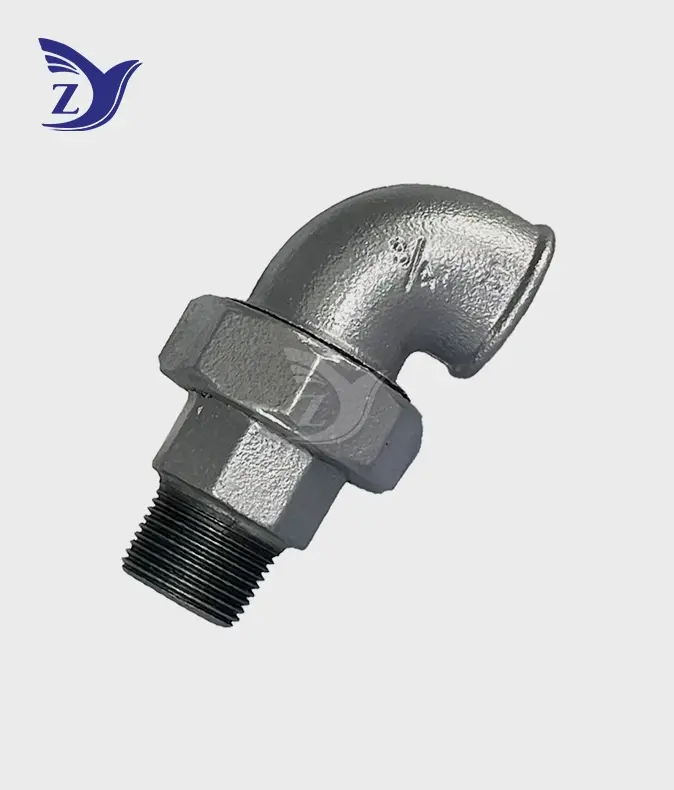
Understanding 90 Degree Galvanized Union Elbow Fittings
These special connectors are different from regular elbows because of how they are made. At their heart, they are 90-degree pipe bends with two threads that can be detached and used in different directions.
Core Structural Components
Each galvanized union elbow threaded pipe fitting with male and female ends has three important parts that work together. The outside male thread connects directly to equipment ports with female threads, getting rid of extra nipples and possible leak points. The second connection point is made by the internal female thread, which fits male pipe ends. The union device is located between these two parts. It is a radial ground joint with a union nut that lets the pipes be disconnected without moving either one. This design solves a problem that has been bothering the industry for a long time: upkeep in small areas where cutting would be needed to get to buried or wall-mounted pipes.
Thread Standard Compliance
When making threaded connections, manufacturing accuracy is very important. NPT threads meet ASME B1.20.1 standards, which make tapered profiles that fit together to seal mechanically. BSPT threads are made according to British Standard guidelines. They have similar taper traits but different pitch measurements. Both standards make sure that when the male and female ends are put together correctly with the right thread sealants, they form pressure-tight seals. The precision-threaded iron construction keeps the dimensions the same even when the temperature changes. This keeps the parts from coming loose during thermal cycles, which can happen in steam and hot water uses.
Galvanization Process and Protection
Hot-dipped galvanization joins the iron base to the zinc layer mechanically. Galvanized union elbow threaded pipe fittings with male and female ends are submerged in liquid zinc at a temperature of about 860°F during this process. This creates several layers of zinc-iron metal that are about 86 microns thick. This protective layer rusts faster than the iron underneath, greatly increasing its useful life compared to painted or untreated alternatives. In contrast to electroplating, which only applies thin zinc films, hot-dipped galvanization goes deep into surface flaws and thread roots to protect areas that are most likely to get wet. Testing according to ASTM A153 standards shows that the coating sticks well and is the same thickness all over complicated fitting shapes.
Choice of material strikes a mix between power and ease of use. According to ASTM A197 standards, malleable iron must have a minimum tensile strength of 40,000 psi and must also be able to bend without cracking during installation. This combination is very important for technicians who have to tighten fittings in changing field conditions where there is a high risk of over-torquing.
Advantages of Using Galvanized Union Elbow Fittings in Piping Systems
By comparing different types of materials, we can see why galvanized malleable iron is used so much in industry, even though other materials are available.
Material Performance Comparison
Stainless steel is better at resisting corrosion, but it costs three to five times as much as other materials, so it can't be used for large-scale water supply or building drainage systems. Brass is easy to work with and doesn't rust or rusting very easily, but it's not strong enough for high-pressure steam uses above 150 psi. While PVC completely eliminates the risk of corrosion, it can't handle temperatures above 140°F or the impact resistance needed in industrial settings. Black iron costs less at first, but it rusts quickly without coats to protect it. This makes upkeep more difficult, which cancels out the initial savings.
Galvanized union elbow threaded pipe fittings with male and female ends are the best mix because they are strong, don't rust, and don't corrode. For decades, zinc coating can withstand being exposed to air, soil, and fresh water. When a thin layer of damage happens to the coating, zinc's selfless defense keeps protecting the iron by working electrochemically. This ability to fix itself is very helpful for outdoor setups and underground pipes that are hard to get to for inspections.
Union Design Maintenance Advantages
When installing or removing traditional elbow fittings, the pipe has to be completely rotated. This isn't possible when the lines go through walls or connect equipment that is set in place. The industrial-grade union elbow makes a strong link while still letting you take the part apart. When you loosen the union nut, the fitting comes loose without affecting the pipes upstream or downstream. With union connections, maintenance work is done much faster. Cutting and re-threading pipes used to take hours, but now it only takes minutes.
This is a feature that engineers who build pump houses and tool rooms really like. When pumps need to be serviced or replaced, disconnecting the union elbows lets you get to them right away without having to shut down the whole system. One fitting can replace different nipples, couplings, and standard elbows in the male-female live joint elbow design, which cuts down on the number of parts that need to be kept on hand.
Application Suitability Analysis
Zinc is good for water pipelines because it is non-toxic and doesn't let mineral scale stick to it. Galvanized fittings have been used for a long time in fire hydrant systems, building pipes, and distributing water for cities. Fittings for gas pipeline installations need to be rated for WOG service, which means they can handle water, oil, and gas. Usually, these ratings are Class 150 or Class 300. For natural gas and propane uses, local rules often call for ground-joint unions. These fittings meet those requirements when they are chosen and put in correctly.
How to Install 90 Degree Galvanized Union Elbow Threaded Fittings?
Using the right installation methods will make sure there are no leaks and extend the life of the fitting. By following organized steps, you can avoid common problems and keep the system's purity.
Pre-Installation Preparation
Carefully check all of the parts before you start putting them together. Check the threads for damage, dirt, or mistakes in the way they were made that could make closing less effective. Check that the size and thread type (NPT vs. BSPT), as well as the pressure rating, of the fitting match the system's requirements. Get the tools you'll need, like pipe wrenches that are the right size for the fitting, thread sealant (like PTFE tape or pipe dope), deburring tools, and cleaning brushes.
Remove any scale, rust, or cutting oils that get in the way of thread contact by cleaning the pipe ends well. Do not damage the fitting threads during assembly by deburring the cut ends of the pipes. Because galvanization can slightly raise thread friction, it is very important to use the right lubricant to stop galling, which is sticky wear that hurts threads when they are being tightened.
Assembly Sequence
Only use thread sealant on male threads. To do this, wrap two or three turns of PTFE tape clockwise around the pipe end, or brush pipe dope evenly around the thread peaks. To keep dirt from getting into the system, don't put sealer on the first two threads. Hand-thread the male end of the pipe into the female hole of the fitting until it fits snugly. Make sure the line stays straight to avoid cross-threading.
Using wrenches of the right size, tighten the connection while keeping an eye on the rotation. For NPT threads to properly connect, they usually need three to four more turns after being hand-tightened. When you tighten something too much, it can crack soft iron, and when you tighten it too little, it leaves gaps that let leaks happen. The union nut needs its own care. Place the union parts together, making sure that the ground joint faces fit flush, and then tighten the nut by hand before using a screwdriver. Tighten the union nut all the way, but don't use too much force, as that could damage the ground seat.
Troubleshooting Common Issues
Damage to a thread shows up as rough engagement or deformation that can be seen. When you try to push broken threads back into place, you make weak spots that are likely to break under pressure. Misaligned pipes cause stress to build up; if galvanized union elbow threaded pipe fittings with male and female ends don't line up naturally, look at the pipe runs again instead of pushing connections. Leaks at threaded joints generally mean that there isn't enough sealing or that the joint isn't tight enough. Leaks at union joints could mean that the ground faces are dirty or that the fixing isn't done evenly.
Inspections that happen on a regular basis find problems early. In important situations, check parts every three months for weeping, rust, or mechanical damage. The galvanized layer lets you see when it's wearing off. When the gray zinc goes, revealing reddish iron, it's time to replace or re-galvanize the item. Stress cycling, which loosens connections over time, can be stopped by keeping the system pressure at the right level.
Conclusion
Choosing the right galvanized union elbow threaded pipe fittings with male and female ends has a direct effect on how long the system lasts and how well it is maintained. The two-threaded design lets you take it apart without cutting the pipe, and the hot-dipped galvanization protects it from rust for decades. Knowing the technical details, how to install something, and how to buy something gives buyers the power to make smart choices that balance performance needs with budget limits. As long as fire protection, city infrastructure, and factories keep putting maintenance ease and durability first, these NPT/BSPT compatible fittings will be necessary parts of all modern piping systems.
FAQs
What distinguishes male-female union elbows from standard union elbows?
The male-female configuration has both link and adaptability built into it. Standard female-female union elbows need an extra close nipple to connect to equipment ports. This makes the elbows longer and adds more leak paths. This middle piece isn't needed in male-female designs, which saves installation space and lowers the risk of failure. This is especially helpful in equipment rooms that aren't very big and piping runs that aren't very long.
Can these fittings be reused after disassembly?
Yes, being able to use something again is a major benefit. The union nut and ground joint seat can be put together and taken apart many times without losing their binding ability. Normal threaded connections wear out every time they are tightened, but if you keep them in good shape, union connections can handle many service cycles. To put it back together, clean the sides of the ground joints and check the threads for damage. To keep the system working properly, replace any parts that are clearly worn.
Are galvanized union elbows suitable for both water and gas applications?
It depends on the pressure level and whether it meets area codes. Fittings that meet pressure standards usually don't have any limits when used with water. Installations for gas must have Class 150 grades or higher and certain types of union joints. Ground-joint unions usually meet the requirements for natural gas and propane. Before choosing fittings for gas service, you should always check the area rules and the design pressures of the system. Our expert team helps customers make choices that are right for their needs.
Partner with Zhiyuan Malleable Steel for Reliable Galvanized Union Elbow Solutions
If you need approved, high-performance galvanized union elbow threaded pipe fittings with male and female ends for your plumbing projects, Zhiyuan Malleable Steel is ready to help. We have been casting for 26 years, can make 30,000 tons of products a year, and have many quality certifications, such as ISO 9001, CE, UL, and FM. This means that our products are always of the highest quality. We offer full NPT and BSPT compatible specifications and fast shipping—standard items ship within two hours from our large inventory. Our ODM/OEM customization services meet the specific needs of each project, and our replacement promise for broken goods gets rid of the risk of buying something that might not work. Get in touch with us at q1236800000@gmail.com or visit zymalleablepipefitting.com to talk about your needs with skilled suppliers of galvanized union elbow threaded pipe fittings with male and female ends who are dedicated to the success of your project.
References
- American Society of Mechanical Engineers (2017). ASME B1.20.1: Pipe Threads, General Purpose (Inch). ASME International Standards.
- ASTM International (2016). ASTM A153: Standard Specification for Zinc Coating (Hot-Dip) on Iron and Steel Hardware. ASTM Technical Publications.
- ASTM International (2018). ASTM A197: Standard Specification for Cupola Malleable Iron. ASTM Standards Collection.
- British Standards Institution (2015). BS 21: Specification for Pipe Threads for Tubes and Fittings Where Pressure-Tight Joints Are Made on the Threads (Metric Dimensions). BSI Group.
- Stewart, H.L. (2019). Pipefitters Handbook: Installation, Maintenance, and Repair of Industrial Piping Systems. Industrial Press Inc.
- Nayyar, M.L. (2020). Piping Handbook: Seventh Edition - Materials, Components, Installation, and Testing. McGraw-Hill Education Professional.
Online Message