
Jul 3, 2026
Why is coupling used in piping?
Couplings are the most important part of an effective pipe system because they make it possible for pipes to meet safely and keep the system's integrity under pressure. In business, government, and industry settings, couplings like NPT round face galvanized round edge coupling pipe fittings make joints that don't leak, can handle heat expansion, are easier to maintain, and make pipelines last longer. By interference fitting, these threaded parts make mechanical seals that stop fluid or gas leaks and let techs repair broken parts without taking whole systems apart. The galvanized layer makes them resistant to rust, which makes them essential for networks that handle water, heat, fire, and gas, where safety and durability are paramount.
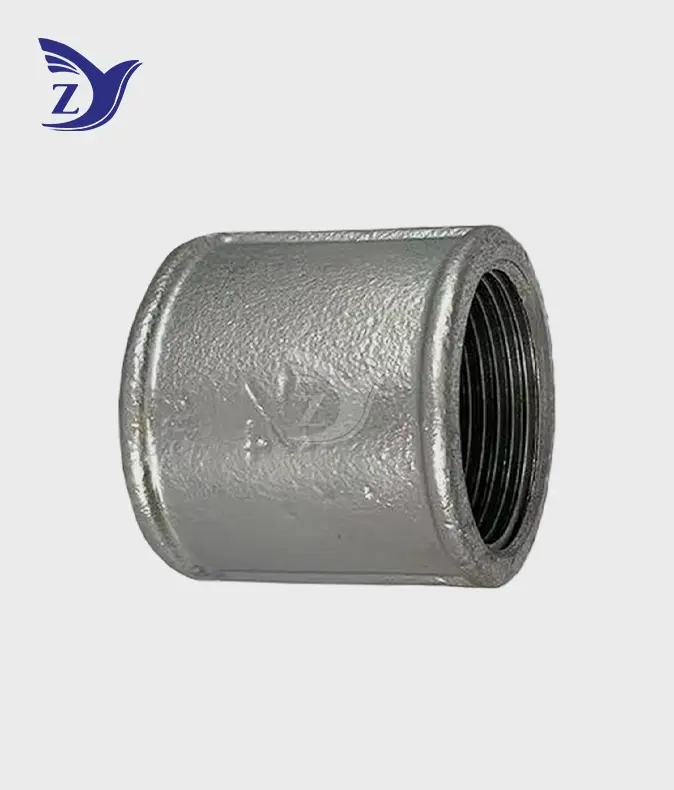
Role of Couplings in Piping Systems
Core Functions of Pipe Couplings
Pipe connections have many important jobs that have an immediate effect on how well a system works and how much it costs to run. They connect the ends of two pipes in a straight line, keeping the structure straight and ensuring that fluid or gas movement doesn't stop. Precision-threaded contacts that press against pipe threads to form tight seals without welding or special tools make this connection method leak-proof.
In addition to connecting pipes, NPT round face galvanized round edge coupling pipe fittings also absorb small movements caused by pumps or fluid flow. This lowers the stress on nearby pipe sections and stops fatigue cracks from forming. This ability to reduce vibrations makes parts last longer in heavy-traffic industry settings where equipment is always turning on and off. When repairs are needed, couplings make it easy for workers to quickly disconnect and replace broken pipe segments. This keeps important systems like fire sprinkler networks and city water mains running as smoothly as possible.
Types of Couplings and Their Applications
The pipe business uses a number of different coupling types, each of which is best for a certain set of circumstances. Rigid couplings keep the pipes in a set position, making them perfect for systems that won't move around much. Flexible couplings can handle small misalignments or changes in angle, which is helpful in places where earthquakes are common or in systems that experience temperature cycles.
Threaded connections are most common in situations where parts need to be put together and taken apart often. They can be installed without using glue and don't require lasting bonding. When it comes to these, hot-dipped galvanized malleable iron connections last the longest in harsh settings. The design with round edges and a reinforced bead at each exit spreads mechanical stress equally, so it won't crack when tightening the wrench or for future maintenance.
Why NPT Round Face Galvanized Fittings Stand Out
When you tighten two pipes together, the NPT (National Pipe Taper) fitting causes more contact between the threads, making a wedge-shaped seal. This taper design is different from straight threads because it creates compression that stops fluid flow without the need for seals. The round face shape makes it easier to enter pipes than square-faced options, which lowers the risk of cross-threading during installation in the field.
These fittings are galvanized using ASTM A153 hot-dip methods, which adds zinc layers that are about 1.5 to 2 mils thick and protects them from rusting. In wet or salty environments, zinc rusts more slowly than iron, which protects the iron underneath and makes the metal last decades instead of years. Because they protect against both mechanical leaks and corrosion, these fittings are necessary for outdoor installations, sites near the coast, and underground pipes.
Features and Benefits of NPT Round Face Galvanized Round Edge Couplings
Material Composition and Manufacturing Standards
These joints are made from malleable iron, which is a type of cast iron that has been heated and then annealed to make it flexible. Grey iron is flimsy, but malleable iron can be bent without breaking. This is important for making sure it can handle installation pressure and hydraulic shock. During the annealing process, carbon is changed into nodular graphite. This makes a microstructure that can bend under high stress instead of breaking.
Asme B16.3 dimensional limits and ISO 9001 quality control rules are followed during production. Thread gauging is done on each batch using accurate L1 ring gauges to make sure that the taper values are correct to within 0.0005 inches. Porosity or casting flaws can be found before they are distributed by hydrostatic testing at 1.5 times the working pressure, which is usually 450 PSI for Class 150 fittings. Meeting the requirements for UL and FM approvals makes sure that the equipment can be used in fire defence systems where failure could put lives at risk.
In the galvanization process, cleaned casts are put into molten zinc at 840°F. This makes a strong link between the coating and the base metal. Copper sulphate soaking in the Preece Test proves that the coating is still intact; parts that pass the test show no copper deposits after four one-minute dips. With this strict quality control, the electroplated options don't rust before they're supposed to.
Advantages Over Alternative Coupling Types
NPT round face galvanized round edge coupling pipe fittings are 40–60% cheaper than stainless steel couplings and are just as resistant to rust in most commercial settings. Stainless steel is only needed for high-purity medicinal or food-grade uses where zinc touch is not allowed. Galvanized fittings are the best choice for city water systems, petrochemical plants, and HVAC installs.
Instead of round beads, square-faced connections have flat support bands. Both designs make the outlet zones stronger, but round sides spread contact forces more evenly around the diameter, which lowers stress concentrations in certain areas. When there is water hammer or pressure bursts in a system, this geometry is helpful because rapid force spikes can break square corners.
Another important benefit is that installations are quick and easy. The chamfered entry on the round face automatically lines up the pipes, so techs can get the right engagement even in tight areas or at odd angles. When hundreds of links need to be made quickly for big projects with tight deadlines, faster installation means lower labour costs.
How to Install NPT Round Face Galvanized Round Edge Coupling Pipe Fittings?
Preparation and Thread Inspection
Preparation is the first step to a successful operation. Check the threads of the pipe for damage, dirt, or rust that could make sealing less effective. Take off any rust or paint from the thread crests with a wire brush. This will make sure that the metal-to-metal contact is clean. Look at the connection threads in good lighting to make sure there are no burrs, stripped areas, or other production flaws.
To keep the tape from coming apart during assembly, wrap it clockwise around the male pipe threads with PTFE tape or anaerobic pipe sealer. For NPT threads, use three to four pieces of tape, making sure that the covering goes from the second thread to two threads before the pipe end. Anaerobic sealants harden when there is no air in the joined parts. They fill in tiny holes that tape might miss.
Assembly Technique and Torque Guidelines
Hand-thread the connection onto the pipe until the resistance rises to a level that you can feel. For normal sizes, this should take about 3–4 turns. Pipe wrenches should be used on both the coupler and the pipe, and the right size wrenches should be used to avoid crushing thin-walled parts. Tighten until the pipe goes through the connection far enough that you can still see two or three threads at the entry point.
Do not over-tighten, as this can damage the threads or crack the iron body, which can be shaped. As a general rule, you should stop when you meet strong pushback instead of applying full force. For 1-inch connections, the goal torque range is 40 to 50 ft-lbs; as the size goes up, so does the torque. When tightened properly, the curved threads are compressed into a wedge shape that doesn't go beyond the limits of the material.
To stop cross-threading, keep the axial line while putting the parts together. Misaligned starts damage the threads, which forms spiral leak tracks even after the threads look like they are tightened. If resistance appears during the first turn, back off fully and start the engagement again, making sure there is a straight entry before adding torque.
Post-Installation Inspection and Maintenance
After putting everything together, check each joint visually to make sure that the threads are engaged evenly around the coupling's diameter. Check that the gap between the coupler face and the pipe end is the same on both sides. There shouldn't be any big differences. Pressure testing should be done according to the system's design specs. For Class 150 lines in water service, this is usually 150 PSI. During the test, connections should be checked for leaks.
Regular checks, especially in harsh settings, are needed to keep the galvanization's integrity. The formation of white rust (zinc oxide) is a normal sign of weathering and doesn't mean the security is lessened. Red rust means that the zinc level has dropped, so the surface needs to be prepared and cold galvanizing solution needs to be applied to restore barrier protection. Inspections once a year catch rust early, which keeps expensive problems from happening.
Conclusion
Couplings are the most important parts of a piping system because they are where the dependability depends on the right choice of materials, good production, and correct fitting. NPT round face galvanized round edge coupling pipe fittings have been used successfully in many different situations. They are made of strong, malleable iron, have zinc coatings that prevent rust, and have precision-threaded sealing surfaces. Because they are so flexible, they are used by fire protection workers, city planners, plant managers, and plumbing dealers who need reliable connections that are both cost-effective and long-lasting. Understanding the basics of linking, checking the identities of suppliers, and following best practices for installation all help make sure that systems work safely for as long as they're supposed to, reducing downtime and increasing the return on investments in infrastructure.
FAQs
Can galvanized couplings be used in potable water systems?
For uses with drinking water, high-purity hot-dip galvanization that meets NSF/ANSI 61 standards is fine. Third-party testing shows that the zinc layer must have very little lead or cadmium in it. Before selecting fittings for public supply systems, you should always ask for proof that the water is safe to drink. When galvanization is done right, zinc oxide surfaces are formed that are inert and don't release dangerous chemicals into water sources.
What differentiates round edge from banded coupling designs?
Round edge connections have reinforced beads at each exit that spread the mechanical load evenly around the edge. When you use banded patterns, flat support strips focus the forces at the edges of the bands. The round shape can handle pressure and torque better during fitting, which lowers the risk of cracking in high-stress situations. Both styles are stronger than plain couplings, but round edges look better and are more popular in some places, in addition to being more useful.
How do I verify proper thread engagement?
When the joint is tightened, the right assembly leaves two or three threads that can be seen at the entry. Not enough contact means that the bolts are not tightened enough, which makes the seals weak and vulnerable to leaks. If you tighten it too much, you might lose more than two threads and the threads could break or strip. For important systems, use calibrated torque wrenches to get the numbers set by the maker. Visual inspection and pressure tests are used to make sure the installation went well before the system is turned on.
Partner with Zhiyuan Malleable Steel for Reliable Pipeline Solutions
Since 2006, Zhiyuan Malleable Steel has been making precision-engineered pipe fittings for fire defence companies, local utilities, and manufacturing facilities around the world. Our NPT round face galvanized round edge coupling pipe fittings supplier operations keep a 30,000-ton annual production capacity and keep over 1,000 specs in stock, so normal orders can be delivered in two hours. Our dedication to quality is shown by our ISO 9001, CE, UL, and FM standards, and our OEM/ODM customisation meets the specific needs of each project. Our 50,000-square-meter factory is in Shanxi Province and has direct access to the airport. It has modern medium-frequency furnaces, energy-efficient annealing kilns, and environmental hot-dip galvanizing systems that make parts that meet ASTM A153 and ASME B16.3 standards. You can email our expert team at q1236800000@gmail.com to talk about your purchasing needs, get test reports, or set up tours of the building. You can look at our whole product line at zymalleablepipefitting.com and learn why top engineering firms trust Zhiyuan to provide them with mission-critical pipeline parts.
References
- American Society of Mechanical Engineers. ASME B16.3: Malleable Iron Threaded Fittings - Classes 150 and 300. New York: ASME Press, 2016.
- ASTM International. ASTM A153/A153M: Standard Specification for Zinc Coating (Hot-Dip) on Iron and Steel Hardware. West Conshohocken: ASTM International, 2020.
- National Fire Protection Association. NFPA 13: Standard for the Installation of Sprinkler Systems. Quincy: NFPA Publications, 2022.
- Underwriters Laboratories. UL 213: Standard for Rubber Gasketed Fittings for Fire Protection Service. Northbrook: UL Standards, 2018.
- Nayyar, Mohinder L. Piping Handbook, 8th Edition. New York: McGraw-Hill Education, 2019.
- Smith, Peter. The Fundamentals of Piping Design: Drafting and Design Methods for Process Applications. Houston: Gulf Professional Publishing, 2017.
Online Message