
Sep 23, 2026
What type of thread does a Class 300 black malleable iron cap use?
If you manage piping procurement for a petrochemical facility or industrial plant, getting the thread specification right on a pipe cap is not a minor detail — it is a safety-critical decision. The wrong thread profile under high-pressure conditions can mean leaks, system failures, and costly shutdowns. So let me give you a direct, technically grounded answer. A class 300 black coated malleable iron cap uses NPT (National Pipe Taper) threads as the primary standard in the U.S. market, conforming to ANSI/ASME B1.20.1. Many manufacturers, including Zhiyuan Malleable Steel, also offer BSPT (British Standard Pipe Taper) threads to serve international markets. Both thread profiles are tapered, creating a pressure-tight mechanical seal through thread interference rather than relying on a gasket or O-ring.
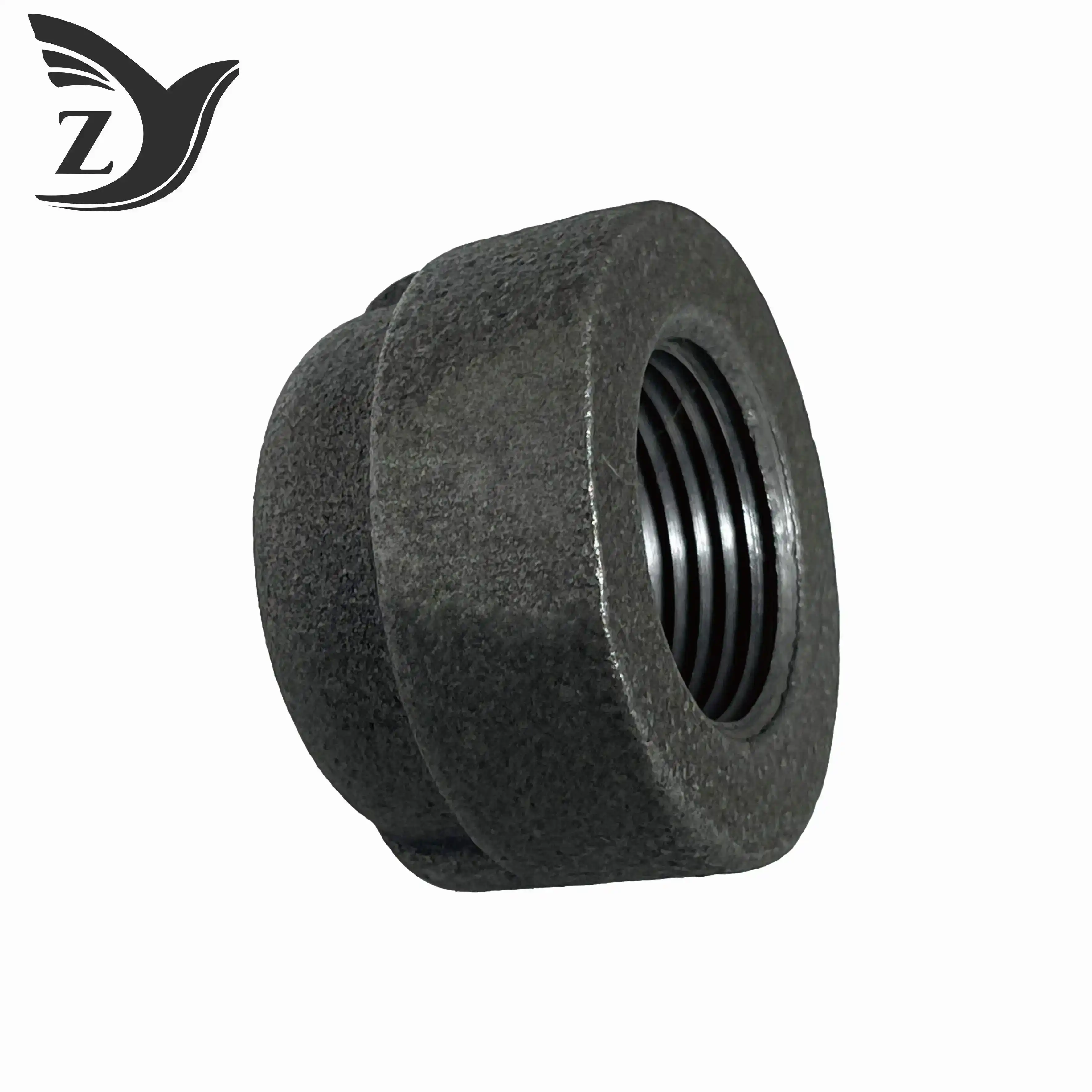
Thread Type of Class 300 Black Coated Malleable Iron Caps
NPT Thread: The Dominant Standard for U.S. Industrial Piping
For NPT threads, ANSI/ASME B1.20.1 says that the thread angle should be 60 degrees and the drop rate should be 1 inch for every 16 inches of length. When the fitting is tightened, this taper geometry forces the mating threads to wedge together. This creates the sealing interference that keeps pressurized media inside. For a Class 300 fitting rated at 600 psi WOG (Water, Oil, Gas), this mechanical contact must be very accurate in terms of size—even a small change in pitch width can cause a helical leak path when pressure is kept up.
BSPT Thread: The International Counterpart
The rules for BSPT threads are BS 21 and ISO 7-1. They use a 55-degree thread angle and the same taper idea. These two types of threads can't be switched out because the side angle is different from NPT. When you force an NPT cap onto a BSPT male end, or the other way around, you damage the thread crests and make spiral leakage paths that can't be fixed with sealant. When engineers design fittings for projects in the Middle East, Southeast Asia, or Europe, they usually need BSPT, but NPT is used by default in North America.
The class 300 black coated malleable iron cap from Zhiyuan Malleable Steel has both NPT and BSPT internal threads, so buying teams that manage supply chains across multiple regions don't have to guess about compatibility.
Material and Performance Profile of the 300LB Black Coated Cap
The thread shape will only work as it should if the material underneath can handle the mechanical loads. A controlled annealing process turns rigid cementite into tempered carbon crystals, which make malleable iron. This iron has a minimum tensile strength of 330 MPa and an elongation of ≥8%. Because it is flexible, the fitting deforms slightly when over-torqued instead of breaking, which is an important safety feature in industrial settings with a lot of vibration.
Here are the main things that make the Zhiyuan Class 300 black-coated malleable iron cap work well:
- Class 300 pressure rating (600 psi WOG): It has a Class 300 pressure rating (600 psi WOG) and is designed for heavy-duty piping in oil, gas, fire suppression, and industrial process lines where standard Class 150 fittings are too small.
- Integral one-piece casting construction: The cap body has no welded gaps or mechanical joints, so the wall thickness is constant. This makes stress distribution predictable, and it stops cracks from spreading during heat cycles.
- Even black anti-rust coating: A smooth surface coating keeps out moisture in the air and light harmful substances. The black coating stays stable in the temperature range that is common in steam and gas lines, while galvanized coatings can peel off at temperatures above 140°F and contaminate valves or instruments further downstream.
- Precision thread machining: CNC machining keeps the thread measurements within very small ranges. This makes sure that the pitch width and taper stay the same, which are the two factors that directly affect how well the seal works at steady Class 300 pressure.
Because of these features, the fitting can be used for natural gas distribution, irrigation mains, fire protection headers, and industrial process pipelines. When you combine high-quality materials with precise threading, you get a fitting that can handle its rated pressure without needing to be re-torqued or sealant reapplied often.
Comparing the Black Coated Cap Against Galvanized and Stainless Alternatives
A lot of the time, procurement experts have to choose between stainless steel, galvanized malleable iron, and the class 300 black coated malleable iron cap. The thread profile (NPT or BSPT) usually stays the same between these material types, but the selection logic changes a lot depending on the service environment.
The thread standards for galvanized malleable iron caps are the same, but they have a zinc layer that is put on by hot-dip galvanizing. Zinc is a great material for protecting against water and the elements outside. In gas lines, steam systems, or oil service, on the other hand, the zinc layer can flake off at high temperatures, letting metal particles into sensitive equipment further down the line. The black-coated choice gets rid of that chance of contamination while still providing enough rust protection for most industrial gas and process uses.
Stainless steel threaded caps are better at resisting rust in harsh chemical conditions, but they cost a lot more per unit, and the threads are less flexible. For normal petrochemical pipes that don't handle highly concentrated acids or chloride-rich media, a properly rated malleable iron cap with a good black coating gives the same service life at a fraction of the cost of the material. This is something to think about when you're in charge of an annual budget for buying things that ranges from $100,000 to $500,000.
Installation Guidelines for Class 300 Black Coated Malleable Iron Caps
Both the fitting and the pipe system are protected by a proper installation of the Class 300 black-coated malleable iron cap. Thread interference is what keeps NPT and BSPT threads from coming apart, but there are always tiny gaps at the root and crest of mating threads. To fill those gaps and keep the joint smooth during assembly, you must use a thread glue that is compatible with the service medium. This could be PTFE tape or a pipe joint compound made for that medium.
Finger-tight contact followed by two to three full wrench turns is the standard way to install NPT fittings. When you tighten a cap too much on a tee or nipple, the female port experiences hoop stress, which can cause the receiving fitting to split. This type of failure is expensive and dangerous in a live piping system. Before installing, check the thread crests visually for burrs or deformation and make sure the thread standard matches the component it fits. A Go/No-Go thread gauge is the most accurate way to check before fitting.
Once everything is set up, the joints must be checked for integrity with a pressure test at 1.5 times the rated working pressure, which must be held for a certain amount of time according to the project requirements. Only then is the system turned on.
Procurement Guidance: What to Verify Before Placing an Order
When supply chain managers make or keep an Approved Supplier List (ASL), thread quality is just one of many things they look at when evaluating a Class 300 black coated malleable iron cap. Dimensional agreement needs to be backed up by proof that can be proven.
As a starting point, when checking out a supplier of Class 300 threaded pipe caps, ask for the following paperwork:
- Material Test Reports (MTR) that can be linked to the heat/lot number and prove the chemical make-up and mechanical qualities according to ASTM A197
- Thread inspection records that show compliance with ANSI/ASME B1.20.1 (NPT) or BS 21/ISO 7-1 (BSPT)
- ISO 9001 quality management certificate that is still valid
- Certificate of Conformance (COC) and Certificate of Analysis (COA) per shipment
Lead time and the amount of stock also matter. For planned plant turnarounds, schedule risk is eliminated by a supplier who has finished goods on hand and can promise delivery within a certain time. Zhiyuan Malleable Steel keeps a lot of standard sizes in stock and can handle large orders thanks to its 30,000-ton annual production base.
Conclusion
Picking the right thread for a class 300 black coated malleable iron cap is an exact engineering choice that isn't based on personal taste. NPT is still the standard for industrial uses in the U.S., while BSPT is used for projects in other countries. Both types of threads need to be machined accurately to work reliably at 600 psi WOG. When buying petrochemicals, you can't skimp on the quality of the materials, the regularity of the finish, or the ability to fully track all of your paperwork. When all of these things work together in a single product and provider relationship, you lower the total cost of ownership, the risk of installation problems, and the cost of compliance at the same time.
FAQ
1. Are NPT and BSPT threads interchangeable on a black malleable iron cap?
No, the thread angle for NPT is 60 degrees, and the angle for BSPT is 55 degrees. Even though both are tapered, pushing them together changes the shape of the thread and creates spiraling leak paths that sealant can't reliably stop. Before putting the cap and fitting together, you should always check that the threads are the same size on both.
2. What sealant should I use with a Class 300 NPT pipe cap?
Most people choose PTFE tape or a pipe joint material that is rated for the type of service medium, like gas, oil, or water. The sealant keeps the joint smooth while it's being tightened and fills in the tiny holes that are naturally present in tapered threads.
3. Can a black coated malleable iron cap handle steam service?
It is recommended that malleable iron caps be used with steam at a lower pressure than their atmospheric WOG rating. Check the published data from your supplier to make sure that the rated steam pressure at the actual operating temperature matches what you need for steam applications.
4. Why choose black coating over galvanized for gas or oil lines?
When temperatures get too high, galvanized zinc coatings can come off, letting zinc particles into gas or oil streams and possibly blocking valves and instruments. The risk of contamination is eliminated by the black coating, which is still suitable for most gas and oil service environments.
5. What certifications should a qualified supplier hold?
At least ISO 9001 approval for quality control. CE, UL, or FM certifications may also be needed depending on the needs of the project. For petrochemical ASL approval, materials must be able to be tracked back to a heat or lot number, and full MTR paperwork must be provided.
Request a Quote from Zhiyuan Malleable Steel
Since 2006, Zhiyuan Malleable Steel has been making precision-machined malleable iron pipe fittings. They can make up to 30,000 tons of these each year and have ISO 9001, CE, UL, and FM certifications. As a reliable class 300 black coated malleable iron cap supplier, we offer full MTR documentation, two thread options (NPT and BSPT), and the ability to do OEM and ODM work. To get a price or a trial order right away, email our team at q1236800000@gmail.com.
References
1. ASME B1.20.1 — Pipe Threads, General Purpose (Inch), American Society of Mechanical Engineers, 2013.
2. ASTM A197/A197M — Standard Specification for Cupola Malleable Iron, ASTM International, 2020.
3. BS 21 / ISO 7-1 — Pipe Threads Where Pressure-Tight Joints Are Made on the Threads, British Standards Institution, 2017.
4. Malleable Iron Fittings: Materials, Dimensions and Pressure Ratings, Manufacturers Standardization Society (MSS SP-83), 2019.
5. Piping Handbook, Mohinder L. Nayyar, McGraw-Hill, 2000.
6. ASME B16.3 — Malleable Iron Threaded Fittings, Classes 150 and 300, American Society of Mechanical Engineers, 2021.
Online Message