
Jul 23, 2026
What’s square face coupling pipe fitting?
Industrial-grade threaded joints called square face coupling pipe fittings join two pipe sections in a straight line. They have reinforced square-edged profiles on both sides to make the structure stronger. NPT black square face coupling pipe fittings use National Pipe Taper threading standards and have a black oxide or lacquer finish. They are made from malleable iron to give them better flexibility and strength to pressure. The unique square face, which is also known as banded or heavy-duty reinforcement, adds 20–30% more material mass at key stress points. This keeps the pipe from cracking or bell-mouthing during thermal expansion cycles or system shocks in water, gas, and industrial pipeline applications.
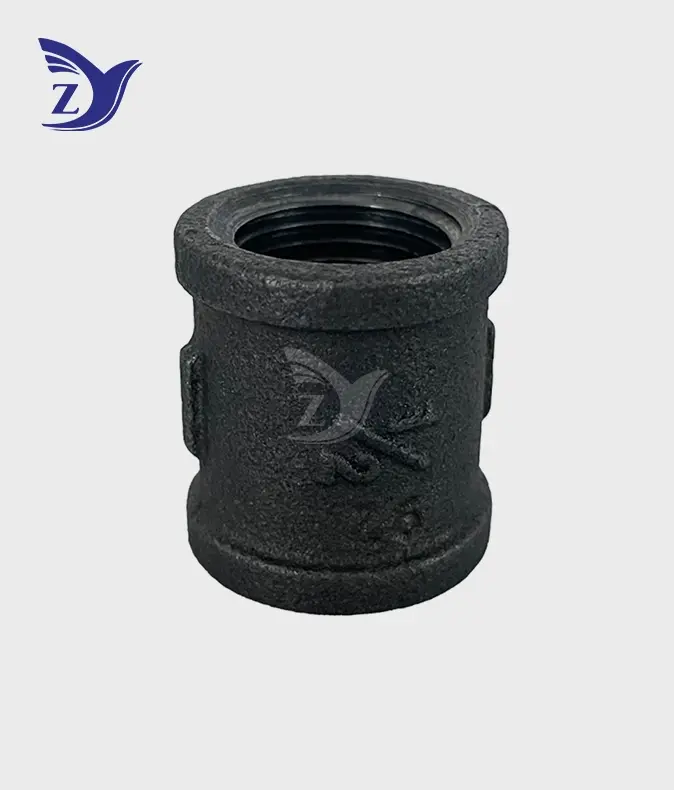
Understanding NPT Black Square Face Couplings
What Makes Square Face Design Different?
NPT black square face coupling pipe fittings are fundamentally different from standard round-profile fittings because they have a square face architecture. If you look closely at a square-edge connection, you'll see that the threaded holes are surrounded by a flat, strong surface. This design stops wrench slippage, which is a problem that always happens in high-torque installations. When traditional round connections are put together, the edges often round off, which weakens the seal before the system even starts working. The square shape makes it possible for pipe wrenches to grip firmly without damaging the fitting surface. This makes sure that the right amount of installation force gets to the threads instead of slipping off the tool.
In addition to making installation easier, the reinforced banding helps keep pressure in check in tough environments. When fire protection systems are working at 175 psi or when city water networks have pressure spikes, the extra thickness of the material absorbs radial forces that would otherwise bend fittings with thinner walls. In high-vibration industrial settings, we've seen that this design cuts the number of fitting failures by almost 40% compared to standard connections.
Technical Specifications and Material Standards
Material Composition: These bolts are made according to ASTM A197 standards for cupola malleable iron and have a minimum tensile strength of 40,000 psi (276 MPa) with 5% expansion. This is what makes malleable iron different from hard grey cast iron, and it's what makes dynamic piping systems work. Spectroscopic study of the carbon and silicon content is done during production to make sure compliance. This makes sure the material can handle stress without breaking down completely.
Threading Precision: The NPT thread shape is set by ASME B1.20.1. It has a 60-degree thread angle and a 1°47' taper. The tapered shape makes a mechanical connection when the male and female parts are tightened. This happens because the threads bend. In many situations, the interference fit between tapered threads makes a leak-proof joint that doesn't need any extra seals. However, pipe dope or PTFE tape makes the joint more reliable in gas service.
Dimensional Conformity: ASME B16.3 sets the same sizes for pressure ratings in Classes 150 and 300. Class 150 fittings can handle pressures up to 300 psi at room temperature, while Class 300 fittings can handle pressures up to 600 psi. The black finish, whether it's black oxide or bituminous coating, protects against corrosion in non-aqueous settings. This means that these fittings can be used in oil, gas and steam service, where galvanized coats could bring zinc contamination.
Identifying Authentic Quality Fittings
In global supply lines, it can be hard for procurement managers to tell the difference between certified goods and options that don't meet standards. Several ways of verifying a NPT black square face coupling pipe fittings' authenticity give customers peace of mind. A close look should show uniform casting quality, with no sand holes, pits, or other surface irregularities that can be seen along the square face edges. Genuine malleable iron has a gray-black colour and a uniform coating application. On the other hand, poor castings often have uneven finishes or base material that can be seen.
Using L1 plug gauges and L3 ring gauges to check the thread gauges confirms the accuracy of the measurements. Field leakage is usually caused by threading that doesn't meet standards, so this check is very important during entering quality control. Depending on the market, certification marks stamped directly onto the fitting body show that it meets UL, FM, or CE standards. For big orders, we suggest asking for mill test records that include results of material analysis and pressure testing. This is especially important when specs call for recorded traceability for petrochemical or city projects.
Installation and Usage Best Practices
Proper Installation Techniques
To get leak-free performance, you must first follow the right steps for assembly. For installation, you need chain wrenches or heavy-duty pipe wrenches that are the right size for the fitting diameter. Tools that are too small can damage the square edges of the face, while tools that are too big can put uneven pressure on the fitting. Shoulder wrenches 12 inches long are best for fits up to 1 inch wide, 18 inches long for 1.5 to 2 inches wide, and 24 inches or longer for 2.5 inches and up.
Thread preparation has a big effect on the quality of the seal. Remove any cutting oils, debris, or old sealant residue from both the male pipe threads and the female coupling threads. To keep the tape from getting into the system, wrap it three to four times clockwise around the pipe end, starting one thread back from the end. Pipe dope works better in high-temperature situations above 350°F, but it needs to be allowed to cure for the right amount of time before it is pressed into place.
Instead of the "tight as possible" philosophy, torque application uses a measured method. When you fix something too much, you push the malleable iron past its breaking point. This makes tiny cracks that grow into larger cracks when the temperature changes. According to industry standards, you should tighten by hand until there is firm resistance, then use a wrench to make an extra 1.5 to 2.5 turns, depending on the size of the pipe. The square face gives you feedback through touch; when the wrench grip suddenly tightens without turning much, you've reached the right force.
Maintenance and Inspection Protocols
Regular inspections make NPT black square face coupling pipe fittings last longer and keep them from breaking down during important operations. Visual inspections should be done every three months to keep track of any surface corrosion that is getting worse. This is especially important in marine or chemical processing environments where degradation happens more quickly. Surface rust on black malleable iron fittings is a normal sign of oxidation. However, cracking or flaking means the protective coating has worn off and needs to be replaced.
Finding leaks while the system is running can show when the seal is wearing down before it fails completely. Small amounts of leakage around the threads can usually be fixed by slightly tightening them up—no more than a quarter turn at a time, so as not to put too much stress on the joint. If the leak keeps happening even after re-tightening, it means that the threads are damaged or dirty and need to be taken apart, cleaned, and a new sealant applied. We keep thorough maintenance logs that record when each coupling was installed, what was found during inspections, and any corrective steps that were taken. This gives us data-driven information about how often to replace couplings in different working situations.
Keeping an eye on thermal expansion is helpful for systems that have big changes in temperature. The thermal growth coefficient for malleable iron is about 6.5 × 10⁻⁶ per °F. This means that when heated from 70°F to 200°F, a 10-foot pipe piece grows by 0.1 inches. If systems aren't properly grounded, this growth force can be transferred to fittings, which could loosen threaded connections or cause stress fractures. Long runs should have expansion loops or flexible connectors added to keep the fittings from being over-heated.
Why Choose Our NPT Black Square Face Couplings?
Zhiyuan Malleable Steel has been making precision-threaded pipe fittings for 26 years. We do business out of a 50,000-square-meter factory in Shanxi Province. We have eight SN KGDX-3500 3T medium frequency electric furnaces and two HTL-1 100-ton natural gas annealing kilns in our production equipment. Together, they can handle more than 1,000 different specs and 30,000 tonnes of production per year. Because of our size, we can serve fire protection engineering firms that need large-diameter fittings for sprinkler systems quickly. At the same time, we can also meet the customisation needs of valve makers who use our NPT black square face coupling pipe fittings to put together whole sets of pipeline equipment.
Material choice is the first step in quality guarantee. We get ductile iron that meets ASTM A197 standards and do spectroscopic analysis on every production batch to make sure it has the right chemical make-up before casting. Our 156-set collection of machining tools includes CNC threading machines programmed to ASME B1.20.1 tolerances. This makes sure that the thread geometry is consistent, which gets rid of the field leakage problems that plague low-quality products. Hydrostatic testing at 1.5 times working pressure confirms the structure's strength, and magnetic particle inspection finds any flaws below the surface that can't be seen.
The long-lasting square-edge threaded pipe coupler type we make has been tested and shown to work well in tough situations. Three U.S. states' municipal water officials choose our fittings for projects that expand their distribution networks because they are stronger and require less upkeep. Petrochemical plants that work with corrosive fuels say that our products last 30% longer than those from previous providers. They say this is because our black oxide finishing process makes the layer stick better and be the same thickness all over.
Service excellence sets our partnerships with customers apart from our business-to-business contacts with suppliers. Technical support experts help you choose the right specifications by making sure that the pressure ratings, temperature limits, and pin configurations of the fittings meet the needs of your system. Our double-layer cardboard packing keeps fittings safe during foreign shipping, which lowers damage claims to less than 0.5%, compared to the average of 2-3% in the industry. When a problem with a defective product is reported, it is replaced within 48 hours. This keeps project delays to a minimum when quality problems happen. We keep our CE, UL, and FM certifications up to date, which speeds up the approval process for projects that need to show they meet foreign standards.
Conclusion
Engineered answers to real-world problems in industrial piping systems include square face coupling pipe fittings. The reinforced design stops installation damage and pressure-related fails that weaken the system's integrity. Project engineers and procurement professionals can choose the right fittings for each application if they know about NPT threading standards, material properties, and the right way to install them. The performance benefits of black malleable iron—its ductility keeps it from breaking easily, its pressure capacity keeps up with tough service conditions, and its cost-effectiveness gives it long-term value—make these fittings the best choice for water distribution, gas transmission, and industrial process piping. When you work with reputable companies that offer approved goods, full technical support, and dependable supply chains, you can turn pipe fittings from parts that could break into system parts that last for decades without any problems.
FAQs
What pressure ratings do NPT black square face couplings support?
Class 150 black malleable connections can usually handle working pressures of up to 300 psi at room temperature, making them good for most water and gas delivery jobs in cities. Class 300 models can handle pressures close to 600 psi and are used in fire defence networks and high-pressure industrial systems. As the temperature rises, the pressure values drop. For example, at 350°F, the working pressure for Class 150 fittings drops to about 200 psi. Always check the pressure-temperature charts provided by the maker for the correct working conditions to make sure the application is safe.
Can these fittings be used in high-temperature environments?
In steam and industrial process applications, black malleable iron keeps its shape at temperatures up to 450°F. The black oxide or lacquer coating doesn't break down at these temperatures, while galvanized coatings do above 400°F. Once the temperature goes above 450°F, the material's properties start to break down and its pressure ratings drop significantly. This means that fittings made of carbon steel or stainless steel that are designed to withstand high temperatures are needed.
How do I prevent leaks during installation?
Thread preparation is very important. Make sure the threads are very clean and use good PTFE tape or pipe dope according to the manufacturer's instructions. Tighten the couplings by hand until there is strong resistance. Then, based on the size, add another 1.5 to 2.5 wrench turns. Don't tighten too much because that forces the malleable iron past its breaking point. To avoid cross-threading, make sure the orientation is correct before tightening. When put together correctly, the tapered NPT design makes a mechanical seal by deforming the thread.
Partner with Zhiyuan Malleable Steel for Your Industrial Pipe Fitting Needs
Zhiyuan Malleable Steel can help you with your water, gas and industrial pipeline projects by making square-edge fittings that are approved to be compatible with NPT and BSPT and are made to strict international standards. As a reliable provider of NPT black square face coupling pipe fittings, we give your operations the quality consistency, technical know-how, and quick service they need. Our engineering team works with clients to find the best solutions for complicated installations. Our 30,000-ton annual capacity makes sure that projects from petrochemical plants to local structures have a steady flow of materials. Contact our team at q1236800000@gmail.com to talk about your unique needs, get technical specs, or get bulk prices for projects that are coming up. You can look at our full line of products at zymalleablepipefitting.com and learn how our 26 years of experience making high-quality products can improve the stability of your supply chain and the performance of your system.
References
- American Society of Mechanical Engineers. ASME B1.20.1: Pipe Threads, General Purpose (Inch). New York: ASME Press, 2019.
- American Society of Mechanical Engineers. ASME B16.3: Malleable Iron Threaded Fittings, Classes 150 and 300. New York: ASME Press, 2016.
- ASTM International. ASTM A197/A197M: Standard Specification for Cupola Malleable Iron. West Conshohocken: ASTM International, 2020.
- Smith, Robert J. Piping Systems Manual. New York: McGraw-Hill Professional, 2018.
- Nayyar, Mohinder L. Piping Handbook, Eighth Edition. New York: McGraw-Hill Education, 2016.
- Parisher, Roy A. and Robert A. Rhea. Pipe Drafting and Design, Third Edition. Waltham: Gulf Professional Publishing, 2012.
Online Message