
Nov 17, 2026
What is the maximum pressure rating of a threaded pipe plug?
A standard threaded pipe plug rated at Class 150 handles up to 300 psi WOG (Water, Oil, Gas), while a Class 300 solid plug can reach 1,000 psi WOG. For a hot-dipped galvanized non-flanged pipe plug pipe fitting made from malleable iron, pressure capacity depends on thread standard (NPT or BSPT), wall thickness, and whether the plug is solid or cored. Most non-flanged pipe plug I source for industrial water and gas pipelines fall within these two classes, covering the majority of commercial and light industrial applications.
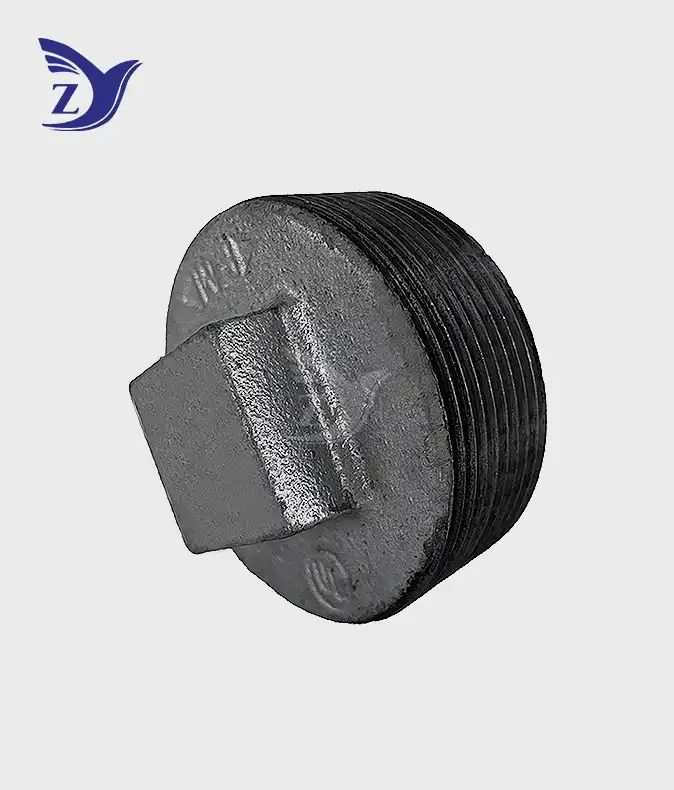
Threaded Pipe Plugs Pressure Ratings
Before placing a bulk order, I always make sure my team understands the basics. Pressure ratings are not arbitrary numbers—they reflect real engineering limits tied to material grade, thread geometry, and design class.
Flanged vs. Non-Flanged: What Changes?
A galvanized non-flanged pipe plug pipe fitting (square or hex head) transfers wrench torque directly through the body column. This design allows for heavier tightening without the risk of flange cracking. A flanged plug uses a wider collar that can seat against a face—useful for aesthetic flush finishes but less suited to high-torque, high-pressure industrial installations.
How Materials and Thread Standards Set the Ceiling
Malleable iron (ASTM A197) and carbon steel (ASTM A105) are the standard materials for industrial-grade plugs. NPT threads follow ANSI/ASME B1.20.1 with a 60° flank angle and a 3/4-inch-per-foot taper; BSPT threads follow ISO 7-1 with a 55° Whitworth profile. Both tapers tighten progressively under pressure, which actually improves the seal as system pressure rises.
Pressure Class Ratings at a Glance
Class 150 cored plugs are rated at 300 psi WOG—adequate for standard plumbing and light gas lines. Class 300 solid plugs reach 1,000 psi WOG, suited for oil, compressed air, and high-pressure water systems. Temperature matters too: ratings drop at elevated temperatures, so always verify the derating curve from your manufacturer before specifying for steam or high-heat environments.
Galvanized Non-Flanged Pipe Plugs in Industrial Applications
Some procurement teams forget how much corrosion costs over time. An inside-out fix with a galvanized non-flanged pipe plug pipe fitting is better than just an outside fix.
Why Hot-Dip Galvanization Matters
Following ASTM A153, a zinc layer about 70 to 85 microns thick is put down during hot-dip galvanization. When it's warm outside, this zinc layer acts as a sacrifice anode, meaning it oxidizes before the base iron does. This adds 20 to 50 years to the life of the service. ASTM B117 salt spray tests show that the product will work for more than 500 hours without red rust appearing.
Standard Dimensions and Compatibility
NPT/BSPT unflanged zinc malleable plugs come in sizes from 1/8" to 4" and are made to fit standard IPS female-threaded fittings. The square or hex head form makes it possible to use a wrench right away. Any elbows, tees, or connections from the same galvanized malleable iron line will work with these plugs. The threads will not need any adapters.
Real-World Application Examples
Water treatment plants use pipe caps that don't rust to close test ports on distribution headers that go through 150 to 250 psi every day. In oil and gas fields with hydrogen sulfide-filled air, solid-body Class 300 plugs keep pressurized manifold ports closed. This is because black iron fittings would break in months. An iron plug that is precision-threaded, doesn't rust, and is flexible costs less to own overall than one that isn't coated.
Comparing Galvanized Non-Flanged Pipe Plugs to Other Types
To pick the right plug type, you need to make sure that the material qualities fit your budget and the way you plan to use the plug. Here's how the main options stack up.
Galvanized Malleable Iron vs. Plastic and Stainless Steel
Plastic plugs are cheap and light, but they should only be used in places with 150 psi of pressure and high temperatures or UV light. There is a price difference of three to five times between coated malleable iron and stainless steel plugs. Stainless steel plugs can handle more than 2,000 psi and acidic chemicals well. For closing industrial water and gas pipes, hot-dipped galvanized malleable iron is the best choice because it can handle the most pressure, doesn't rust, and costs the least per unit.
Non-Flanged vs. Flanged in High-Pressure Systems
Galvanized non-flanged pipe plug pipe fitting is better at transferring torque when the field is rough. To close well, the face of the flanged plug that fits against it needs to be clean and flat. This isn't always the case when they are put in the field. It's easier to install the industrial-grade unflanged pipe plug properly, and buyers in bulk who sell to hardware shops and installation crews don't have to call them back as often.
Galvanized vs. Black Iron: Long-Term Infrastructure Value
Black iron pipe plugs are a little less expensive at first, but they rust quickly outside or in wet places. A galvanized corrosion-proof pipeline cap has a zinc coating that makes it last a lot longer before it needs to be replaced. This saves end users money on labor and downtime. For distributors who sell to contractors who work on gas or water mains, this case about longevity is a good one.
Procurement Considerations for Galvanized Non-Flanged Threaded Pipe Plugs
To get a lot of galvanized non-flanged pipe plug pipe fittings, you need to do more than just find the cheapest price. As long as the quality of your sales at the ton level stays the same, your relationships with people further down the chain will be safe.
Key Buying Criteria
If you want to find a reliable supplier for long-lasting, corrosion-proof pipeline caps, look at these three things:
- Thread precision: Go/No-Go gauging per BSPT (ISO 7-1) or NPT (ANSI/ASME B1.20.1) must be documented for every production batch. Thread failures cause the most frequent downstream returns.
- Zinc coating verification: Magnetic induction measurements should confirm a minimum average of 63 µm for hot-dip coatings. Request salt spray test certificates for each production lot.
- Pressure test records: Hydrostatic testing at 1.5× working pressure (e.g., 450 psi for Class 150) screens out casting porosity before shipment.
You need to show proof of either BSPT (ISO 7-1) or NPT (ANSI/ASME B1.20.1) go/no-go gaging for every production batch of threads. Thread problems are the main cause of most downstream returns.
Installation, Maintenance, and Longevity of Galvanized Non-Flanged Pipe Plugs
Step-by-Step Installation for a Leak-Proof Seal
The female threads of the receiving galvanized non-flanged pipe plug pipe fitting can be cleaned with a wire brush to get rid of dirt and dust. Wrap PTFE tape around the male threads of the NPT/BSPT plug two or three times, going clockwise. You could also use pipe thread glue, which is also called "pipe dope." First, tighten by hand. Then, add torque with a wrench in steps. For NPT, this is usually two to three more turns after torqued by hand. Be careful not to use too much torque because it could break the fitting body.
Routine Inspection and Corrosion Prevention
Check the plugs once a year if they are outside or in a place with a lot of humidity. The zinc layer is broken if you see red rust spots. Instead, look for a buildup of white zinc oxide. This is normal and safe. Put a thin layer of anti-corrosion grease on plug heads that are exposed to salt air. This will help the zinc layer last longer.
Recognizing When to Replace
You should get a new threaded pipe seal if the thread roots have red rust, the body is cracked, or the threads get stuck and won't fully engage. If the seal fails in a high-cycle pressure system, it is cheaper to replace the plugs on purpose every five years than to have to shut down the system in an emergency.
FAQ
What is the maximum pressure rating for a galvanized malleable iron plug?
Plugs in Class 150 can handle up to 300 psi WOG, and plugs in Class 300 can handle up to 1,000 psi WOG. Always check the class stamp on a fitting before putting it in a pressure system.
Does galvanization improve pressure resistance?
This is because the mechanical pressure number is already set by the width of the wall and the grade of the material. Galvanization does not directly raise that number. But it keeps the structure of the base iron strong over time by stopping rust, which would otherwise weaken the walls and lower the useful pressure capacity.
Can these plugs be used in outdoor gas line applications?
Yes, galvanized plugs that work with both NPT and BSPT are often used outside to distribute gas. Make sure to always follow the area code (ASME B31.1 or B31.3), and if the service is gas, always use rated thread sealer.
What thread sealant is recommended?
If you want to use oil, gas, or water as the service medium, you need PTFE tape or a pipe thread compound (pipe dope) that is rated for that. The zinc coating makes the threads thicker, so they need to be oiled to keep them from getting stuck and to make sure the seal doesn't let air in.
Get a Direct Quote from Zhiyuan Malleable Iron
Zhiyuan Malleable Iron offers galvanized non-flanged pipe plug pipe fittings straight from our 30,000-ton yearly capacity plant in Shanxi, China. We help distributors of goods in the Middle East, Southeast Asia, the US, and other places. We're certified by ISO 9001, CE, UL, and FM, and we carry over 1,000 specs. To get a tiered price quote right away, please go to zymalleablepipefitting.com or email q1236800000@gmail.com.
Conclusion
How it was made, what class it is in, and how much pressure it can handle determine its highest pressure number. Standard galvanized non-flanged pipe plug pipe fitting, which can handle 300 psi at Class 150 and 1,000 psi at Class 300, are needed for the majority of industrial water, gas, and oil pipeline closing applications. Hot-dipped galvanized, precision-threaded malleable iron plugs are the best choice for contractors and wholesalers who need to keep quality high on a big scale. They don't rust, work well under pressure, and are cheap to buy. Make sure you get the right pressure class for your system, check the thread standards, and buy from a certified maker to protect your margins and relationships with customers in the future.
References
- ASME B1.20.1 — Pipe Threads, General Purpose (Inch), American Society of Mechanical Engineers, 2013.
- ASTM A197 — Standard Specification for Cupola Malleable Iron, ASTM International, 2000 (reapproved 2020).
- ASTM A153 — Standard Specification for Zinc Coating (Hot-Dip) on Iron and Steel Hardware, ASTM International, 2016.
- ASTM B117 — Standard Practice for Operating Salt Spray (Fog) Apparatus, ASTM International, 2019.
- ISO 7-1 — Pipe Threads Where Pressure-Tight Joints Are Made on the Threads, International Organization for Standardization, 1994.
- MSS SP-4 — Wrought and Fabricated Butt-Welding Fittings for Low Pressure, Corrosion-Resistant Applications, Manufacturers Standardization Society, 2018.
Online Message