
Sep 14, 2026
What is the difference between a cap and a plug in a pipe?
A pipe cap fits over the outside of a pipe end, while a pipe plug threads into the inside of a female fitting or pipe opening. Both serve as pipeline closure solutions, but their installation geometry is entirely opposite. When sourcing plugs fitting for industrial water, gas, or oil systems, choosing the wrong type creates seal failures, pressure drops, or costly rework. Understanding this distinction upfront saves procurement teams significant time and money across bulk orders.
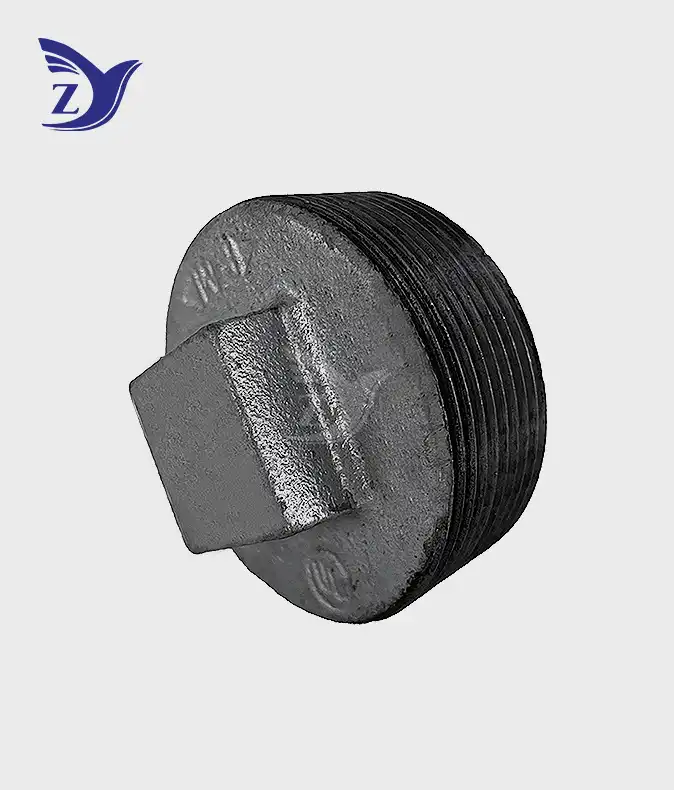
Understanding Caps and Plugs in Pipe Systems
There is no difference between caps and plugs when it comes to how they stop a pipeline. Like a bottle cap, a pipe cap slides over the male end of a pipe and threads or welds onto the outside of the pipe. A pipe plug threads into the hole of a female fitting to make an internal seal.
Where Each Fitting Gets Used
Caps are often put on pipe runs that stop in a dead end during system testing, maintenance shutdowns, or permanent closures, where the pipe end sticks out. Plugs, on the other hand, are found inside tees, couplings, crosses, or any other female-threaded port that needs to be blocked temporarily or permanently. Most distribution manifolds have more than one female-threaded branch, which means that plugs see more rotation when they are used to close water and gas pipelines in factories.
Material Compatibility Across Systems
You can get both parts in carbon steel, brass, PVC, malleable iron, and stainless steel. Hot-dipped galvanized malleable iron is still the workhorse of the industry when it comes to demanding environments or outdoor use. ASTM A197 says that malleable iron castings must have a minimum tensile strength of 40,000 psi, making them highly reliable under sustained line pressure.
Comparative Analysis: Cap vs. Plug in Pipe Fittings
Choosing between a cap and a plug involves more than geometry. For a B2B distributor who handles thousands of SKUs, the total cost of ownership is based on things like the pressure grade, the speed of installation, and the long-term corrosion protection.
Here are the core performance differences procurement teams should evaluate:
- Sealing position: A plug seals from the inside, while a cap seals from the outside. In gas lines with a lot of vibration, an internal plug thread engagement tends to resist loosening better because the pipe wall mass covers it on all sides.
- Pressure handling: When properly torqued to NPT or BSPT thread standards, both plug fittings can handle about the same amount of pressure. A precision-threaded, hot-dipped galvanized malleable iron plug rated to 300 PSI WOG (water, oil, and gas) works well in most distribution systems.
- Corrosion resistance: An unflanged galvanized malleable iron plug with a hot-dipped zinc covering averaging 85 microns has a much longer useful life in damp or outdoor settings than bare black iron options.
- Installation speed: Plugs are usually easier to install on manifold branches because the wrench can grip the square or hexagonal head on top of them more quickly. For caps, you need to wrap a pipe wrench around the body of the fitting, which can be hard to do in tight spaces.
These differences are what really affect how distributors buy things. To keep downstream customers from having to return items under warranty, a wholesale buyer who stocks both types needs to make sure that the thread precision and coating uniformity are the same on every pallet.
Inconsistent coating thickness or threads that don't meet specifications are the most common causes of field returns in this product category. Your margin is directly protected when you choose a provider with written quality controls.
Exploring Plugs Fitting Types, Materials, and Benefits
Unlike what many buyers first think, the plug-fitting group is larger. Within malleable iron alone, you encounter square-head plugs, round-head plugs, hex-head plugs, and bar-stock plugs, each suited to different wrench access scenarios.
NPT vs. BSPT Thread Standards
The thread standard is the first specification to lock down. NPT (National Pipe Taper) is the standard in North American markets; BSPT (British Standard Pipe Taper) is standard across Southeast Asia, the Middle East, and large parts of Africa and South America. Stocking both standards is a baseline requirement for distributors serving export channels. An NPT/BSPT compatible, secure sealing plug eliminates sourcing confusion when fulfilling mixed regional orders.
Hot-Dipped Galvanizing vs. Electro-Galvanizing
When hot-dipped galvanizing is done, zinc is metallurgically bonded to the iron substrate, making a coating that is 45–85 microns thick on average. Electro-galvanizing typically deposits only 5–25 microns. For industrial-grade unflanged pipe plugs installed in outdoor gas or water infrastructure, the thicker hot-dipped layer protects against corrosion much longer—an important factor when downstream installers expect a 20-year service life.
How to Choose the Right Cap or Plug for Your Pipe System?
Procurement managers balancing hundreds of line items need a repeatable selection framework. The following criteria cut decision time and reduce specification errors:
- Pipe size and schedule: Match the plug fitting size precisely to the pipe's nominal diameter. A 3/4-inch NPT plug will not seal a 1-inch female port, and mixing schedules leads to pressure-rating problems.
- Operating pressure and medium: Confirm the fitting's WOG (Water, Oil, and Gas) rating exceeds system maximum operating pressure by at least 25%. For industrial water and gas pipeline closure applications, 150 or 300 PSI WOG ratings cover most commercial distribution systems.
- Thread standard verification: Always confirm NPT or BSPT before placing a bulk order. Thread gauges at the receiving dock catch any that don't meet standards before they reach your customers.
- Coating specification: For work in corrosive or outdoor service, specify hot-dipped galvanized with a minimum zinc coating weight per ASTM A153. This protects both your reputation and your downstream contractor's installation.
Sourcing directly from a certified malleable iron pipe fittings manufacturer rather than through intermediaries compresses the price gap and gives you direct access to production-level quality data.
Installation Best Practices and Troubleshooting
Correct installation is as important as correct product selection. A high-strength, anti-rust malleable iron plug installed with improper torque will leak just as reliably as a substandard one.
Step-by-Step Installation
Apply PTFE thread tape or pipe thread compound to the plug's external threads before insertion. Hand-thread the plug until it fits snugly, then use a wrench to apply torque based on the pipe size—typically 1/4-inch plugs require 6–8 ft-lb, while 2-inch plugs require 35–45 ft-lb. Over-torquing malleable iron fittings can crack the casting, so a calibrated torque wrench matters on larger sizes.
Common Leak Causes and Fixes
Most field leaks trace back to three issues: cross-threading during installation, thread engagement that isn't good enough (less than three full turns), or a seating surface that is broken from an earlier fitting. Re-threading a port and using a new durable, corrosion-proof pipeline cap or plug resolves the majority of these cases without replacing the entire fitting assembly.
Conclusion
The seal on a pipe cap is on the outside; plugs fitting while on the inside of a pipe plug it is on the inside. Both are essential inventory items for any serious wholesale distributor or contractor supply house. Selecting hot-dipped galvanized, precision-threaded malleable iron plug fittings in both NPT and BSPT configurations covers the broadest range of project requirements. Consistent thread quality and coating specification are the two variables most directly linked to customer satisfaction and repeat orders.
FAQ
1. Can I use a plug where a cap is specified, or vice versa?
No. Caps fit over male pipe ends; plugs fit into female openings. They are not interchangeable. Using a plug where a cap is required leaves the pipe end exposed; using a cap where a plug is required leaves the female port open.
2. What material works best for corrosive water or gas pipelines?
Hot-dipped galvanized malleable iron is the standard choice for most industrial water and gas pipeline closure applications. For aggressive chemical environments, stainless steel or brass fittings offer additional corrosion resistance.
3. How do I verify thread compliance before a bulk order?
Request a thread gauge report or dimensional inspection certificate from your supplier. Reputable manufacturers supply this documentation routinely. Confirm NPT or BSPT designation in writing on the purchase order.
4. What is the typical zinc coating thickness on a galvanized malleable plug?
Hot-dipped galvanized malleable iron plugs conforming to ASTM A153 carry a minimum average zinc coating of 1.0 oz/ft² (approximately 43 microns). Higher-grade products reach 85 microns for extended outdoor service life.
Source Your Plugs Fitting Supply Directly from the Manufacturer
Since 2006, Zhiyuan Malleable Steel has been making ISO 9001-certified, CE, and FM-approved malleable iron pipe plug fittings. They can make more than 30,000 tons annually and keep more than 1,000 specs in stock. Whether you need NPT or BSPT plug fittings in galvanized or black iron, our factory-direct pricing protects your margin. Contact our team at q1236800000@gmail.com to request a bulk quotation today.
References
1. ASTM International. ASTM A197: Standard Specification for Cupola Malleable Iron (2023).
2. Anvil International. Pipe Fittings and Flanges Catalog (2022).
3. ASTM International. ASTM A153: Standard Specification for Zinc Coating (Hot-Dip) on Iron and Steel Hardware (2023).
4. Thomas Publishing Company. 2024 Pipe Fittings Supplier & Manufacturer Directory.
5. Victaulic Company. Installation and Assembly Instructions for Threaded Pipe Fittings (2023).
6. Valve World. Malleable Iron Fittings: Market Standards and Quality Benchmarks (2023).
Online Message