
Jul 15, 2026
What is a malleable iron pipe fitting?
A malleable iron pipe fitting is made of cast iron that has been heated and annealed. This process turns brittle white cast iron into a flexible, impact-resistant material. This change in the metal's structure makes threaded connections, like elbows, tees, couplings, and unions, that can withstand mechanical stress without breaking. This is why they are essential in networks for pressurized water, gas, and fire suppression in both industrial and business settings.
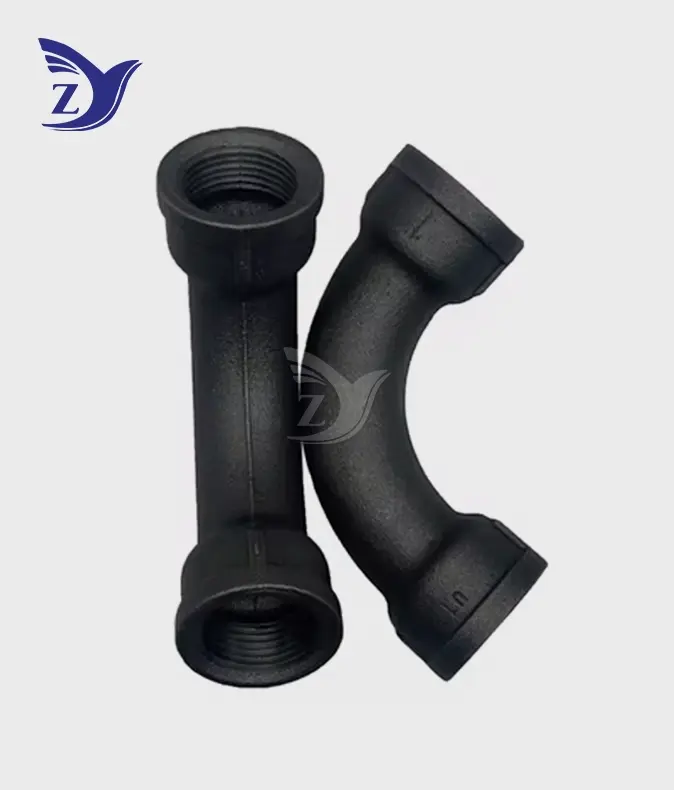
Understanding Malleable Iron Pipe Fittings
Material Properties and Manufacturing Process
Malleable iron pipe fittings start out as white cast iron that has a lot of carbon in it. By using controlled heat in annealing kilns, the carbon structure changes into nodular graphite. This makes the material much more flexible while keeping the strength benefits of cast materials. At Zhiyuan Malleable Steel's factory in Shanxi Province, this change takes place in two Blue Sky HTL-1 type 100-ton natural gas energy-saving annealing kilns. This makes sure that the properties of each batch of material are the same.
The annealing process usually lasts longer than 48 hours and takes place at temperatures between 850°C and 950°C, based on the size of the fitting and the thickness of the wall. This careful heating process makes sure that the parts can take impact loads during installation and service, which is a big plus over regular cast iron that would break in the same situations. The finished product has a tensile strength of more than 50,000 psi and is still flexible enough to bend before breaking. This was confirmed by testing it for crush strength as part of quality control.
Common Fitting Types and Configurations
Threaded fittings can be arranged in many different ways to fit the shape of a pipe system. Elbows can change the flow at different angles, but the most common ones are 90 degrees and 45 degrees. The NPT square face zinc 90° square edge elbow is a common part used to change directions. It has National Pipe Thread (NPT) curved threads that make mechanical seals when tightened with pipe dope or thread tape.
Tees let branch links happen in networks of pipelines. A BSPT square face galvanized square edge straight tee has three connection points that meet the requirements of the British Standard Pipe Thread (BSPT). This means that it can work with systems that are made to meet the metric standards that are popular in foreign markets. Different inlet and exit sizes are built into reducing tees, so you don't need to use separate reduction fittings when you need to change the size of the flow.
Street elbows, which are also known as male-female elbows, have external threads on one end and internal threads on the other. This lets two female-threaded parts connect directly to each other without needing a separate nipple. This design saves area and is especially useful for repair setups that don't have a lot of room. An example is the banded galvanized reducing street elbow with BSPT threads.
Applications and Benefits of Malleable Iron Pipe Fittings
Industrial and Commercial Applications
Fire safety systems use malleable iron pipe fittings the most. Sprinkler networks need parts that can keep their pressure integrity over decades of use while also being able to handle the occasional hit from maintenance work or building settlement. These fittings are strong and flexible, so they are perfect for both wet pipe systems that work at 175 psi working pressure and dry pipe installations that get very pressurized when they are activated.
A lot of galvanized malleable iron pipe fittings are used in potable water distribution networks in municipal infrastructure projects. The zinc coating protects against corrosion in buried applications and extends the service life beyond 50 years if installed correctly. Gas distribution systems benefit from the leak-tight thread engagement and mechanical robustness that prevent catastrophic failures in situations where safety margins allow no compromise.
These fittings are used in HVAC systems for returning chilled water, heating hot water, and steam condensate. The malleable iron pipe fitting keeps its shape even when the temperature changes, and the threaded connections make it possible to make changes in the field without using special welding tools, which is very helpful for tenant improvement projects or system expansions.
Mechanical Strength and Pressure Ratings
Pressure ratings for malleable iron pipe fittings are usually 150 psi for standard-weight parts and 300 psi for extra-heavy ones. These ratings take into account safety factors like pressure surges, thermal expansion, and long-term material degradation. The crystalline structure that forms during annealing spreads stress evenly across fitting walls, stopping the stress concentration points that cause cracks in materials that haven't been treated.
Impact resistance is especially useful during installation. Dropped wrenches, accidental hits from other trades, and transportation handling rarely damage the integrity of fittings. This is in stark contrast to brittle alternatives that break under the same conditions. This durability means less material waste on construction sites and fewer emergency repairs in operational systems.
How to Select the Right Malleable Iron Pipe Fitting for Your Project?
Pressure and Temperature Considerations
The fitting specifications are based on the system design parameters. Engineers have to match the pressure class ratings to the highest expected operating pressures plus the right safety margins. Usually, this is 2:1 for static systems and 3:1 for applications that experience water hammer or pressure cycling. Temperature ratings usually cover -20°F to 400°F for standard malleable iron pipe fittings. For higher temperatures, engineers need to talk about the material properties and how the thread sealant might break down.
When choosing a material, fluid properties are more important than just the basic pressure ratings. For example, corrosive chemicals may need better coatings or different alloys, and thread sealant compatibility is important for petroleum products. Galvanized protection is best for water systems, while black oxide coatings can be used for steam condensate applications to withstand thermal cycling without breaking.
Thread Compatibility and Meeting Standards
Geographical markets determine the thread standard. For example, North American projects usually need NPT threads, while European and Asian markets usually need BSPT or metric ISO 228 parallel threads. When working on mixed-standard projects, it's important to keep track of your inventory carefully to avoid cross-threading incidents that damage parts and cause installations to be late.
Different types of projects and jurisdictions have different certification needs. For example, fire protection systems need UL or FM approval to make sure that fittings meet performance standards for listed assemblies. Municipal water projects may need NSF-61 certification to make sure that materials are safe for contact with potable water and that they don't contain too much lead. Zhiyuan Malleable Steel has both ISO 9001 quality management certification and CE marking for European markets, which speeds up the approval process for international projects.
Conclusion
When it comes to pressurized piping systems, malleable iron pipe fittings are the most reliable because they are strong, don't leak, and last a long time. The annealing process makes impact-resistant parts that can last for decades in fire protection, municipal infrastructure, HVAC, and industrial settings. To make the right choice, you need to match the pressure ratings, thread standards, and coating specifications to the needs of the system and buy from suppliers who have a history of consistent quality, technical skill, and supply chain reliability. To install them correctly, you need to follow best practices for thread engagement, sealant application, and tightening procedures that keep the fittings' integrity throughout the system's lifecycle.
Partner with Zhiyuan Malleable Steel for Reliable Pipe Fitting Solutions
Zhiyuan Malleable Steel brings 18 years of manufacturing expertise to your next project, combining certified quality with responsive service that keeps construction schedules on track. As a leading malleable iron pipe fitting supplier, we maintain inventory depth across NPT and BSPT configurations—from standard 90-degree elbows to specialized reducing tees—with standard products shipping within two hours of order placement. Our ISO 9001-certified facility produces 30,000 tons annually using advanced annealing technology and 156 precision machining centers, ensuring dimensional accuracy and material consistency across every batch. We support custom ODM and OEM requirements, delivering engineered solutions backed by CE, UL, and FM certifications for global market compliance. Contact our technical team at q1236800000@gmail.com or visit zymalleablepipefitting.com to discuss your specific requirements and receive detailed quotations tailored to your project's scope, schedule, and budget parameters.
FAQ
What standards should malleable iron pipe fittings meet for commercial projects?
Malleable iron pipe fittings must comply with ASTM A197 for material specifications and ASME B16.3 for dimensional standards. Fire protection applications require UL listing or FM approval, while potable water systems need NSF-61 certification confirming lead content compliance. ISO 9001 certification demonstrates manufacturing quality management, and ASTM A153 governs galvanizing requirements. European markets demand CE marking under the Pressure Equipment Directive (PED) 2014/68/EU for pressure-bearing components.
How do malleable iron fittings compare with ductile iron in corrosive environments?
When properly coated, both materials repel corrosion about the same amount, but ductile iron is slightly stronger in thick-wall applications. Malleable iron pipe fittings are easier to shape into precise threads with tighter tolerances, which makes threaded connections more reliable. Because malleable iron pipe fittings are cheaper and more common in standard pipe sizes, they are better for most commercial installations. Ductile iron, on the other hand, is used in high-pressure industrial applications that go over 300 psi working pressure.
Can malleable iron fittings handle high-pressure natural gas systems?
Most commercial gas distribution applications work with delivery pressures of 60 psi or less and can use malleable iron pipe fittings rated for 300 psi service pressure. The threaded connections make mechanical seals that are suitable for gaseous media when properly assembled with thread sealants rated for natural gas compatibility. However, pipeline safety regulations say that high-pressure transmission lines exceeding 300 psi must use welded steel fittings.
References
1. American Society for Testing and Materials. (2020). ASTM A197: Standard Specification for Cupola Malleable Iron. West Conshohocken, PA: ASTM International.
2. American Society of Mechanical Engineers. (2021). ASME B16.3: Malleable Iron Threaded Fittings, Classes 150 and 300. New York, NY: ASME Press.
3. British Standards Institution. (2019). BS EN 10242: Threaded Pipe Fittings in Malleable Cast Iron. London, UK: BSI Standards Publication.
4. National Fire Protection Association. (2022). NFPA 13: Standard for the Installation of Sprinkler Systems. Quincy, MA: NFPA Publications.
5. Smith, Robert L. (2018). Piping Systems Manual: Design, Installation, and Troubleshooting. McGraw-Hill Professional Engineering Series, New York.
6. Williams, Howard T. (2021). Materials Science for Mechanical Engineers: Metallurgy and Heat Treatment Processes. Cambridge University Press, Cambridge, UK.
Online Message