
Oct 19, 2026
Threaded or Welded? Choosing a Galvanized 45° Elbow
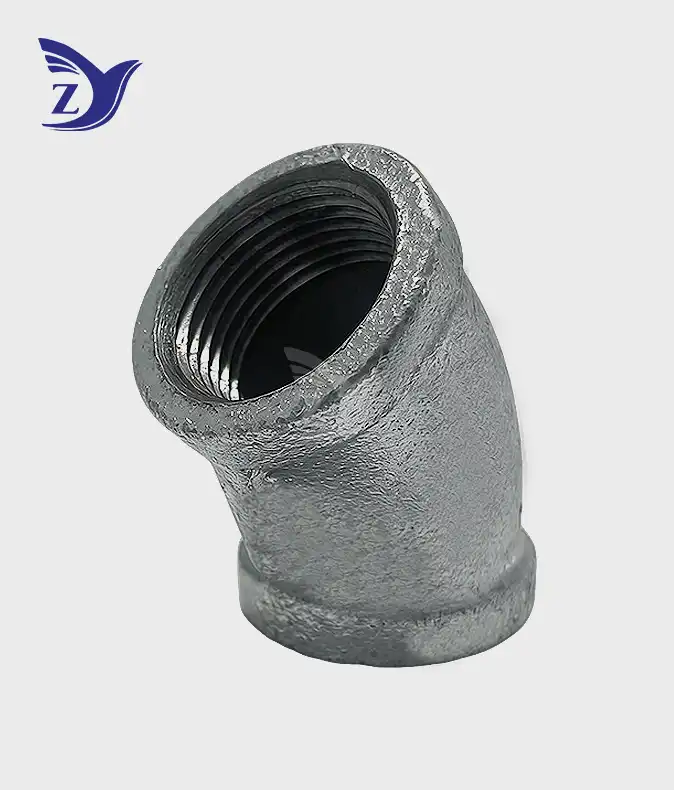
If you are sourcing pipe fittings for industrial water, gas, or oil pipeline systems, the choice between threaded and welded connections is not trivial. A square face galvanized 45° square edge elbow pipe fitting made from malleable iron gives you a 45-degree flow direction change with NPT or BSPT precision threads and a hot-dip galvanized zinc coating rated to ASTM A153 standards. This guide walks through what separates threaded from welded options, how to pick the right fitting for your project, and where to source consistent quality at scale.
Understanding Galvanized 45° Elbow Pipe Fittings
What Makes a 45° Elbow Different
A 45° elbow bends the flow of fluid at a less sharp angle than a 90° bend. Pipe flow engineering data shows that a 45° elbow cuts friction loss along the same length by about 40–50% compared to a 90° elbow. That directly means lower pump energy costs and more stable pressure along long pipeline runs, which is a big plus for water and gas delivery networks in factories.
Material and Coating Standards
The square face galvanized 45° square edge elbow pipe fitting is made from ASTM A197 cupola malleable iron, which has a high tensile strength and enough flexibility to handle being heated up and cooled down in gas and steam lines. Hot-dip galvanizing adds a zinc layer thicker than 85 microns, protecting against oxidation both physically and electrically. This is important for HVAC, fire suppression, and oil field auxiliary lines that are outside all year and are exposed to water.
Square Edge vs. Beaded Edge
The term "square edge" or "banded" refers to the strengthening band at each threaded outlet. The flat rectangular cross-section, as opposed to a rounded beaded shape, makes it easier for pipe tools to grip and adds hoop-stress resistance that keeps the pipe from cracking during high-torque assembly. The fitting fits into any normal Class 150 or Class 300 pipe layout without any changes needed because it meets ASME B16.3 dimensions.
Threaded vs. Welded Galvanized 45° Elbow Fittings: Key Considerations
The conditions of installation, the pressure in the system, and the need for long-term upkeep all play a role in choosing between threaded and soldered connections. Neither choice is always better than the other; each one works better in certain situations.
Where Threaded Fittings Win
When you need a square face galvanized 45° square edge elbow pipe fitting that you can take apart later, threaded NPT/BSPT square edge elbows are the best choice. In commercial HVAC and irrigation systems, maintenance crews often replace single sections without having to cut the pipe. Installation doesn't need a heat source, which is important in gas settings. When combined with PTFE tape or pipe sealant, the tapered NPT thread at 60° and 1°47' machined to ASME B1.20.1 makes a pressure-tight metal-to-metal interference fit that is rated at 300 psi WOG (Water, Oil, Gas) at room temperature for standard Class 150 fittings.
Where Welded Fittings Win
Welded links get rid of the spiral leak path that comes with tapered threads. A welded joint is stronger and doesn't depend as much on the installer's torque technique for high-pressure steam lines above Class 150 ratings or buried pipelines that can't be reached. Welding, on the other hand, burns off the galvanizing layer at the joint, which means that zinc repair is needed after the weld. This extra work and cost of materials is not needed with threaded fittings.
Durability and Maintenance Comparison
Threaded, ductile iron elbows can handle temperatures of up to 350°F (177°C) in Class 150 conditions. This means they can be used for most water, gas, and low-pressure steam needs. Welded steel elbows are stronger than this range, but they need skilled welders and full treatment after the weld. Threaded fittings ship ready to use, cut down on installation time, and lead to a lot fewer complaints from hardware shops, contractors, and installation teams who buy in bulk.
Selecting the Right Fitting for Your Project
Galvanized Malleable Iron vs. Other Materials
Stainless steel elbows are more resistant to rust in chemical or food-grade settings, but they cost a lot more per unit. Plastic parts are cheap, light, and easy to work with, but they break when exposed to heat and UV light in industrial settings outside. Hot-dip galvanized malleable iron is the best of both worlds because it can handle most water, oil, and gas conditions and is priced in a way that protects distributor profits. This is why it is the most popular choice for building and utility pipelines around the world.
Matching Thread Standards to Your Pipeline
An important feature for buying: BSPT threads have an angle of 55°, while NPT threads have an angle of 60°. No matter what sealant you use, mixing the two will damage the threads and cause leaks. Before you place an order for a container, you should always check to see if your downstream customers work with NPT (most common in North America) or BSPT (most common in the UK, Asia, and the Middle East). The NPT/BSPT square-edge 45° galvanized malleable iron elbow line meets both standards, so it's easy to match them as long as you give the right information.
Custom Sizes and Dimensional Compatibility
Most product lines have standard sizes that range from 1/8" to 4", which are big enough to meet most industrial and business pipeline needs. There are ODM and OEM production choices that meet all ASME B16.3 dimensions if a downstream builder wants a non-standard reducing elbow or a certain wall thickness.
Where and How to Buy Galvanized 45° Square Edge Elbow Pipe Fittings
Identifying a Reliable Source Manufacturer
When you deal directly with a factory instead of a middleman, you cut out one or two price points and get direct access to the production schedule. Zhiyuan Malleable Steel was established in 2006 and is based in Taigu District, Shanxi Province. It has ISO 9001, CE, UL, and FM standards and can produce more than 1,000 different types of products every year. That level of scale means that the quality of each batch is the same, which is very important when your customers further down the line rely on uniform thread precision across every pallet.
Pricing Structure and Sample Verification
Reliable factories offer tiered prices for container-load orders (20GP/40HQ), meaning that the cost per unit goes down as the number goes up. Request examples of key specs before you place a full order. A quick copper sulfate (Preece) dip test on sample pieces shows if the zinc coating is uniform. A rough surface, dross inclusions, or color differences show that the hot-dip processing wasn't done properly. As a normal service policy, Zhiyuan repairs broken items, which lowers your risk of having to send them back later.
Logistics and Delivery Planning
Standard items are shipped within two hours of proof of the order, as long as they are in stock. For exports, double-layer cardboard boxes or woven bags that keep out wetness and rust are used. This is done so that the goods don't get damaged on the long sea freight lines to Southeast Asia, the Middle East, Africa, or South America.
Best Practices for Maintaining Galvanized 45° Elbow Fittings
Routine Inspection Schedule
Check threaded joints once a year in damp or outdoor areas. If you see white zinc corrosion (zinc hydroxide deposits) on the threads, it means the galvanized layer is still working but is getting thinner. Base-iron rust can't form if the problem is found early, which means the service life is much longer than the typical 20 years that field studies say galvanized things last.
Corrosion Mitigation in Service
When working with water, you should never connect galvanizing parts directly to metals that are not the same. The zinc anode will break down quickly due to galvanic action. In dry gas lines, quick contact runs are usually okay according to local code, but you should always check the standards first. If you reapply zinc-rich cold spray to a mechanically damaged coating area, the barrier can be fixed without having to be replaced completely.
Addressing Thread Wear
Most of the time, NPT and BSPT threads fail early because they are over-tightened. The square face galvanized 45° square edge elbow pipe fitting is less likely to crack than a beaded shape, but the thread crest will still become deformed if the pressure specification is exceeded. Write down the torque values on the installation sheets you give your customers. This will cut down on complaints and warranty claims from the field across your entire distribution network.
FAQ
Q1: Can I use a threaded galvanized 45° elbow for both water and gas lines?
Class 150 NPT/BSPT square edge elbows can be used for WOG (Water, Oil, and Gas) service at 300 psi and room temperature. To stop the circular leak path, you should always use PTFE tape or pipe sealer on NPT threads.
Q2: What is the difference between square edge and beaded edge on a galvanized elbow?
The square edge (banded) design gives pipe wrenches a flat surface that keeps them from slipping while applying high torque. It also gives the fitting's mouth more radial strength, which makes it less likely to crack than a rounded beaded fitting.
Q3: How do I verify galvanized coating quality before placing a bulk order?
Ask for sample pieces and do a dip test with copper sulfate (Preece). A smooth surface with no sharp zinc spikes and a consistent silver-gray color are signs of good hot-dip processing. Industrial-grade parts must have a zinc layer of at least 85 microns.
Q4: What is the maximum operating temperature for malleable iron galvanized elbows?
Fittings made of malleable iron can usually handle temperatures up to 350°F (177°C). Class 150 pressure rates start to drop above 150°F; always check the manufacturer's derating chart for uses that will be used at high temperatures.
Q5: How do I avoid mixing NPT and BSPT threads in a bulk order?
Make sure you clearly state the thread standard on your buy order and check it with the factory before the order is made. BSPT threads are 55°, while NPT threads are 60°. They can't be switched out, and if you mix them, they will leak.
Request a Quote from Zhiyuan Malleable Steel
Zhiyuan Malleable Steel sells square face galvanized 45° square edge elbow pipe fittings that are approved by ISO 9001, CE, UL, and FM straight from the factory. They have over 1,000 specifications in stock, offer tiered prices for container sales, and guaranty replacement of any defective products. Our team can help you quickly whether you need NPT or BSPT threads or standard or custom sizes. You can email us at q1236800000@gmail.com or go to zymalleablepipefitting.com to get samples or a quote for a large order right now.
Conclusion
Threaded or welded square face galvanized 45° square edge elbow pipe fitting should be chosen based on the working pressure, ease of upkeep, and installation climate. Threaded NPT/BSPT square-edge malleable iron fittings are used in most industrial water, gas, and low-pressure steam applications because they are easy to install, can be taken apart, and keep the full galvanized coating integrity at the joint. Strong pressure or buried systems work best with welded options, but they cost more and take more work. For bulk distributors, threaded fittings provide the best mix of product versatility, shelf life, and customer satisfaction further down the line.
References
- ASME B16.3: Malleable Iron Threaded Fittings, Classes 150 and 300 — American Society of Mechanical Engineers, 2021.
- ASTM A153: Standard Specification for Zinc Coating (Hot-Dip) on Iron and Steel Hardware — ASTM International, 2016.
- ASTM A197: Standard Specification for Cupola Malleable Iron — ASTM International, 2020.
- ASME B1.20.1: Pipe Threads, General Purpose (Inch) — American Society of Mechanical Engineers, 2013.
- Crane Co. Technical Paper 410: Flow of Fluids Through Valves, Fittings, and Pipe — Crane Co., 2013.
- NSF/ANSI 61: Drinking Water System Components — Health Effects — NSF International, 2022.
Online Message