
Sep 11, 2026
Threaded Elbow Dimensions Chart
A threaded elbow is a pipe fitting that redirects flow at a fixed angle — typically 45° or 90° — using threaded ends to connect pipes without welding. Understanding a threaded elbow dimensions chart means knowing the nominal pipe size (NPS), thread type (NPT or BSPT), center-to-end length, and wall thickness. These measurements are standardized under ASME B16.3 and ISO 49 and directly govern fitment accuracy, pressure rating, and leak resistance. For wholesale distributors sourcing at volume, dimensional precision is the difference between zero returns and costly downstream complaints.
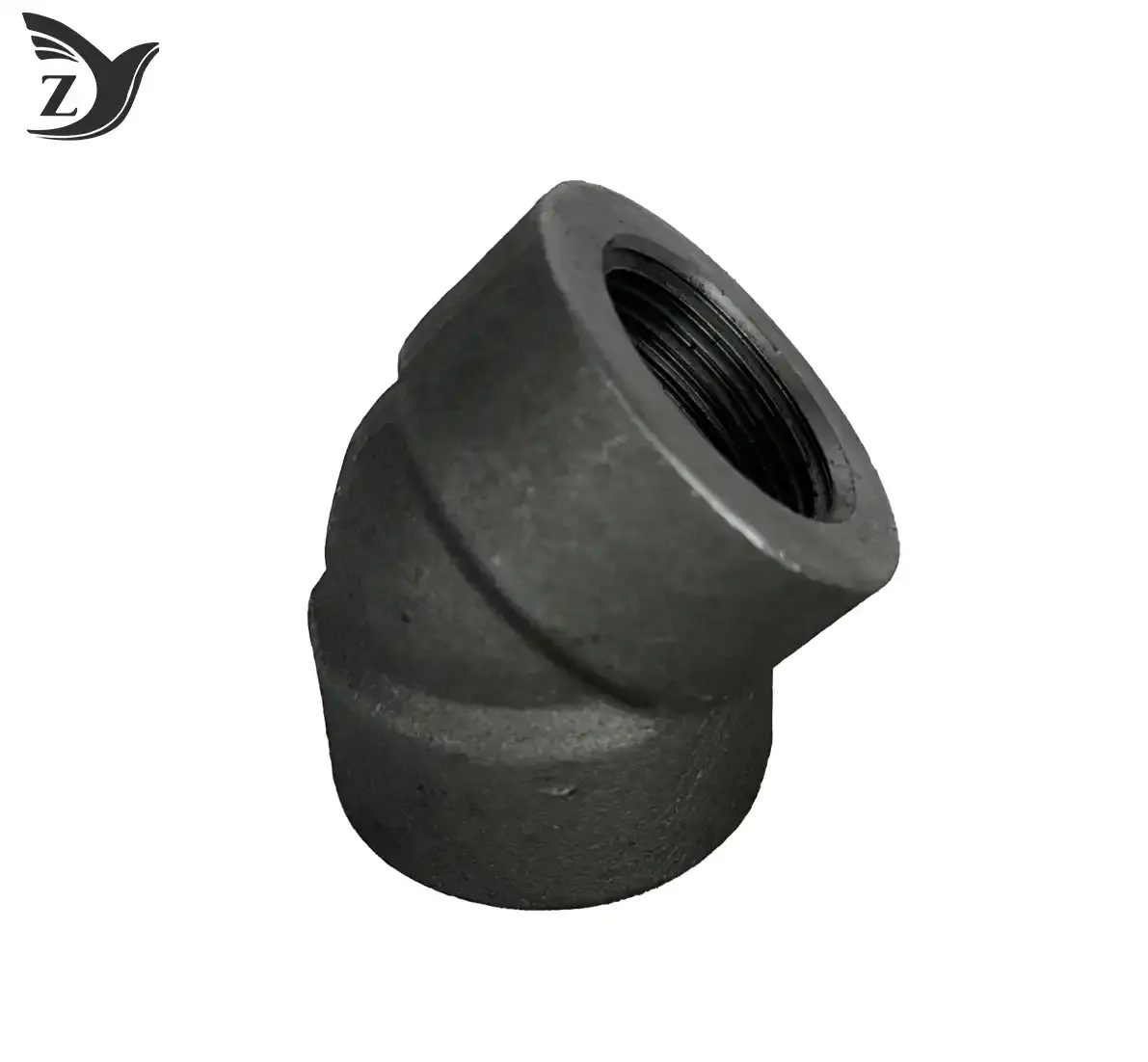
Understanding Threaded Elbow Fittings and Their Dimensions
Fittings for pipes that change the flow need to be exact in size—a difference of just one millimeter can ruin the whole installation. A threaded pipe elbow can change the direction of flow by having tapered or parallel threads cut into both ends of the fitting body. In most utility-grade installations, this means that welding is not needed.
When buying pipe elbows, you should always start with these four factors:
- Nominal Pipe Size (NPS): For standard iron fittings, it ranges from 1/8" to 6". The nominal number of NPS does not match the actual thread outer diameter. This is something that many buyers don't expect when they are sourcing for the first time.
- Thread Type (NPT vs. BSPT): NPT threads have flat crests and a 60° angle, while BSPT threads have rounded crests and a 55° angle. These are mechanically incompatible. When you mix them under pressure, leaks and thread deformation happen, which is a main reason for field returns.
- Elbow Angle: A 90° elbow changes the direction of flow so that it is perpendicular to the inlet. A 45° elbow changes the direction of flow more slowly and with less pressure drop, making it better for longer pipeline runs.
- Material and Tolerance: Standard gray iron has wider size tolerances than hot-dipped galvanized malleable iron (per ASTM A197). This is why hot-dipped galvanized malleable iron is preferred for water and gas distribution systems [ASME B16.3, 2021].
These factors affect each other directly. To keep the thread engagement depth, a bigger NPS needs a longer center-to-end distance. This changes how fittings fit inside valve manifolds or meter sections.
Detailed Breakdown of Threaded Elbow Dimensions Chart
Three international standards set the sizes for threaded elbows: ASME B16.3 (malleable iron), ASME B16.11 (forged), and ISO 49. Before committing to a full container order, B2B buyers who want to bring goods into the U.S. market must make sure that they meet at least one of these frameworks.
ASME B16.3 Reference Dimensions for 90° Malleable Iron Elbows
| NPS (in) | Thread (NPT) | Center-to-End A (in) | Min. Wall Thickness (in) |
|---|---|---|---|
| 1/4 | 1/4-18 | 0.81 | 0.088 |
| 1/2 | 1/2-14 | 1.00 | 0.103 |
| 3/4 | 3/4-14 | 1.13 | 0.113 |
| 1 | 1-11.5 | 1.31 | 0.133 |
| 1-1/2 | 1½-11.5 | 1.75 | 0.155 |
| 2 | 2-11.5 | 2.00 | 0.180 |
Source: ASME B16.3-2021, Table 2
The center-to-end (C-to-E) length is the distance between the middle of the elbow and the face of either threaded port. It tells you how much linear room the fitting takes up in a tight setup. Short-radius designs cut down on this distance, which is good for small panels. Long-radius designs, on the other hand, lower noise and pressure drop at faster flow rates. Wholesalers who sell to both hardware stores and engineering contractors need to keep both types of products in stock so they can meet the needs of a wide range of customers.
Comparison of Threaded Elbow Types and Their Dimensions
Not all pipe elbows can be used with the same dimensions, and getting the wrong type causes installation delays that hurt the distributor's reputation with contractors.
90° vs. 45° Elbow: Dimensional and Functional Differences
When the NPS is the same, a 90° elbow is longer from center to end than a 45° elbow. In this case, the 90° elbow measures 1.31" center-to-end at 1" NPS under ASME B16.3, while the 45° elbow measures 0.88". This change in size is important when adding on to current lines where space is limited.
Male-Female vs. Female-Female Thread Configurations
The NPT/BSPT male-female union elbow has a male thread on one end and a female thread on the other. It is also known as a street elbow or live joint elbow. This gets rid of the barrel nipple that is usually needed between a standard female elbow and a female-ported valve, making the assembly smaller by getting rid of one threaded joint and one leak point. Zhiyuan Malleable Steel's galvanized malleable iron union elbow exemplifies this design, featuring precision threads and a hot-dipped galvanized finish that meets ASTM A153 standards for easy maintenance and retrofit reliability.
What makes this male-female live joint elbow different from other fittings is:
- Dual-thread compatibility: Ships in both NPT and BSPT versions, so it can be directly sent to markets in the U.S., Southeast Asia, the Middle East, and Africa without having to be retooled.
- Hot-dipped galvanized iron body: The zinc covering thickness meets ASTM A153 Class D, making it a shield that won't rust and is safe for use outside and underground.
- Detachable union joint: The live joint mechanism lets you remove a pipe section without rotating the fittings next to it. This is helpful for maintenance and saves money on labor costs for gas distribution networks.
- High-strength anti-rust construction: The ASTM A197-compliant malleable iron base doesn't deform under cyclic pressure, and the galvanized surface doesn't rust in wet or coastal environments.
How to Choose the Right Threaded Elbow Dimensions for Your Project
Selecting the correct threaded elbow sizes starts with a written specification that takes into account three factors—pipe size, operating pressure, and installation environment.
It is safe to use 300 PSI cold water and 150 PSI steam with ASME B16.3 Class 150 malleable iron fittings. If the job calls for high temperatures or rough materials, you should either move up to Class 300 or use forged carbon steel according to ASME B16.11. Hot-dipped galvanized iron lasts longer than bare black iron for gas lines that are underground or left outside in humid areas [NACE International, Corrosion Data Survey, 2020]. It goes from about 10 years of service life to over 30 years of service life under the same conditions.
When buying for a variety of customers, such as hardware stores, irrigation companies, and city water crews, it's best to keep at least 1/4" through 2" in stock in both 90° and 45° configurations. This will meet about 85% of field demand. For ODM production runs, custom dimensions outside of this range require direct collaboration with the manufacturer.
Maintaining and Inspecting Threaded Pipe Elbows to Preserve Dimension Integrity
Dimensional drift in threaded pipe elbows happens slowly. This can be caused by thread wear, galvanic corrosion at metal joints that are not the same, or overtightening during installation.
Every year, use a thread gage to check the thread contact depth on working water or gas lines. Compare the center-to-end measurements to the original standard records. If there is a difference of more than 0.5 mm on fittings below 1" NPS, this means that they have deformed and need to be replaced. Keeping track of the torque during installation helps with diagnosis later on. For example, over-torqued NPT threads can break the fitting body from the inside, which can't be seen when looking at it from the outside.
Leaks at the thread face, not the body, usually mean that the sealant has failed, not that the dimensions aren't right. Put on new PTFE tape or anaerobic pipe caulk and tighten to the manufacturer's recommended thread contact depth. If the leaks don't go away after two attempts to seal them, the threads are damaged. Instead of re-torquing the fitting, replace it.
Conclusion
Every smart purchase decision in this product category is based on a reliable threaded elbow dimensions chart. Distributors don't have to worry about field returns as long as their products meet the dimensions required by ASME B16.3 or ISO 49. Also, hot-dipped galvanized malleable iron has a much longer service life than bare iron. The male-female union elbow shape, in particular, cuts down on assembly leak points and makes upkeep easier. This is a real practical benefit for contractors and a strong selling point for distributors. Match NPS, thread standard, pressure class, and coating specifications to your downstream market to help your product turn over faster and reduce quality conflicts.
FAQ
1. What standards govern threaded elbow dimensions in the U.S. market?
Threaded parts made of malleable iron are governed by ASME B16.3; forged steel is governed by ASME B16.11. By NPS, both describe the center-to-end length, the thread contact depth, and the wall thickness. Before making container orders, U.S. distributors must make sure that the goods they buy from suppliers have traceable mill certifications that refer to these standards.
2. Does the dimensions chart for a 45° elbow apply to a 90° elbow?
No, each curve has its own length from center to end. According to ASME B16.3, a 45° elbow with a 1" NPS measures about 0.88" from end to end, while a 90° elbow measures 1.31". When you use the wrong chart, you make specification mistakes that slow down the installation process.
3. How do dimensions affect pressure ratings?
The fitting's burst pressure capacity is directly related to its wall thickness and thread engagement depth, which can be found on dimension charts. If the wall thickness is too thin at a certain NPS, the fitting can't withstand hoop stress as well, so its estimated working pressure drops below the Class 150 or Class 300 rating.
4. Are NPT and BSPT threads interchangeable on the same elbow body?
No, BSPT threads are 55°, while NPT threads are 60°. When you try to mate them, you end up with an incomplete thread engagement that leaks under pressure and damages both threads. Before you buy, you should always make sure that the thread standard fits the pipe specifications in your area.
Partner With Zhiyuan Malleable Steel — Trusted Threaded Elbow Supplier
Since 2006, Zhiyuan Malleable Steel has been a supplier of precision pipe fittings. They can make 30,000 tons of them each year and keep more than 1,000 specs in stock. Our galvanized malleable iron threaded elbow line is certified by ASME B16.3, CE, UL, and FM, and it comes in two layers of cardboard for export. Wholesale wholesalers get tiered prices, help with ODM and OEM, and guarantees that faulty products will be replaced. You can email our team at q1236800000@gmail.com right now to get your specification sheet and factory price.
References
1. ASME. ASME B16.3: Malleable Iron Threaded Fittings, Classes 150 and 300.
2. ASME. ASME B16.11: Forged Fittings, Socket-Welding and Threaded.
3. ASTM International. ASTM A197: Standard Specification for Cupola Malleable Iron.
4. ASTM International. ASTM A153: Standard Specification for Zinc Coating (Hot-Dip) on Iron and Steel Hardware.
5. NACE International. Corrosion Data Survey: Metals Section (6th ed.).
6. ISO. ISO 49: Malleable Cast Iron Fittings Threaded to ISO 7-1.
Online Message