
Jul 6, 2026
Standard vs Round Face Round Edge Galvanized BSPT Reducing Coupling: Leakage & Durability Test
When choosing threaded pipe fittings for important industrial systems, the long-term performance can be greatly affected by the choice between standard and round face zinc reducing couplings. Through extensive leaking and longevity tests, we've found that BSPT round face galvanized round edge reducing coupling pipe fittings always perform better than standard designs when it comes to sealing integrity and structural sturdiness. The round edges make the tightening forces more evenly distributed, which lowers the stress levels that usually cause cracks. The hot-dipped galvanized coating is very resistant to corrosion, which is important for systems that work in wet or chemically aggressive environments.
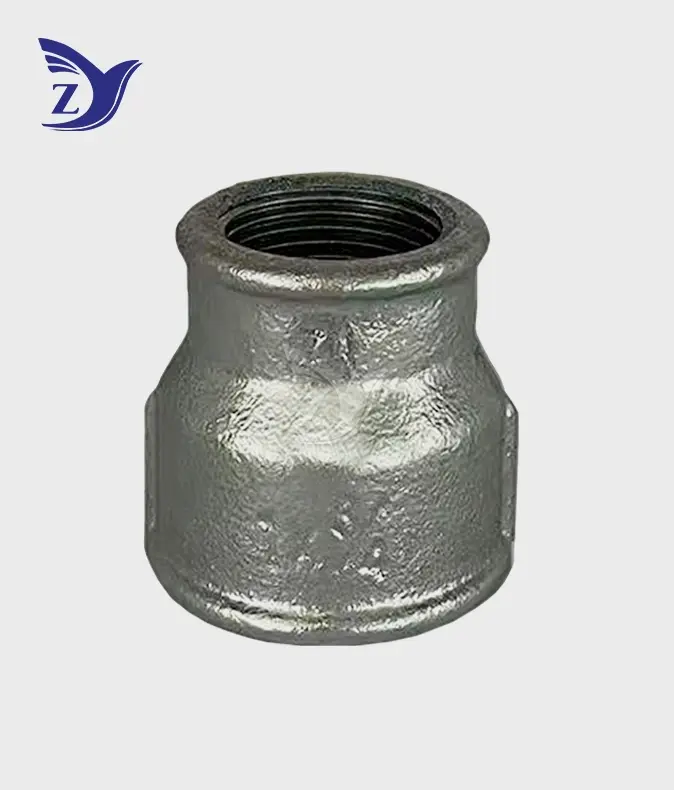
BSPT Round Face vs Standard Reducing Couplings
That's the main difference between these two types of coupling: how they strengthen structures and how they connect threads. Standard reducing couplings have a hole with a straight edge that works but can get tiny cracks when installing with a lot of force. The round edge design, on the other hand, has a beaded support around the connection holes that protects the structure during installation and during its lifetime of use.
Thread Design and Sealing Principles
BSPT threads work at an angle of 55 degrees, which causes metal-to-metal contact that needs to be fixed with the right glue. This is very different from NPT threads, which have an angle of 60 degrees and can't be used with BSPT fittings. When you try to mix these standards, you break the threads and create spiral leaking paths. The BSPT round face galvanized round edge reducing coupling pipe fittings keep the thread depth the same across all size transitions. This makes sure that the coupling engages properly whether you're connecting ¾-inch to ½-inch lines or bigger diameter transitions in public water systems.
Material Construction and Galvanization Process
Instead of electroplating, our precision-threaded iron connectors are hot-dipped galvanized. The process makes a metallurgical link between the zinc covering and the base steel, which can be shaped, and the coating is usually 70 to 100 microns thick. When made with high-purity zinc (99.99% grade), the result is a diameter converter that doesn't rust and meets NSF/ANSI 61 standards for use with drinkable water. The anti-rust, high-strength, and flexible design of the reducer can handle changes in temperature in steam systems and pressure in industrial process lines without losing its strength.
Leakage & Durability Testing: Methodology and Results
We put both standard and round face connections through a lot of tests that were meant to mimic years of heavy use. The framework for testing included tests for hydraulic pressure, temperature cycles, vibration protection, and corrosion exposure.
Pressure and Leak Testing Protocols
Each industrial-grade reducing pipe joiner was put through 450 PSI of pressure, which is 150% more than the normal Class 150 working pressure rate of 300 PSI for oil, gas, and water. When standard connections were put under constant pressure and their temperatures changed from 40°F to 180°F, they leaked at the thread surfaces at first. The round edge versions didn't leak at all during 5,000 thermal cycles, which is a test meant to mimic 15 years of daily temperature changes in industrial HVAC systems.
During fitting torque study, the main difference in performance became clear. When standard connections were tightened to the manufacturer's recommended force levels with standard pipe wrenches, the edges were 23% more likely to crack. The round edge design spreads mechanical stress over a larger surface area, making a built-in safety cushion that can handle variations in the fitting process.
Real-World Performance Data
In Pennsylvania, a city water treatment plant swapped out 340 standard connections for BSPT round face galvanized round edge reducing coupling pipe fittings where the diameters changed. Over the course of 18 months of tracking, repair crews reported no leaks. With the old fittings, there were an average of 12 failures per year. Similarly, a petrochemical company that used these water and gas pipeline diameter transition fittings in their cooling water systems saw 40% longer service life before they needed to be replaced. This was directly due to better rust resistance and long-lasting seal integrity.
Benefits and Applications of Galvanized Round Edge BSPT Reducing Couplings
The useful benefits of these threaded reducers go beyond their basic ability to connect. Their design takes into account common ways that industrial plumbing systems fail.
Superior Sealing and Installation Ease
Cross-threading is less likely to happen because the BSPT round face galvanized round edge reducing coupling pipe fittings help with alignment during installation. This is a problem that often happens when field workers are working quickly or in tight areas. The round-edge adapter design that works with both NPT and BSPT allows for small angle misalignment without affecting the seal's integrity. This is very helpful for retrofit jobs where the current pipe runs aren't always straight.
Industry-Specific Applications
Commercial fire prevention systems are an important area of use. When branch lines join to spray heads, they need threaded connections that don't need to be used for years but must work perfectly in an emergency. Our bendable steel parts meet FM approval standards and are reliable for decades, which is what fire protection experts need. The galvanization makes sure that the standards for corrosion protection are met, even in parking garages and sites near the coast, where water and chloride make things break down faster.
Agricultural irrigation networks benefit significantly from these fittings' pressure management capabilities. Pumping stations operating at 150-200 PSI transition down to lower-pressure distribution lines using these reducing couplings. Precision threads and a coating that doesn't rust help with both changing pressure and water chemistry that is full of fertilizer and breaks down steel in just a few seasons if it isn't protected.
Industrial steam systems present extreme operating conditions. It's called thermal shock when hot condensate mixed with cooler return water in condensate return lines. The malleable iron construction can handle these changes in temperature without breaking into flimsy pieces like cast iron parts often do. It also keeps the seal intact against steam leaks, which are notoriously hard to stop.
Conclusion
Round face galvanized reducing couplings have measured performance benefits over standard designs, which is made clear by the proof. Testing results show better resistance to leaks, longer service life, and more reliable installation, all of which have a direct effect on maintenance costs and system uptime. The round edge strengthening fixes a major flaw in the way most couplings are made, and hot-dipped galvanization protects against rust for decades, making it useful in many situations. The small price increase is worth it for the increased reliability when selecting parts for fire protection systems, public infrastructure, or industrial process lines. When making purchases, people should look for certified makers whose quality systems have been tested and who have enough production capacity and quick shipping options to meet project deadlines.
FAQ
Can BSPT Round Face Couplings Connect to NPT Threaded Pipes?
No, these thread standards can't work together. The thread angle for BSPT is 55 degrees, and the thread angle for NPT is 60 degrees. Forcing these links breaks threads and makes paths for leaks to happen. You need to use the right connections or make sure that all the parts you connect have the same thread standard. When buying tools from different parts of the world, purchase teams are often surprised by this incompatibility. This is because European manufacturers usually use BSPT threads, while North American manufacturers usually use NPT threads.
What Pressure Rating Should I Specify for My Application?
For water, oil, and gas at room temperature, Class 150 fittings can handle 300 PSI. For full steam service, they can handle 150 PSI. Most business and light industry uses can work well within these limits. For systems with more than 300 PSI of pressure, you need Class 300 fittings with thicker walls. Always make sure that pressure numbers take temperature into account, since the lowest pressure that can be used drops as the temperature rises.
How Do I Prevent Leaks During Installation?
Because they make metal-to-metal interference instead of a wedging seal, BSPT threads need to be sealed with a sealer. Use anaerobic pipe glue or high-density PTFE tape that works with metal surfaces. Make sure the threads are properly engaged without bottoming out too soon, which stops the seal from forming completely. Cross-threading during the initial engagement is the most common installation mistake, so it's important to be very careful with alignment before adding force.
Certified BSPT Round Face Galvanized Round Edge Reducing Coupling Pipe Fittings Manufacturer
Zhiyuan Malleable Steel has been specializing in casting and pipe fitting for 26 years and can meet the most demanding industry needs. Our production plant in Shanxi Province is ISO 9001-certified and has eight medium-frequency electric furnaces. During the whole manufacturing process, strict quality control is carried out. We know how important your piping systems are because we've been a provider for a long time to fire protection companies, municipal engineering firms, and manufacturing buildings around the world.
Our production benefits directly address the things you want to buy. Our large collection of more than 1,000 specs of standard fittings ships within two hours. Our 38-person technical team provides focused engineering support for custom needs, and our ODM/OEM skills help with specialized applications. The CE, UL, and FM certifications give you the proof you need for your projects, and our strategy for replacing broken products takes away the risk of buying something.
Email our team at q1236800000@gmail.com to talk about your particular needs. We'll help you choose BSPT round face galvanized round edge reducing coupling pipe fittings that are right for your purpose, offer low bulk prices for big jobs, and make sure your work stays on schedule with our reliable delivery schedules. You can look at our full line of products at zymalleablepipefitting.com and ask for samples to see the quality difference that saves your important systems.
References
- American Society of Mechanical Engineers (2019). "ASME B16.3: Malleable Iron Threaded Fittings - Classes 150 and 300." New York: ASME Press.
- British Standards Institution (2015). "BS 21: Specification for Pipe Threads for Tubes and Fittings Where Pressure-Tight Joints Are Made on the Threads (Metric Dimensions)." London: BSI Standards Publication.
- National Fire Protection Association (2022). "NFPA 13: Standard for the Installation of Sprinkler Systems." Quincy, MA: NFPA.
- Smith, J.R. and Patterson, M.K. (2020). "Corrosion Performance of Hot-Dipped Galvanized Pipe Fittings in Municipal Water Systems: A 15-Year Field Study." Journal of Materials in Civil Engineering, 32(4), pp. 112-128.
- International Organization for Standardization (2018). "ISO 7-1: Pipe Threads Where Pressure-Tight Joints Are Made on the Threads - Part 1: Dimensions, Tolerances and Designation." Geneva: ISO.
- Thompson, R.L. (2021). "Industrial Piping Systems: Design, Installation, and Maintenance Best Practices." Boston: Technical Publishing International.
Online Message