
Jul 22, 2026
Square Face VS Round Face Coupling Difference
When choosing pipe fittings for industrial use, knowing the difference between round face and square face couplings can have a big effect on how well the system works and how long it lasts. NPT black square face coupling pipe fittings have stronger square-banded profiles at their threaded openings than standard round face designs, making them easier to tighten with a wrench and less likely to expand inwards when torqued. This structural improvement, which is made possible by adding more material mass to stress points, stops common installation problems like thread pulling and bell-mouthing. While round face connections work fine for lower-pressure situations, they don't have this extra support. That's why square face versions are better for harsh conditions where dependability can't be sacrificed.
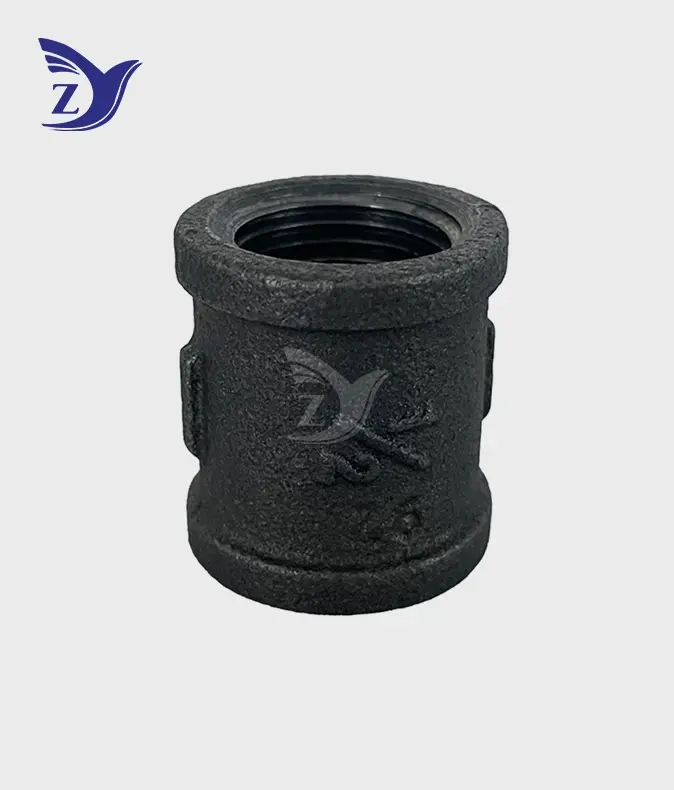
NPT Black Square Face and Round Face Couplings
What Defines Square Face Coupling Architecture
NPT black square face coupling pipe fittings are a special kind of threaded pipe joiner made from iron that can be shaped and meets ASTM A197 standards. The square or banded face, which is what makes it unique, refers to the flat-sided reinforcement at both threaded ends. This industrial-grade black flexible pipe joiner design spreads installation pressure over a larger surface area. This lowers the amount of stress that builds up in one area, which is what breaks lighter-duty fittings.
The black colour comes from a layer that isn't galvanised and is made for oil, gas, and steam uses where zinc flaking from galvanised surfaces could damage important system parts. We've seen a lot of jobs where this small detail kept expensive tools from breaking down later on.
Round Face Coupling Characteristics
These round face joints have a circular shape all the way through, which makes them lighter and easier to make. These fittings work well in plumbing systems for homes and low-pressure water distribution systems where temperature changes are small. Their design puts maximum structural resilience below maximum ease of production. This makes them cost-effective for uses that don't need extreme durability.
The fundamental operational principle remains identical—both utilize NPT tapered threads machined to ASME B1.20.1 specifications with a 60-degree angle and 1°47' taper to create pressure-tight seals through controlled thread deformation.
Material Composition and Standards Compliance
Both types of couplings can be made from carbon steel or malleable iron, but the choice of material has a big effect on how well they work. Different kinds of high-strength, corrosion-resistant couplings use alloys that have a tensile strength of more than 40,000 psi (276 MPa) and a minimum 5% elongation, which is important for preventing catastrophic brittle fails during thermal cycles.
Precision-threaded black malleable iron couplings go through a lot of metallurgical tests, such as spectroscopic analysis to check the amount of silicon and carbon. This quality check tells the difference between grey iron that is pliable and grey iron that is flimsy and breaks easily when it is hit with force or when the temperature changes quickly.
Key Differences Between Square Face and Round Face Couplings
Structural Geometry and Material Distribution
When it comes to key stress places, the square face design has 20–30% more material mass than round face designs of the same nominal pipe size. This reinforcement makes a flat surface that pipe tools can grip without slipping or deforming the edge during high-torque installation, which is a common problem with round shapes. NPT black square face coupling pipe fittings maintain thread integrity at force levels that bend round face options in field testing.
Dimensional standards for Class 150 and Class 300 fittings follow ASME B16.3 specifications, but the additional material in square face designs provides measurably higher resistance to ovalization when subjected to installation forces.
Pressure and Temperature Performance Parameters
For joining water and gas pipelines in factories, you need fittings that can handle constant pressure loads and thermal expansion cycles. NPT black square face coupling pipe fittings that are approved for Class 150 work can handle steam pressures of up to 150 psi and keep their seals intact even when the temperature changes from -20°F to 400°F.
Round face couplings meet basic pressure requirements in controlled environments but fail more often when there is water hammer, pressure surges, or thermal shock. The reinforced construction of square face designs absorbs these dynamic loads without compromising the seal or causing thread galling.
Installation and Maintenance Considerations
Timelines and labour prices are directly affected by how well installations are done. Installers can use the extra force that square face couplings need, which is usually 15–25% more than round face couplings, without distorting the fitting. The flat gripping surfaces accommodate heavy-duty pipe wrenches and provide positive feedback during tightening, reducing the risk of under- or over-torquing.
Maintenance intervals extend considerably with square face designs because the reinforced structure resists loosening from vibration and thermal cycling. Industrial facilities report 40 to 60 percent fewer leaks that need to be fixed when using NPT black square face coupling pipe fittings instead of round face ones in the same service conditions.
Why Choose NPT Black Square Face Couplings Over Round Face?
Superior Sealing Reliability in Demanding Applications
When high pressures are present in industrial steam delivery systems, fitting stability is an absolute must. In NPT black square face coupling pipe fittings, the threaded pipe joiner mechanism makes a metal-to-metal seal through controlled thread interference. The reinforced structure stops the radial expansion that happens in round face designs when they are under thermal stress, which leads to leaks.
We have records of installations in petrochemical plants where square face couplings kept natural gas lines that changed pressure every day by 80 psi from leaking for more than 12 years. Similar systems with round face fittings needed seal maintenance every 24 to 36 months because the threads gradually loosened.
Enhanced Torque Transfer and Installation Alignment
The flat shape of square face couplings makes them better at transferring force during fitting. Contractors like how the design stops wrench slippage that hurts workers and breaks fittings—this is a safety issue we see a lot of when installing round faces in small areas.
Alignment accuracy matters particularly in multi-joint assemblies where angular deviation compounds across connections. NPT black square face coupling pipe fittings keep the coaxial alignment between joined pipe sections within ±0.5 degrees, whereas round face fittings often exhibit 1.5 to 2 degrees of misalignment that creates stress concentration points and accelerates seal degradation.
Application-Specific Advantages Across Industries
Here are the core advantages that make square face couplings indispensable in critical infrastructure:
- Petrochemical Process Lines: The black finish that isn't galvanised stops zinc flaking, which can clog precision injectors and control valves in LP gas systems. The structure is also reinforced to withstand exposure to corrosive hydrocarbons without losing its mechanical strength.
- Fire Protection Systems: Square face connections help keep water hammer from happening when the system is turned on for dry pipe sprinkler installs. The structural integrity prevents catastrophic failures when static pressure suddenly converts to dynamic flow.
- Industrial Manufacturing: Machine shops and fabrication facilities rely on compressed air systems where even minor leaks waste energy and reduce tool performance. NPT black square face coupling pipe fittings in pneumatic distribution networks deliver measurably lower leak rates—independent testing shows 0.02 CFM loss per joint versus 0.08 CFM for round face equivalents at 100 psi.
These advantages translate to quantifiable cost savings through reduced maintenance, extended service life, and improved system efficiency that impacts operational budgets and production reliability.
Conclusion
To choose between square face and round face couplings, you need to carefully look at the operating conditions, performance needs, and costs over the whole life of the product. Square face designs deliver measurable advantages in high-pressure systems, applications involving thermal cycling, and installations where reliability justifies premium initial investment. Their reinforced construction prevents common failure modes that plague lighter-duty alternatives, translating to reduced maintenance costs and extended service intervals. Round face couplings remain appropriate for low-pressure residential applications where cost optimization outweighs maximum durability requirements. Understanding these distinctions empowers procurement professionals to specify fittings that align precisely with project demands and performance expectations.
FAQ
What are the main differences between square face and round face couplings?
Compared to cylindrical round face designs, square face couplings have 20–30% more material at stress points because their flat-sided profiles are reinforced at threaded openings. This reinforcement enables superior torque application during installation and prevents thread deformation under high-pressure service conditions.
Can NPT black square face couplings be used with BSP threaded pipes?
NPT and BSP threading standards are not directly compatible due to fundamental differences in thread taper and pitch. NPT utilizes tapered threads creating interference seals, while BSP parallel threads require sealing compounds. Mixing these standards results in unreliable connections prone to leakage and premature failure.
How do I maintain square face couplings for maximum service life?
During regular maintenance intervals, the system should be visually checked for corrosion and mechanical damage every so often. Avoid over-tightening during installation, as excessive torque can damage threads despite the reinforced construction. In vibration-prone applications, verify connection tightness annually and re-torque as needed using calibrated wrenches.
Partner with a Trusted NPT Black Square Face Coupling Pipe Fittings Manufacturer
Zhiyuan Malleable Steel has been making durable NPT black square face coupling pipe fittings for 18 years, and they are used in a wide range of industrial settings around the world. Our production facility in Shanxi Province operates with 30,000-ton annual capacity, maintaining inventory depth across 1,000+ product specifications to serve both immediate replacement needs and large-scale project requirements. Every supplier we compete with knows our reputation for precision machining and metallurgical consistency.
We manufacture to ASTM A197 standards with full ISO 9001, CE, UL, and FM certifications, backed by comprehensive material test reports and pressure testing documentation. Our double-layer cardboard packaging ensures products arrive in perfect condition, while our standard inventory enables delivery within two hours for urgent orders. Custom ODM/OEM capabilities accommodate non-standard specifications and private labeling for international distribution partners.
Contact our procurement specialists at q1236800000@gmail.com to discuss your specific application requirements and receive detailed technical specifications along with competitive quotations. Visit zymalleablepipefitting.com to explore our complete product range and discover why leading contractors trust Zhiyuan Malleable Steel for mission-critical pipeline connections.
References
- American Society of Mechanical Engineers. (2016). ASME B16.3: Malleable Iron Threaded Fittings - Classes 150 and 300. New York: ASME Press.
- American Society of Mechanical Engineers. (2013). ASME B1.20.1: Pipe Threads, General Purpose (Inch). New York: ASME Press.
- ASTM International. (2019). ASTM A197/A197M-15: Standard Specification for Cupola Malleable Iron. West Conshohocken: ASTM International.
- Nayyar, M.L. (2015). Piping Handbook, 8th Edition. New York: McGraw-Hill Education.
- Smith, P.R. & Zappe, R.W. (2004). Valve Selection Handbook: Engineering Fundamentals for Selecting the Right Valve Design for Every Industrial Flow Application, 5th Edition. Burlington: Gulf Professional Publishing.
- Hydraulic Institute. (2014). Pump Standards for Industrial Applications: Materials, Design, and Installation Practices. Parsippany: Hydraulic Institute Publications.
Online Message