
Sep 10, 2026
Pipe Coupling vs Union: What's the Difference?
When sourcing pipe fittings at scale, choosing the wrong connector type can cost your downstream customers — and your margin. A pipe coupling creates a permanent or semi-permanent joint between two pipe ends, while a union fitting provides a fully detachable threaded connection that allows disassembly without cutting the pipe. Both serve critical roles in water, gas, and industrial pipeline systems. Understanding which product belongs in which application helps procurement professionals stock the right inventory, reduce returns, and protect profit margins on every container order.
Understanding Pipe Couplings and Union Fittings
What Is a Pipe Coupling?
There is a small sleeve called a pipe coupling that can permanently or temporarily connect two pipes with the same or different sizes. You can get couplings in full, half, and reducing sizes. They are made of carbon steel, brass, CPVC, and malleable iron. Carbon steel couplings rated to ASTM A197 are still the most popular choice for commercial plumbing and HVAC installations because they are strong enough to pull apart and can be welded together. Once placed, a standard coupling usually needs to be cut out in order to be removed. This means that they aren't good for situations where regular repair access is needed.
What Is a Union Fitting?
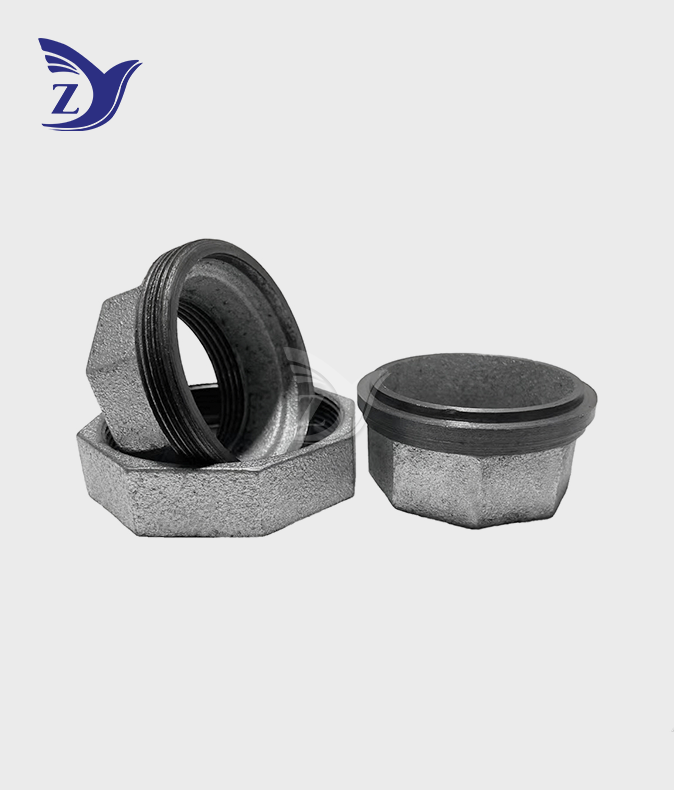
A union fitting is made up of three parts: two threaded end pieces, a nut in the middle, and a clamp that holds the joint together without turning the pipe. Because of how it's built, the union is an industrial-grade, replaceable pipe joint. To break the joint, all you have to do is open one nut. One useful example is the NPT/BSPT 330 galvanized malleable union from Zhiyuan Malleable Steel. It is hot-dipped galvanized and has precision-threaded NPT or BSPT ends. It works well in water and gas pipeline systems and doesn't rust. It can also be serviced in the field.
Technical Comparison: Pipe Coupling vs Union Fitting
Pressure Ratings and Material Performance
Threaded fittings made of malleable iron that meet ASME B16.3 standards have a Class 150 rating, which means they can handle pressures of up to 300 psi at room temperature. Hot-dip galvanized coatings, which must be applied at a thickness of at least 45 µm according to ISO 1461, keep metals from rusting in damp places. Stainless steel union fittings work better in media that are harsh on chemicals, while brass unions are better for systems that handle potable water. When you choose by material first and then by pressure class, you avoid costly mistakes that lead to warranty claims later on.
Installation and Maintenance Considerations
Threaded unions are clearly better in systems that need a lot of maintenance. When it comes to procurement, these are the main operational differences that matter:
- Pipe coupling — threaded type: Use pipe dope or PTFE tape to attach to both ends of the pipe. The joint can hold weight right away, but it can't be taken apart without a pipe wrench, which could damage the threads. Perfect for fixed risers, underground lines, and high-vibration service where you don't want the joints to move.
- Union fitting — 330 malleable iron type: The two end connections on the 330 type union fitting thread onto each pipe separately. Then, the central nut makes a metal-to-metal seal between the male and female seats. Because the pipe doesn't have to be rotated to take it apart, it's the best removable pipe joiner for pump rooms, boiler connections, and meter bypasses.
- Threaded vs. socket-weld couplings: Socket-weld versions offer better pressure stability in the DN15–DN50 bands, but they need people who know how to weld in the field. Threaded connections only need hand tools to install, which cuts the cost of work by about 40–60% per joint in retrofit jobs.
These differences affect the mix of your goods in a direct way. Wholesalers who work with plumbers should keep both types on hand, since one job site might need couplings in the walls and unions at every appliance connection that can be used.
How to Choose Between Pipe Coupling and Union Fitting?
The choice is based on four factors: permanence, entry regularity, pressure class, and fluid media. Permanently buried or hidden lines are better for couplings, while lines that are visible near equipment are better for unions. Unions are required by gas distribution systems in many areas because they make it safe to disconnect appliances for service.
Cost-effectiveness is also important. A malleable iron coupler usually costs 20–35% less per unit than a similar union. However, because the union fitting can be taken apart, it avoids costly service calls where a worker has to cut and rethread pipe. In high-maintenance settings, unions often offer lower total purchase cost over the course of a system's lifecycle. Before making an order for a container, make sure that it has ISO 9001 certification, CE or UL marks, and NPT/BSPT thread compliance. This will keep you from having to deal with quality issues at the target port.
Procurement Insights: Sourcing Quality Fittings at Scale
When you buy directly from a specialized maker, you avoid the markups that come from distributors and get factory-direct prices, which are often the best way to increase your sales margin. For markets with brand-conscious buyers, it's important to find providers that can support OEM/ODM labeling and have verifiable standards like ISO 9001, CE, UL, and FM.
Established in 2006, Zhiyuan Malleable Steel has a 50,000 m² factory in Shanxi Province that makes more than 1,000 different types of malleable iron pipe fittings every year. The corrosion-resistant 330 pipe union is an example of their high-strength, anti-rust, malleable iron body with a hot-dipped galvanized finish and precision NPT/BSPT threads made on 156 specialized CNC units. Standard items are shipped within two hours of confirmation of the order, and broken items are replaced right away. Woven bags or wooden boxes that don't absorb water are used for export packing. These keep the galvanized surface safe during long ocean trips to Southeast Asia, the Middle East, Africa, and the Americas. You can see the full collection and different price levels at zymalleablepipefitting.com.
Troubleshooting & Maintenance Best Practices
More often than not, leaks at threaded connections are caused by either joints that aren't torqued enough or assemblies that are threaded on both sides. Two or three wraps of PTFE tape clockwise on male NPT threads and then torquing to the manufacturer's standard (usually 25 to 35 ft-lb for 1-inch malleable iron) stops most field failures that happen. When the joint in a union fitting breaks, check the metal seat faces for scoring. A damaged seat turns into a leak path right away.
Every three months in coastal or chemically-adjacent areas and every six months indoors, maintenance teams should set up a schedule for visual inspections. If the zinc coating loses more than 30% of its surface area, there are signs that it needs to be replaced right away. These include visible pitting on the thread flanks or a union nut that doesn't seat flush. Unplanned downtime, which costs a lot more than the fitting itself, can be avoided by replacing it before it breaks.
Conclusion
Different issues can be fixed with pipe connections and union fittings. Couplings make a strong, low-cost permanent joint, while unions make a serviceable, detachable connection that saves time and money over the life of any system that can be maintained. When you buy in bulk, making sure that the right fitting type is used for each job cuts down on returns and improves your reputation with installers and contractors. Getting precision-threaded, hot-dipped galvanized iron parts from a company that is ISO 9001-certified makes sure that the quality of every container is the same.
FAQ
1. Can a union fitting handle high-pressure gas lines?
Yes, as long as the fitting has the right material grade and pressure rating. Gas service can use Class 150 malleable iron unions that are rated to ASME B16.3 and can handle up to 300 psi at room temperature. Before specifying for gas applications, always check the fitting's pressure-temperature rating table and make sure that the thread standard (NPT or BSPT) meets the local code requirements.
2. What material works best in corrosive or outdoor environments?
When the zinc coating meets ISO 1461 thickness standards, hot-dipped galvanized malleable iron works reliably in water and gas pipeline systems that are outside. Stainless steel joints are better at resisting corrosion in chemical environments or near the coast, where salt water is common. Because it complies with drinking water rules, brass is still the best material for systems that handle potable water.
3. How do I size a union or coupling correctly?
The outside width of your pipe should match the official pipe size (NPS) of the fitting. Then, make sure the thread standard is correct. A 1-inch NPT union fits onto a 1-inch NPT pipe. The official size does not match the outside width. Using a thread gauge to check the pitch before placing a large order keeps a full container shipping from having costly mismatches.
Get Factory-Direct Pricing on Malleable Iron Union Fittings — Zhiyuan Malleable Steel
Zhiyuan Malleable Steel sends ISO 9001, CE, UL, and FM-approved malleable iron pipe fittings to wholesalers and distributors all over the world straight from our production base in Shanxi. We are a reliable union fitting manufacturer with over 1,000 SKUs and an annual capacity of 30,000 tons. We offer tiered pricing, OEM/ODM support, and basic stock dispatch within two hours. To get a catalog and price quote right away, email our team at q1236800000@gmail.com.
References
1. Nayyar, M. L. (2000). Piping Handbook (7th ed.). McGraw-Hill. Chapter 6: Pipe Fittings and their Applications.
2. American Society of Mechanical Engineers. (2017). ASME B16.3: Malleable Iron Threaded Fittings, Classes 150 and 300.
3. International Organization for Standardization. (2009). ISO 1461: Hot-dip galvanized coatings on Fabricated Iron and Steel Articles.
5. American National Standards Institute / Manufacturers Standardization Society.
6. American Society of Mechanical Engineers. (2018). ASME B1.20.1: Pipe Threads, General Purpose, Inch.
Online Message