
Sep 22, 2026
NPT Tee Fittings vs Other Threaded Pipe Fittings: What’s the Difference?
When you're sourcing pipe fittings for a plumbing or gas pipeline project, the choice between fitting types can directly affect whether your system passes inspection — or fails under pressure. NPT round face galvanized round edge straight tee pipe fittings stand apart from other threaded options because they combine a tapered thread seal, hot-dip galvanized corrosion protection, and a round-edge bead that reinforces the outlet against wrench stress. This guide breaks down what makes NPT tee fittings unique, how they compare to alternatives, and what procurement teams should prioritize when sourcing industrial-grade malleable iron tees.
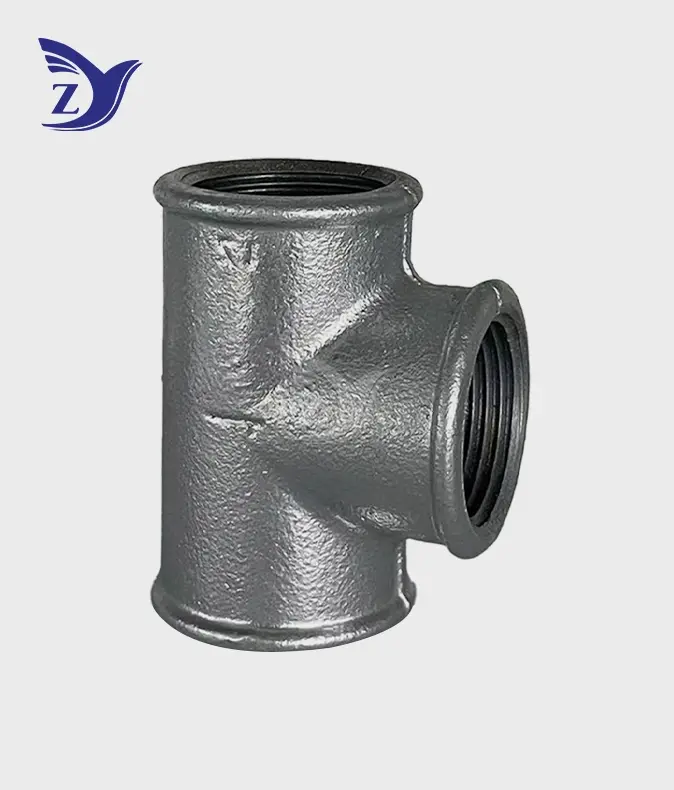
Understanding NPT Tee Fittings and Their Unique Features
NPT threads have a 60-degree thread angle and a 0.75 in/ft taper, which is in line with ASME B1.20.1. When the threads compress against each other during assembly, that taper makes a pressure-tight seal. This is a mechanical benefit that straight-thread systems can't match without extra O-ring or gasket parts.
Material Composition and Structural Design
The iron body is malleable and has a minimum tensile strength of 40,000 psi (≈276 MPa), which means that these fittings can bend when they are hit. Gray cast iron is very brittle, but malleable iron can bend a little before it breaks. This is very important in systems that are subject to water hammer or temperature cycles. The round-edged bead at each outlet spreads the hoop's stress out evenly, which makes it less likely to crack during high-torque installation.
Hot-Dip Galvanized Protection
The hot-dip zinc finish that meets ASTM A153 gives a zinc layer that is thicker than 86 microns. This thickness gives real cathodic protection—the zinc corrodes before the base iron does. This means that these fittings will last for decades in places with a lot of moisture or that are outside. Electroplated coatings, on the other hand, are much thinner and only protect along the edges; they don't work after being scratched.
Because it has precise cutting and long-lasting galvanization, this fitting is the standard in the U.S. market for distributing water and gas in factories.
Comparison of NPT Tee Fittings with Other Threaded Pipe Fittings
The setting needs to be different for each job. Knowing the pros and cons of each type of material helps buying managers avoid having to make expensive changes in the middle of a project. What makes the best threaded tees different in the things that really matter on the job site?
- NPT Round Face Galvanized Malleable Iron Tee: has a hot-dip zinc covering that makes it more resistant to rust. It can handle 300 psi WOG (Water, Oil, and Gas) and 150 psi saturated steam, according to Class 150 ASME B16.3. When paired with an approved sealant, the round-edge geometry strengthens thread outlets against stress caused by a wrench. The NPT taper threads make a self-sealing mechanical joint that meets U.S. gas code requirements.
- NPT Square Face Galvanized Tee: is made from the same ASTM A197 malleable iron and is galvanized to ASTM A153. It has a flat, wider gripping surface that some users like using with bigger pipe tools. It works the same under Class 150 ratings, but NPT round face galvanized round edge straight tee pipe fittings are more popular in older U.S. plumbing systems. Black Malleable Iron Tee: is standard for distributing natural gas in the U.S. This is because many gas companies don't allow galvanized fittings below ground because they are afraid that zinc will flake off in some types of dirt. The pressure ratings for black iron tees are the same, but they need extra protective coatings in places above ground that are wet.
- Stainless Steel Threaded Tee: is better at resisting chemical corrosion and high temperatures, but it costs a lot more to make. Ideal for chemical process lines or food-grade uses where zinc pollution is not allowed.
- PVC Threaded Tee: is a cheap way to connect low-pressure cold water lines, but the pressure ratings drop sharply above 73°F, and PVC isn't good for gas service or fire suppression systems that need to be resistant to impact.
When a gas contractor in the U.S. has to go through a third-party inspection, these differences are important—the wrong fitting type can lead to a full segment replacement. What you should choose varies on your medium, pressure class, and the surroundings you'll be exposed to. A hot-dipped galvanized, precision-threaded, malleable iron tee will always be the most cost-effective long-term option for most industrial water and gas delivery networks.
Installation and Maintenance of NPT Galvanized Round Face Tee Fittings
A system that leaks on day one is different from one that passes hydraulic testing because of how it was installed.
Step-by-Step Installation Protocol
A wire brush can be used to get rid of any burrs or chips in the pipe threads. Use PTFE tape (two to three wraps, clockwise) or a pipe dope solution that is rated for the medium. For example, gas lines need a sealant that is specifically approved for gas service. Once the fitting is snug, tighten it by hand and then use a pipe wrench to move it forward two or three turns. Do not over-torque, as this can break the fitting body or bend the threads.
Maintenance and Inspection Practices
Check galvanized fittings once a year in setups that are visible or underground. The presence of white zinc oxide layers on the surface is normal and shows that the coating is covering the iron. If you see red rust, it means the zinc layer has been broken. You should replace the fitting right away, before the base corrodes through. On the metal surface, you should never use wire brushes or rough cleaning products. A damp cloth with clean water is all you need for regular washing. A weak acid flush can get rid of scale buildup inside water lines, but the whole system has to be shut down first.
Procurement Considerations for B2B Buyers
For small and medium-sized plumbing or gas installation businesses, buying fittings has a direct effect on the project margin. If a supplier sends the wrong thread standard, like BSPT instead of NPT, the whole job can be held up while new stock is found.
When evaluating an NPT round face galvanized round edge straight tee pipe fittings supplier, these are the verification checkpoints worth building into your qualification process:
- Thread gauging compliance: Make sure that the fittings pass the Go/No-Go ring gage tests according to ASME B1.20.1. If you ask, a good maker will give you records of their gage inspections.
- Hydrostatic test sampling: ask for proof of random-batch pressure testing at 1.5 times the rated working pressure to make sure the casting is dense and doesn't have any holes in it.
- Galvanization layer thickness: data from a magnetic thickness gauge should show that the zinc covering is more than 86 microns all over, even inside thread valleys.
- Axis alignment tolerance: The three outlets of any equal tee must be straight within 0.5 degrees; if they aren't, stress risers are created that cause fatigue cracking to happen too soon.
- Full size range availability: If a seller keeps 1/8" through 6" in stock, you won't have to handle multiple vendors for the same project's bill of materials.
- Certification credentials: Listings for ISO 9001, CE, UL, or FM quality control systems show that they have been checked by independent experts.
These checks protect your project from leak callbacks and failed inspections, which are the two most expensive things that can happen when buying threaded fittings.
Application Scenarios and Performance Insights
Industrial-grade equal pipe tees are used in a lot of different types of important structures and get a lot of tough use. The zinc coating keeps rust from building up and clogging sprinkler heads in municipal fire suppression systems. The round-edge bead absorbs the sudden pressure spikes (called "water hammer events") that fire lines cause when they are activated. Outdoor watering and open industrial lines both depend on the same corrosion resistance to work better in wet settings than bare iron.
Another high-value use is distributing compressed air. The exact NPT taper makes an airtight seal that is necessary for pneumatic efficiency, and the malleability of iron absorbs waves from the compressor that would break more brittle cast iron options over time.
As an example, a 3/4" NPT/BSPT round-edge equal galvanized malleable tee rated Class 150, which is one of Zhiyuan's standard items, has been chosen for municipal water distribution projects in several U.S. states because it meets both ASME B16.3 dimensional requirements and local utility corrosion protection requirements in a single off-the-shelf product.
Conclusion
When it comes to the pressure rating, corrosion resistance, and installation dependability that industrial water and gas projects need, NPT round face galvanized round edge straight tee pipe fittings—especially hot-dipped galvanized malleable iron round-edge straight tees—perform better than other threaded fitting types. Black iron is used for gas lines in places where zinc can't go. Stainless can handle chemical contact. Low-pressure cold water is covered in PVC. But in the U.S. market, a precision-threaded, hot-dip galvanized, high-strength malleable iron tee is still the best choice for most plumbing and gas distribution jobs because it passes inspection and stays in service.
FAQ
1. What thread sealant should I use with NPT tee fittings?
To seal the spiral leaking path that tapered threads have, standard NPT threads need PTFE tape or pipe dope. Unlike NPTF (Dryseal) threads, NPT threads don't seal metal to metal under pressure on their own. To follow the rules in your area, only use sealants that are specifically rated for gas service on gas lines.
2. Are galvanized malleable iron tees approved for natural gas service?
Many places in the U.S. allow galvanized fittings for gas pipes that are above ground, but some utilities don't let them be used below ground because of how zinc reacts with some types of soil. Before putting galvanized fittings on buried gas lines, you should always check with your local gas company. For distributing gas underground, black iron tees that can be shaped are usually used.
3. How do I distinguish hot-dip galvanization from electroplating?
When metal is hot-dip galvanized, the finish is thicker, slightly matte, and uneven. Electroplating makes something look thin, bright, and regular. Hot-dip galvanizing according to ASTM A153 is the standard for industrial fittings. The zinc layer must be thicker than 86 microns to really protect against cathodic damage.
4. Can NPT round face tees handle Schedule 80 pipe pressures?
Schedule 40 system pressures can be used with Class 150 flexible valves. Due to the high pressure of Schedule 80 uses, Class 300 fittings must be used to match the pipe's pressure capacity.
Partner with Zhiyuan Malleable Steel for Certified NPT Tee Fittings
Since 2006, Zhiyuan Malleable Steel has been making pipe parts out of malleable iron. They can make 30,000 tons of them every year and have over 1,000 different types of products ranging from 1/8" to 6". You should be able to find another company that makes NPT round face galvanized round edge straight tee pipe fittings that can match our ISO 9001, CE, UL, and FM certifications, as well as our two-hour dispatch on standard stock. You can email our purchasing team at q1236800000@gmail.com right now to get samples, prices, or an ODM consultation.
References
1. American Society of Mechanical Engineers. ASME B16.3: Malleable Iron Threaded Fittings, Classes 150 and 300. ASME, 2021.
2. American Society of Mechanical Engineers. ASME B1.20.1: Pipe Threads, General Purpose (Inch). ASME, 2013.
3. ASTM International. ASTM A197: Standard Specification for Cupola Malleable Iron. ASTM, 2020.
4. ASTM International. ASTM A153: Standard Specification for Zinc Coating (Hot-Dip) on Iron and Steel Hardware. ASTM, 2016.
5. Nayyar, Mohinder L. Piping Handbook, 7th ed. McGraw-Hill, 2000.
6. Frankel, Michael. Facility Piping Systems Handbook, 3rd ed. McGraw-Hill, 2010.
Online Message