
Jul 4, 2026
Matching Galvanized BSPT Round Face Reducing Coupling to Different Pipe Diameters
To match pipe systems with different sizes, you need precision-engineered parts that make links that are safe and don't leak. BSPT round face galvanized round edge reducing coupling pipe fittings are great for connecting pipes of different sizes while keeping their structure strong and protecting them from rust. These threaded reducers are important industrial pipe links in water, gas, and steam systems. They solve problems with changing the diameter of pipes in petrochemical, fire protection, HVAC, and public services. Their hot-dipped galvanized finish protects against rust for a long time, making them reliable choices for harsh settings where system failure has big effects. This guide gives procurement workers, engineers, and dealers useful information on how to choose, install, and take care of these important parts.
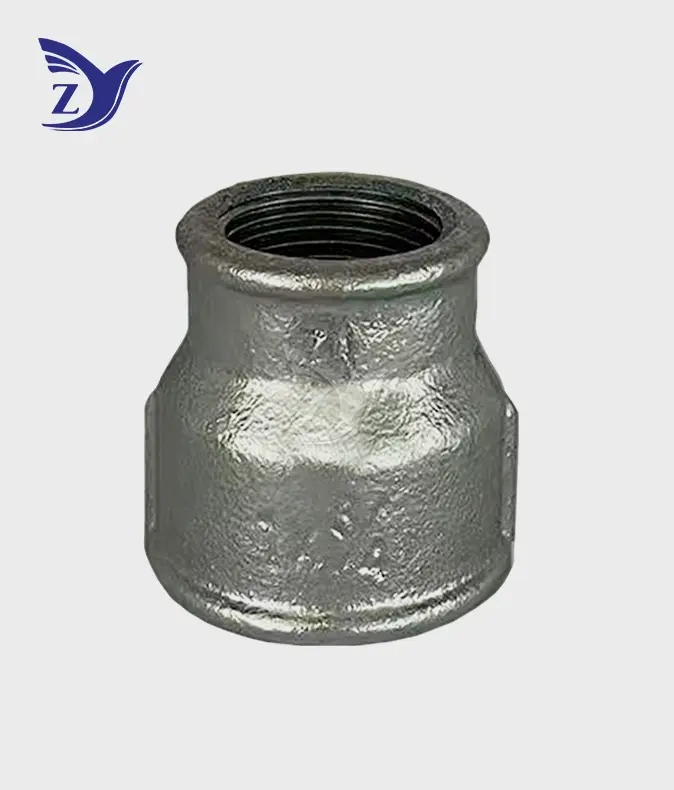
Key Considerations for Matching Couplings to Pipe Diameters
To make diameter changes work, you need to pay close attention to thread compatibility, dimensional tolerances, and working factors that affect how well the change will last.
Thread Dimension Compatibility
The sizes of BSPT round face galvanized round edge reducing coupling pipe fittings are based on standard bore sizes, which range from 1/8" to 6". Each size has its own unique pitch and diameter requirements. The taper shape needs very accurate production tolerances. To make sure the thread axis is aligned correctly, ISO 7-2 calibrated plug gauges are used to check the alignment. Installation leaks are the most common type of failure in threaded systems, and they are caused by bad threads. When going from one size to another, the reducing coupling's internal taper needs to be able to fit both lengths of the pipes that are attached to it without limiting flow or causing pressure to drop.
Face Type and Sealing Performance
Round face reducing connections are different from hexagonal face designs in how they are installed and how they strengthen the structure. A constant circle band spreads torque loads evenly, while a hexagonal pattern puts most of the stress at the corners. In high-pressure steam condensate return lines, where thermal expansion causes repetitive loads, this is very important. The round edge design also lets the piece be rotated during installation without having to be in a certain position. This speeds up field assembly in pipe setups with limited access.
Material Selection Impact
For most water, air, and low-pressure gas uses, galvanized malleable iron is a cost-effective choice. The zinc coating stops rust from the air and protects against cathodic breakdown in metal structures that are not the same. But places that are very acidic or basic may need stainless steel options. The galvanization makes the fitting about 140 microns bigger on the outside, which installation planners need to take into account when there isn't much room. Magnetic induction measurement is used by good makers to make sure that the coating thickness is the same on all areas, which provides even protection.
Step-by-Step Guide to Selecting the Right BSPT Round Face Reducing Coupling
Systematic review stops problems with compatibility and makes sure that the system works at its best for as long as it is installed.
Accurate Diameter Identification
First, use precise calipers to measure the outside diameter and wall thickness of the current pipe. If the BSPT round face galvanized round edge reducing coupling pipe fittings' names you see refer to the nominal bore instead of the real measurements, check them against public thread tables. A 1" nominal pipe has an outside diameter of 33.25 mm and a specific thread pitch of 11 threads per inch. The reducing coupling needs to be able to fit both the larger inlet diameter and the smaller outlet diameter with the right thread engagement depth, which is usually between 6 and 8 full threads for a secure connection. Write down both dimensions before you order so that you don't have to make changes in the field.
Operating Condition Assessment
Check the maximum working pressure, temperature range, and fluid properties. Standard galvanized reducers can handle up to 25 bar at room temperature, but their capacity drops below 120°C. Corrosive fluids with chlorides or sulfates speed up the breakdown of zinc coatings, which may mean that you need to use better materials. Vibration from pumps or machinery requires more thread sealant than just PTFE tape. For long pipe runs, figure out the thermal expansion coefficients, as differential movement can put too much stress on threaded joints beyond their design limits.
Certification Verification
You should ask for proof that the product meets the relevant standards. For example, ISO 9001 certification shows that the product is managed in a systematic way, and CE marking shows that it meets European standards. UL and FM approvals are especially important for fire protection applications where regulations require specific product listings. You should also ask for hydrostatic test reports that confirm the product's resistance to pressure at 20+ bar and metallurgical certifications that confirm the composition of the base material. To ensure quality, you should ask for dimensional reports that show thread gauge readings and coating thickness measurements across production batches.
Supplier Evaluation Criteria
Long-term supply reliability and access to technical support depend on the partner you choose. Manufacturers that have been around for a long time and have a history of casting show process stability through consistent dimensional accuracy. Shanxi Taigu Zhiyuan Malleable Steel is a good example of this approach. They have been specializing in pipe fittings for 26 years and operate 8 sets of medium frequency electric furnaces and 156 processing equipment units. Their 30,000-ton annual capacity supports volume orders while maintaining quality through strict inspection protocols. Before finalizing supplier relationships, look at lead times, inventory depth for standard sizes, and how quickly they respond to technical questions.
Procurement Insights: How to Buy BSPT Round Face Galvanized Reducing Couplings
Strategic buying finds a mix between lowering costs, making sure quality, and making sure the supply chain is resilient.
Bulk Purchasing Advantages
To get price cuts of 15–30% compared to small-lot purchases and to make sure that inventory is available for project schedules, negotiate annual blanket orders with scheduled releases that match construction phases. This will lower warehousing costs and maintain supply security. Be clear about the packaging requirements—double-layer cardboard protection stops shipping damage and makes job site distribution easier. Manufacturers with large production capacities, like Zhiyuan's 30,000-ton annual production, can handle large orders without affecting delivery schedules because their integrated casting, galvanizing, and machining operations get rid of the need for subcontractors.
Pricing Factor Analysis
Zinc and iron ore prices affect the prices of BSPT round face galvanized round edge reducing coupling pipe fittings, which are then affected by certification costs that add 8–12% to base costs but are necessary for regulated applications. Brand reputation commands higher prices, which are justified by consistent quality and technical support—an investment that protects against failures in the field that cause project delays. Geographic factors affect the total landed cost; domestic manufacturers may be able to offset higher labor rates by lower shipping costs and tariff avoidance. Ask for itemized quotes that separate material, processing, certification, and logistics costs to find ways to negotiate.
Customization and OEM Capabilities
For non-standard uses, manufacturers need to offer engineering collaboration and prototype development. Unique project requirements can't be met by standard catalogs, so manufacturers need to be able to offer custom thread configurations, specialized coatings, or dimensional changes. OEM partnerships are good for distributors and equipment manufacturers who want to add pipe fittings to their own systems. Look at the minimum order quantities for custom work, which are usually 500 to 1000 pieces depending on how complicated it is, and the lead times for prototypes, which are usually 3 to 4 weeks. Intellectual property agreements protect proprietary designs while making sure that manufacturing is consistent across production runs.
Conclusion
To match galvanized BSPT round face reducing couplings to different pipe diameters, you need to know about thread specifications, material properties, and the needs of your specific application. These corrosion-proof diameter converters work reliably as long as they are chosen based on dimensional compatibility, operating conditions, and quality certifications. Correct installation techniques and regular maintenance keep them in good shape and avoid costly failures. Strategic procurement practices lower the total cost of ownership by buying in bulk, checking out suppliers, and being able to make changes. By following the technical information and practical advice in this resource, procurement professionals and engineers can confidently specify high-strength anti-rust malleable reducers that keep systems intact in a wide range of industrial settings.
FAQ
What distinguishes round face from hexagonal reducing couplings?
When installing, round face designs have continuous circular reinforcement bands that spread torque loads evenly, while hexagonal patterns concentrate stress at six corner points. The curved profile increases hoop strength by 15-20%, making round edge fittings more resistant to expansion forces in high-pressure or thermally cycling systems. Installation is also different; round faces let you position the wrench at any angle, while hexagonal types need to be installed in a certain way for the wrench to engage. Both types seal well when properly installed, but round faces are better for demanding situations.
Can galvanized BSPT couplings withstand corrosive environments?
Hot-dip galvanization is a great way to protect metals from rust, water, and many industrial chemicals. If the zinc coating is more than 70 microns thick, it corrodes before it reaches the base iron, which greatly extends the service life. However, environments below pH 4 or above pH 12 are very acidic or basic can speed up zinc dissolution, which might mean stainless steel is needed instead. Regular checks to make sure the coating is still intact allow replacement before corrosion weakens the structure.
How do I verify product certifications and quality standards?
Ask for documentation packages that include ISO 9001 quality management certificates, material test reports confirming the grade of the malleable iron, hydrostatic pressure test results, and measurements of the thickness of the coating. CE, UL, and FM certifications show that the product meets regional safety standards. Dimensional inspection reports with thread gauge readings prove that the product was manufactured accurately. Reliable suppliers link purchased fittings to specific quality control data to show batch traceability. For important applications, independent third-party testing provides extra proof.
Partner with Zhiyuan Malleable Steel for Certified BSPT Reducing Couplings
If you need a reliable supplier for premium BSPT round face galvanized round edge reducing coupling pipe fittings, Zhiyuan Malleable Steel has been in business for 26 years and has a wide range of products that are made using integrated casting, galvanizing, and machining processes that are certified by ISO 9001, CE, UL, and FM. We can ship standard inventory items within two hours, and our 30,000-ton annual capacity means that we can handle large orders without sacrificing quality. We also offer full ODM/OEM customization services to meet the needs of each project, from non-standard thread configurations to specialized coatings. Our double-layer cardboard packaging makes sure that products arrive in perfect condition, and we guarantee that any defective products will be replaced.
You can email our technical team at q1236800000@gmail.com to talk about your specific diameter transition needs, get detailed specifications, or set up an evaluation sample. You can also visit zymalleablepipefitting.com to see our full selection of water and gas pipeline diameter transition fittings for fire protection, HVAC, municipal utilities, and industrial uses. Zhiyuan is a trusted partner for distributors, contractors, and engineering firms around the world because of our quality assurance and on-time delivery.
References
- British Standards Institution. (2019). BS 21: Specification for Pipe Threads for Tubes and Fittings Where Pressure-Tight Joints Are Made on the Threads. London: BSI Standards Publication.
- ASTM International. (2020). ASTM A153/A153M-20: Standard Specification for Zinc Coating (Hot-Dip) on Iron and Steel Hardware. West Conshohocken, PA: ASTM International.
- International Organization for Standardization. (2018). ISO 5922: Malleable Cast Iron - Technical Delivery Conditions. Geneva: ISO Central Secretariat.
- European Committee for Standardization. (2017). EN 10242: Threaded Pipe Fittings in Malleable Cast Iron. Brussels: CEN Management Centre.
- Johnson, R. & Williams, P. (2021). Industrial Piping Systems: Design, Installation, and Maintenance Practices for Threaded Connections. New York: Engineering Publishing House.
- National Fire Protection Association. (2022). NFPA 13: Standard for the Installation of Sprinkler Systems - Pipe and Fitting Requirements. Quincy, MA: NFPA Publications.
Online Message