
Aug 11, 2026
Installation and Application Guidance for Male Female 90° Long Radius Elbows
When we talk about efficient fluid direction changes in industrial piping systems, galvanized male female 90° long radius elbow pipe fittings stand out as a specialized hydraulic component that solves spatial and flow management challenges. These street elbows, featuring NPT or BSPT precision threading, combine male and female ends to enable direct equipment connections without intermediate nipples. The long radius design—where the curvature measures approximately 1.5 times the nominal pipe diameter—minimizes pressure drops and turbulence compared to standard elbows. Hot-dip galvanization adds a protective zinc layer that acts as a sacrificial barrier against oxidation, making these fittings particularly valuable in humid, outdoor, or chemically aggressive industrial environments where corrosion poses constant operational risks.
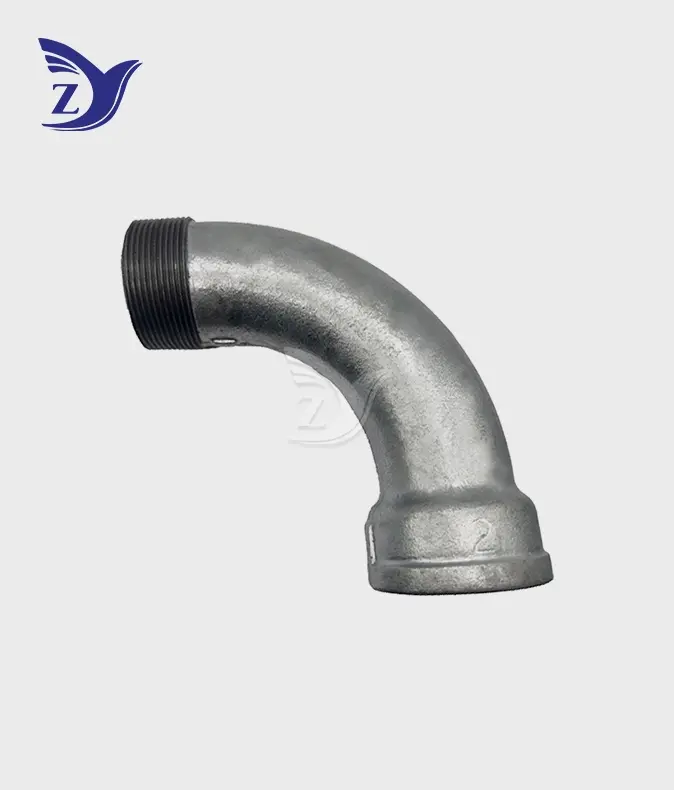
Comparison of Galvanized Male Female Long Radius Elbows With Alternatives
Long Radius Versus Short Radius Performance
When choosing a radius type, you have to weigh the limitations of fitting room against the benefits of hydraulic efficiency. Because they take up about 25% less linear space, short radius elbows are good for equipment rooms that are already crowded or retrofit projects that don't have a lot of room. But because they are more compact, they have higher friction coefficients—usually between 0.6 and 0.9 for short radius variants and between 0.3 and 0.5 for long radius variants.
When the speed is more than 8 feet per second, the flow efficiency edge becomes important from a business point of view. Because there are fewer pressure leaks, the machine will need less energy to pump over its entire life. Long radius fittings could save a city water distribution project with 200 elbows 15 to 20 percent of its yearly pumping costs. The small extra cost would be paid for in two years.
Galvanized Malleable Iron Versus Stainless Steel
The choice of material varies a lot on the chemistry of the fluid and its exposure to the surroundings. Grades of stainless steel like 304 and 316 are better at resisting corrosion in acidic or chloride-rich environments. This is why they are used for sites near the coast or in chemical processes. Hot-dip galvanizing on malleable iron, on the other hand, makes it a very good value for money when it comes to neutral pH water services, natural gas distribution, and compressed air systems.
The difference in price is usually between 3:1 and 5:1, with stainless steel being more expensive. Additionally, malleable iron is better at withstanding impacts at room temperature, which is a big plus in situations where fittings could get mechanical shocks from water hammer or accidental touch during maintenance. When iron is properly annealed and malleable, it stops the catastrophic brittle fracture modes that happen with gray cast iron.
Threaded Connections Versus Welded or Grooved Systems
Threaded joints with male and female ends give you more fitting options than welded systems. For field modifications, only pipe wrenches and thread sealant are needed as hand tools. This means that certified welders, hot work permits, and fire watch staff are not needed. This makes them very easy to get to, which cuts down on the cost of installation labor and speeds up repairs in places that are already running and where downtime costs a lot of money.
Grooved mechanical connections are easier to put together than threaded ones, but they have more parts and could leak. The galvanized male female 90° long radius elbow pipe fittings combines connection points, which makes the system simpler and lowers the amount of material that needs to be kept. Maintenance teams like how clear threaded joints are. If there is poor contact or cross-threading before pressurization, it is easy to see.
Installation and Application Guidance for Male Female 90° Long Radius Elbows
Step-by-Step Installation Best Practices
Checking the threads is the first step in a proper installation. Using the right L1 and L2 gauges that check for ANSI B1.20.1 compliance, check both the male and female threads for damage, debris, or manufacturing flaws. Wire brushes can be used to clean threads well and get rid of any protecting oils, galvanizing leftovers, or contamination that could weaken the seal.
Follow the manufacturer's instructions for applying thread sealer. This is usually two to three wraps of PTFE tape in the direction of thread rotation or a thin bead of anaerobic pipe sealant, making sure to skip the first two threads to keep the system clean. Tighten the link by hand until you feel a hard resistance. Then, carefully use a wrench to apply torque. If you over-torque, the threads could get galled or the fitting could become distorted. If you under-torque, the joints could leak when the pressure changes.
Verification of alignment is necessary for the system to last a long time. The 90° angle should keep the perpendicularity within a range of ±0.5° to avoid pipe stress that leads to early joint failure or damage to the support structure. For important installations where misalignment could cause problems, use precise angle gauges or optical comparators to make sure they are working right.
Industrial Application Scenarios
These fittings are used in a variety of industries with different performance needs. Knowing the specific needs of the application helps procurement professionals choose the right material grades and pressure ratings.
Industrial HVAC and Boiler Systems: galvanized male female 90° long radius elbow pipe fittings are commonly used on condensate return lines because they save room and allow direct equipment port connections. The long radius design stops steam hammer, which is a damaging effect that happens when condensate slugs speed through pipe bends, making shock waves that can break joints or hurt heat exchangers. The smooth flow path stops erosion caused by fast condensate that is full of oxygen and carbon dioxide that are dissolved in water.
Petrochemical Processing Facilities: Coastal facilities have to deal with harsh corrosion from salty air, fuel exposure, and changes in temperature. The galvanized layer protects the structure in places where painted steel would break quickly. NPT tapered seals can handle vibrations from moving parts and heat expansion cycles without releasing fugitive emissions, which is helpful for meeting regulations in places where volatile organic compound tracking is done.
Agricultural Irrigation Networks: Long radius shape makes the flow sweep more gentle in slurry transport systems that carry water that is full of silt. Standard elbows create turbulence zones where particles settle and build up, ultimately blocking flow and needing regular maintenance. The smooth path keeps particles in suspension, which lowers the frequency of buildup. Galvanization can handle the unique rusting problems that come up when soil is constantly wet and chemicals from fertilizer are exposed.
Maintenance Protocols for Extended Service Life
The frequency of proactive inspections depends on the working conditions, but they usually fall between three and twelve months in environments that aren't harmful and a month in environments that are. A visual inspection focuses on the zinc coating's integrity. Look for white rust (zinc oxide formation, which is fine), red rust (base metal exposure, which needs attention), or coating delamination, which means the coating has failed too soon.
When systems go through thermal cycling, threaded connections can become loose over time, so they may need to be retightened from time to time. Write down the baseline torque values during installation so that you have a point of reference for future maintenance checks. Pressure testing at 1.5 times working pressure finds leaks before they become operational problems. This lets repairs be planned ahead of time instead of having to be done quickly.
Thread damage that can be seen, seepage that won't go away even after retightening, or changes in size that point to internal erosion or rust are all signs that the thread needs to be replaced. Modern ultrasonic thickness gauges let you check the remaining wall thickness in suspect parts without damaging them. This lets you make repair decisions based on data instead of guesses about how long something will last.
Procurement Strategies for Galvanized 90° Long Radius Elbow Fittings
Supplier Evaluation and Quality Verification
To find qualified manufacturers, you need to look at more than just price quotes as a sign of their credibility. Getting ISO 9001 certification shows that you handle quality in a planned way, but approval by itself doesn't mean that the product is great. Ask for proof that the base material meets ASTM A197 standards, the threads meet ANSI B1.20.1 standards, and the galvanizing meets ASTM A153 standards. Suppliers with a good reputation will gladly give you mill test results and third-party inspection certificates.
Before placing big orders, it's important to test samples first. When you do a physical review, you should use standardized tools to measure the threads, check the dimensions of the 90° angle and radius, and use magnetic gauges to test the thickness of the coating. When tested hydrostatically at 1.5 times the standard pressure, casting porosity or mechanical flaws that can't be seen with the naked eye are revealed. Sample validation saves money by avoiding expensive fails in the field and project delays caused by materials that aren't up to par.
Bulk Ordering Economics and Lead Time Management
Through economies of scale in manufacturing and transportation, buying in bulk can save you a lot of money. Tier pricing is what most suppliers do. Prices drop at 500, 1000, and 5000 pieces. But the costs of keeping inventory and the space needed for storage must be taken into account when figuring out the total cost of ownership. Work with providers that offer vendor-managed inventory programs for customers who buy a lot. These programs let you reduce the amount of money you need to spend on capital while still making sure you have enough materials on hand.
Lead times are very different depending on how complicated the specifications are and how much can be made. Standard NPT sizes in popular pressure classes ship from stock within 2 to 5 business days, as long as the maker keeps a good supply on hand. For custom specs that need unique tools or materials that aren't common, the first production runs may take 6 to 8 weeks. Once the tools are made, the replenishment rounds get shorter. Building ties with providers who keep warehouses in the United States lowers the risk of delays in foreign shipping during lead times.
OEM Customization Capabilities
Non-standard applications often demand modified specifications beyond catalog offerings. Companies that are good at what they do offer engineering help for custom radius sizes, different coating systems, threading types (BSPT for international markets), or pressure ratings higher than standard classes. Usually, the customization process starts with technical drawings that show the most important measurements, material needs, and quality standards.
Custom work usually has a minimum order quantity of 500 to 1000 pieces, which is based on the economics of tooling amortization. Prototype runs let you test things out before committing to full production. This lowers the risk in situations where performance needs go beyond what is currently possible. Communication that is clear about limits for dimensions, testing criteria, and acceptance standards helps avoid disagreements and makes sure that the products provided meet the needs of the application.
Trusted Brands and Manufacturers of Galvanized Male Female 90° Long Radius Elbow Pipe Fittings
Zhiyuan Malleable Steel: Quality and Reliability
Shanxi Taigu Zhiyuan Malleable Steel Co., Ltd. has been specializing in casting study and galvanized male female 90° long radius elbow pipe fittings production since 2006. With almost 20 years of industrial experience, they have gained a lot of knowledge. With its location in Taigu District and easy access to transportation, the plant can produce up to 30,000 tons of more than 1,000 different types of products every year. This size allows for quick delivery and a wide range of sizes that smaller manufacturers rarely can match.
The company follows strict ISO 9001 quality management rules, and work is divided between four specialized workshops. Eight medium-frequency electric ovens make sure that the melting process is always controlled, and two natural gas heating kilns make sure that the right heat treatment is used to develop the metal's properties. Protecting the environment is still very important to the business. To cut down on pollution, electric heating galvanize furnaces are being used instead of standard fuel-fired systems. There are 156 processing equipment units in the machining area. These allow for precise thread cutting and dimensional control, which are needed for setups that don't leak.
The quality inspection methods used at Zhiyuan are the best in the business. Calibrated L1 and L2 ring and plug gauges are used for thread verification to make sure they meet the requirements of ANSI B1.20.1. Stand-off distance measurements are also used to make sure the engagement geometry is correct. Optical comparators are used for axis alignment checking to make sure that the 90° angle is within a range of ±0.5°. This stops the pipe stress problems that happen with fittings that were not made well. Magnetic tests are used to check the thickness of the zinc coating to make sure it meets ASTM A153 standards. This ensures that the protective layer will last as long as it is supposed to. Random hydrostatic testing at 1.5 times the working pressure finds casting pores that can't be seen with the naked eye. This is an important step in making sure that pressure-containing parts are safe to use.
Service Excellence and Customer Support
In addition to delivering products, the company offers a wide range of services, such as expert advice, engineering for customization, and quick help after the sale. Products that have been certified by CE, UL, and FM meet the standards for fire safety, industry, and commerce around the world. The policy for replacing broken products shows that the company is confident in the quality of its products and looks out for the interests of its customers.
When compared to standard single-layer containers, double-layer cardboard packing saves fittings during shipping and handling, which lowers the number of damage claims. A large stock of standard specifications allows for two-hour delivery for local customers and quick fulfillment for distribution partners. Customers who need changed specs, private labeling, or custom designs for their own uses can use ODM and OEM services. Because Zhiyuan is so flexible, it can be seen as a strategic partner instead of just a seller.
Customer reviews from fire protection contractors, municipal engineering firms, and industrial facility managers always talk about how reliable delivery is, how consistent the products are, and how quickly technical support responds. The company has been in business for 26 years and has a 38-person technical team. This gives procurement workers the institutional knowledge and engineering skills they look for in long-term supply partners.
Conclusion
In conclusion, galvanized male female 90° long radius elbow pipe fittings represent an important part of industrial piping infrastructure because they save space and improve hydraulic performance. The male-female threading design gets rid of the need for coupling, and the long radius shape cuts down on pressure losses and flow turbulence compared to regular elbows. Hot-dip galvanization protects against rust well, which increases the useful life of metals in tough conditions, like seaside petrochemical plants and farm irrigation systems. A successful buying process includes carefully evaluating suppliers, following the rules for quality assurance, and planning ahead for the costs and benefits of big ordering and the ability to make changes. Manufacturers that show thorough certification, strict inspection procedures, and helpful customer service are the ones that industrial buyers want for mission-critical applications.
FAQs
What advantages do long radius elbows offer compared to short radius designs?
Long radius elbows lower pressure drop by 30 to 40 percent by making changes in direction more gradually, which keeps the flow more uniform. The longer curve spreads mechanical stress more evenly across the fitting body, which makes it last longer in situations with changing pressure. These improvements in hydraulic efficiency mean lower costs for pumping energy in large systems, and the small extra cost is usually paid for within 18 to 24 months of operation.
Are these fittings suitable for high-pressure systems?
For many industry uses, standard galvanized malleable iron valves with Class 150 pressure values (300 psi at temperatures from -20°F to 150°F) are fine. You can get Class 300 values (up to 600 psi) by specifying walls that are thicker. Pressure, temperature, and fluid compatibility all affect how well an application works. For specific service conditions, check the manufacturer's pressure-temperature charts and contact technical support.
How do I verify compliance with international standards?
Ask for mill test reports that show the ASTM A197 material's make-up and mechanical properties, as well as third-party inspection certificates that confirm the thread specifications and ASTM A153 galvanizing standards. Reliable suppliers usually give these papers out and let customers or third parties check them out at their sites before shipping.
Partner With Zhiyuan Malleable Steel for Your Piping Solutions
Zhiyuan Malleable Steel delivers industrial-grade NPT/BSPT threaded 90° long radius elbows engineered for demanding applications across fire protection, HVAC, petrochemical, and municipal infrastructure projects. Our 30,000-ton annual production capacity ensures consistent availability of over 1,000 specifications, supported by comprehensive ISO 9001, CE, UL, and FM certifications that meet stringent international quality standards. As an experienced galvanized male female 90° long radius elbow pipe fittings manufacturer, we provide complete ODM/OEM customization services backed by our 38-person technical team and advanced inspection protocols including thread gauging, hydrostatic testing, and coating thickness verification.
Email our team at q1236800000@gmail.com to talk about your specific needs and get a detailed quote. We have reasonable bulk prices, can deliver standard goods in two hours, and can make changes to non-standard specifications as needed. Visit zymalleablepipefitting.com to explore our complete product catalog and discover how our guarantee to replace any defective products and quick after-sales service can protect your investment and improve system performance.
References
- American Society of Mechanical Engineers, "ANSI/ASME B1.20.1: Pipe Threads, General Purpose (Inch)," 2013 edition.
- ASTM International, "ASTM A153/A153M: Standard Specification for Zinc Coating (Hot-Dip) on Iron and Steel Hardware," 2016 revision.
- ASTM International, "ASTM A197: Standard Specification for Cupola Malleable Iron," 2000 reapproved 2014.
- Crane Company Technical Paper No. 410, "Flow of Fluids Through Valves, Fittings, and Pipe," 2013 edition.
- National Fire Protection Association, "NFPA 13: Standard for the Installation of Sprinkler Systems," 2019 edition.
- Plumbing & Mechanical Magazine, "Best Practices for Threaded Pipe Connections in Commercial Applications," Industry Technical Review, March 2021.
Online Message