
Oct 20, 2026
How to Measure Square Face Reducing Tee Pipe Fittings?
To measure a square face galvanized square edge reducing tee pipe fitting accurately, you need to record three key dimensions: the run diameter (both ends of the straight pass-through), the branch outlet diameter, and the face-to-face length of each port. Use a digital caliper to measure the thread outer diameter and count the thread pitch to confirm NPT or BSPT sizing. Always note the size designation in Run × Run × Branch order — for example, 2" × 2" × 1" — and cross-check against ASME B16.3 dimensional tables before placing any bulk order.
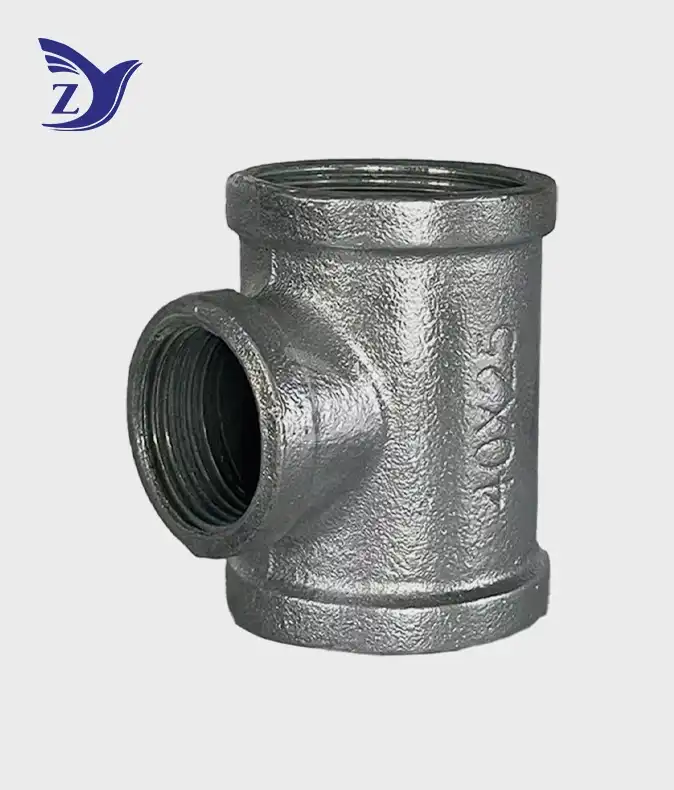
Understanding Square Face Galvanized Reducing Tee Fittings
What "Square Face" Actually Means?
What is meant by "square edge" or "square face" is the flat, banded reinforcement ring that is machined into each threaded hole. This shape, unlike round-bead fittings, gives a pipe wrench a stable, flat surface to grip. This lets them use more installation force without breaking the body. This part of the plan is especially important for orders for a lot of tons, where speed and accuracy of installation are key.
Material and Coating Breakdown
Following ASTM A197, these parts are made from black heart malleable iron and are then hot-dip galvanized. Most of the time, the zinc layer is thicker than 85 microns. This makes a shield that stops oxidation in wet or chemically active places. That layer thickness makes a real difference in how long a water, oil, or gas pipeline lasts in branching situations, which is exactly what your downstream workers have to deal with.
Thread Standards: NPT vs. BSPT
In line with ANSI/ASME B1.20.1, NPT threads have a 60° angle and a 1:16 taper. BSPT threads, on the other hand, have a 55° angle and the same taper rate. They can't be switched out; doing so will cause leaks and damage to the threads. When you place an order, you should always say which standard your downstream market needs. For example, the US market mostly uses NPT, while Southeast Asia, the Middle East, and Commonwealth countries usually prefer BSPT.
Why Accurate Measurement Matters in Square Face Reducing Tee Procurement?
The Cost of a Wrong Measurement
If there is even one wrongly measured square face galvanized square edge reducing tee pipe fittings in a container order, the whole batch can be rejected. One of the top three reasons for fitting returns in industrial distribution channels, according to the Hydraulic Institute's piping standards documentation, is that the dimensions don't match up. Even a 2% return rate cuts into a wholesaler's profit margins a lot when they sell $200,000 to $1,000,000 worth of pipe parts every year.
Square Face Geometry Adds Complexity
Because each port has a flat band, you need to measure both the thread size and the width of the outside face. There are different size limits for the run ports and the branch outlet on a standard 2" × 2" × 1" NPT/BSPT square-edge reducing galvanized malleable tee. The most common mistake we see in B2B buying processes is forgetting to check the face-to-face length on the branch side.
Thread Accuracy Directly Affects Downstream Sales
Fittings with precision threads that meet NPT or BSPT tolerances cut down on calls from fitters and hardware shops. As long as the threads are made to the right specifications, ASME B16.3 Class 150 fittings can handle 300 psi WOG at room temperature. Joints fail under working pressure when the thread pitch isn't right, which is the main reason why building material distributors get returns after the sale.
Step-by-Step Guide: How to Measure Square Face Reducing Tee Fittings?
Tools You Need Before Starting
Get a steel ruler, a thread pitch gage, and a digital vernier measure with a precision of 0.01 mm. A small machinist's square makes sure that the flat band is parallel to the thread axis, which is used to check the square face width. You should always have both ASME B16.3 and your supplier's dimensional chart on hand in case you need to use them together. Parallax errors that throw off caliper readings can be avoided by measuring in a clean, stable area.
Measuring the Main Run and Branch Dimensions
For any industrial-grade, corrosion-proof pipe fitting in the reducing tee group, follow these steps:
Here are four measurements that every procurement team should write down before confirming a large order:
- Run outer diameter: Place the caliper jaws on the threaded end's outer crest. For a 2" NPT fitting, expect approximately 2.375 inches (60.3 mm) at the thread crest. Record both run ports separately — on a reducing tee they should match.
- Branch outlet diameter: Repeat on the branch port. For a 2" × 2" × 1" reducing tee, the branch should measure approximately 1.315 inches (33.4 mm) outer thread diameter. Any deviation beyond ±0.1 mm warrants rejection.
- Face-to-face length (run): Measure center-to-face along the straight run axis. ASME B16.3 publishes reference values for each nominal size; verify your sample matches within tolerance.
- Branch face-to-center: Measure from the branch port face to the centerline of the run pipe. This dimension controls how the fitting integrates into a 3-way flow, efficient diameter transition assembly. Errors here cause misaligned branch piping on site.
When these four pieces of information are recorded regularly, they give your quality inspection team a list that they can use again and again, even for sales of more than one ton, without having to spend more time on inspections.
Cross-Reference Against Standard Charts
Once you have your numbers, check them against the ASME B16.3 Class 150 measurement charts. At zymalleablepipefitting.com, Zhiyuan Malleable Steel posts full-dimensional charts that cover more than 1,000 specs. Before committing to a full container order, ask for a re-run if a sample is more than the published tolerance away.
Comparing Square Face vs. Round Face Galvanized Reducing Tee Fittings for Procurement
Structural Differences That Affect Installation
Round-bead fittings work well for light residential plumbing that doesn't need a lot of torque. When an industrial water or gas pipeline branches off, square face galvanized square edge reducing tee pipe fittings have a strengthened band that takes the force of the wrench during installation. The flat surface of a square face tee makes it easier for workers to hold tools without slipping when they are working in tight spaces like mechanical rooms or trench openings.
Performance in High-Demand Environments
Steel square edge fittings from Class 150 can handle 150 psi at 366°F (saturated steam) and 300 psi WOG at room temperature ranges of -20°F to 150°F. The high-strength, non-rusting malleable iron construction also better absorbs vibration than cast iron, which keeps pump-connected pipes from cracking from overuse. When it comes to wholesalers who sell to factories or building sites, this means fewer warranty claims.
Procurement Decision Framework
Most of the time, square face fittings cost a little more than round-bead options, but most B2B buyers think the lower number of installation problems and returns is worth the extra money. If your customers are engineering firms or hardware shops that serve commercial projects, asking for the square edge variant will protect your image and bring you more business.
Best Practices for Maintaining and Verifying Fit After Installation
Routine Inspection Points
In settings that are likely to rust, check the zinc covering every six months. If you want to know when red rust (iron corrosion) is coming up, look for white rust (zinc oxidation). Check the depth of the thread engagement at each joint. ASME B16.3 says that NPT joints should have at least 3.5 thread turns of contact when they are under working pressure.
Re-Measurement After Installation
When the face-to-face distances are measured again after torqueing, they show that the joint did not pull or push the fitting out of place. A change of 1 to 2 mm in the face-to-face measurement on the branch side can make the pipes and switches further downstream not line up properly. Keeping track of these numbers after installation also helps hold the seller accountable during warranty talks.
When to Flag a Batch for Review
If more than 0.5% of the fittings in a shipment don't pass visual or dimensional checks, the batch should be marked before it is sent out. Most of the time, quality problems in bulk orders are caused by sandhole casting flaws and uneven welding. This risk is greatly reduced if the provider has process controls that are ISO 9001-certified.
Conclusion
Measuring square face galvanized square edge reducing tee pipe fittings correctly protects your procurement investment at every stage — from sample verification to post-installation inspection. The key steps are recording run and branch diameters, face-to-face lengths, and thread specification (NPT or BSPT), then cross-checking against ASME B16.3 Class 150 tables. Choosing hot-dipped galvanized, precision-threaded malleable iron fittings that meet ASTM A197 and ASTM A153 standards gives your downstream customers the corrosion resistance and dimensional consistency they expect, reducing returns and strengthening your position in a competitive building materials market.
FAQ
Can BSPT and NPT fittings be used interchangeably?
No, BSPT threads are 55°, while NPT threads are 60°. When you connect them, the threads don't engage all the way, which causes leaks when the pressure is on. Before you place a large order, you should always make sure you know which standard your final market needs.
What tools give the most accurate measurements on these fittings?
A digital vernier caliper with a resolution of 0.01 mm can measure both thread diameter and face-to-face length. It should be used with a machinist's square to make sure the flat face is straight and a thread pitch gage to check the type of thread (NPT or BSPT).
How do I read the size designation on a reducing tee?
Run Run · Branch is the standard format in the business world. "2 × 2 × 1" means that both of the straight-run ports are 2 inches and the branch exit is 1 inch.
Are galvanized malleable iron fittings suitable for potable water?
Only if the maker gives you a proof that says it is lead-free. Make sure that the zinc layer is made of high-purity (99.99%) zinc and that the product meets all area rules, such as those set by the US Safe Drinking Water Act.
What causes leaks in NPT-threaded fittings even when installed correctly?
Metal-to-metal interference makes NPT threads shut, but they always leave a small spiral leak path. You must use PTFE tape or pipe thread sealer. When installers over-torque round-bead fittings, the body often cracks during proper tightening. The square edge design helps keep this from happening.
Source Your Square Face Reducing Tee Fittings Directly from the Manufacturer
Zhiyuan Malleable Steel has been making malleable iron pipe fittings for 26 years from its 50,000 m² factory in Shanxi Province. It makes more than 1,000 different types of products every year. Our catalog of square face galvanized square edge reducing tee pipe fittings seller includes sizes NPT and BSPT. All of them are made under ISO 9001 quality controls and have CE, UL, and FM certifications. Products that are broken are always replaced. You can email us at q1236800000@gmail.com or go to zymalleablepipefitting.com to get a size chart, samples, or a tiered price quote for your next container order.
References
- American Society of Mechanical Engineers. ASME B16.3: Malleable Iron Threaded Fittings — Classes 150 and 300. ASME, 2021.
- ASTM International. ASTM A197: Standard Specification for Cupola Malleable Iron. ASTM, 2020.
- ASTM International. ASTM A153: Standard Specification for Zinc Coating (Hot-Dip) on Iron and Steel Hardware. ASTM, 2016.
- American National Standards Institute. ANSI/ASME B1.20.1: Pipe Threads, General Purpose (Inch). ASME, 2013.
- Hydraulic Institute. Piping System Component Standards and Installation Guidelines. Hydraulic Institute, 2019.
- International Organization for Standardization. ISO 5922: Malleable Cast Iron. ISO, 2016.
Online Message