
Sep 23, 2026
How to measure long radius elbow?
Measuring a long radius elbow correctly is the foundation of any leak-free pipeline installation. To measure an NPT galvanized female-female 90° long-radius elbow pipe fitting, you need three core dimensions: the center-to-end distance (C-to-E), the nominal pipe size (NPS), and the thread engagement length. The long radius configuration means the radius of curvature equals 1.5 times the nominal pipe diameter — a geometry defined under ASME B16.3 for malleable iron NPT galvanized female-female 90° long radius elbow pipe fittings. Accurate measurement prevents thread mismatch, sealing failure, and costly rework on active job sites.
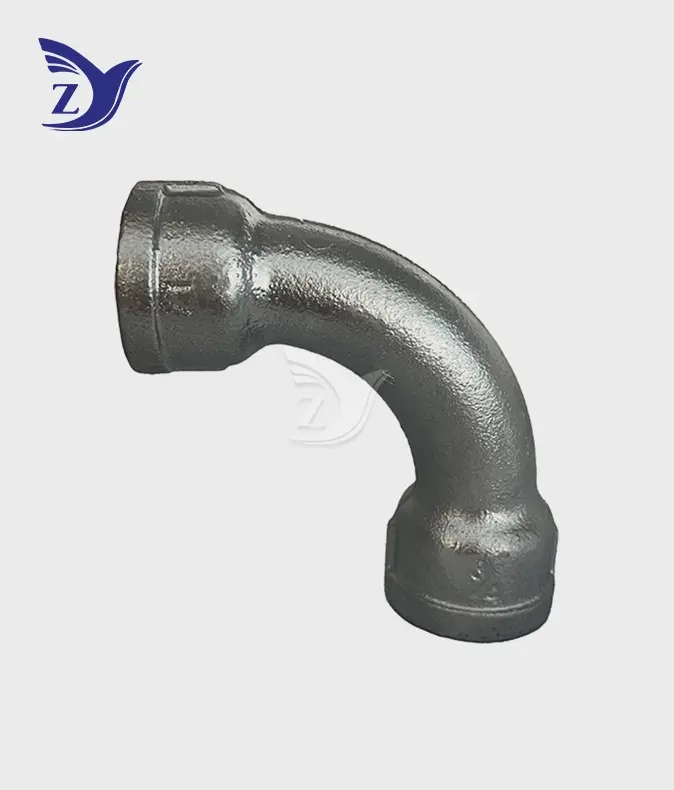
Understanding NPT Galvanized Female-Female 90° Long Radius Elbow
What Makes This Fitting Different?
Because it is female-female (F×F), both ports have internal NPT threads. This means that you don't need a transition nipple when connecting two male-threaded pipe ends at a 90° angle. The double female design spreads thread stress more widely and cuts down on the number of connection points in a run compared to a street elbow, which has one male and one female end. This cuts off straight routes where plumbing, gas, and industrial water systems could leak.
Why the Long Radius Geometry Matters
A normal elbow with a short radius bends very tightly, which speeds up the swirling of fluids and wear inside the pipe. Crane Technical Paper No. 410 says that the long radius design stretches that curve over a softer arc, which lowers the pressure drop by about 30–40% compared to short radius options. In water and gas pipelines with high speeds, this difference means that the fittings last longer and use less energy.
The hot-dipped galvanized zinc finish adds a protective layer that meets ASTM A153 standards. This makes the fittings perfect for places that are wet, chemically aggressive, and outside. The base KTH350-10 malleable iron has a tensile strength of 350 MPa, which is strong enough to meet the structural needs of networks that carry gas and water under pressure.
Dimensional Analysis: Key Measurements for Long Radius Elbows
To be accurate in procurement, you need to know which numbers matter. The required size ranges for threaded malleable iron fittings sold in the U.S. are set by ASME B16.3 and ANSI/ASME B1.20.1. Before putting in an order, every buyer must check the following three measurements:
- Center-to-end distance (C-to-E): This is the distance between the elbow's geometric center and each threaded port's face. According to ASME B16.3 Table 1, the C-to-E of a ½" long-radius 90° elbow is about 1.50 inches. This measurement tells you how much room the fitting takes up in a routed pipeline and has a direct effect on how well it works hydraulically.
- Nominal pipe size (NPS) and thread engagement length for NPT galvanized female-female 90° long radius elbow pipe fittings: NPT threads taper at 1° 47' (1/16" per inch of length). It is important that the contact length — how far the male pipe threads into the female port — is within the ANSI B1.20.1 L1 and L2 gauge range for a pressure-tight seal to be made without putting too much stress on the socket wall.
- Inside diameter (ID) and galvanizing allowance: ASTM A153 Class B says that hot-dip galvanizing adds 45–85 µm of zinc thickness. This makes the effective ID a little smaller, which is important when figuring out flow factors for systems that are close together.
When these three measurements are added together, they give purchasing managers a full geometric fingerprint of the fitting before it even ships.
Step-by-Step Guide: How to Measure NPT Galvanized Female-Female 90° Long Radius Elbow
Tools You Need
You will need a steel ruler, an NPT thread plug gauge set (L1 and L2), a vernier caliper with a resolution of at least 0.02 mm, and a thread pitch gauge. If you don't have a soft jaw insert, don't use steel-jaw calipers on galvanized surfaces. Zinc scoring can damage the protective layer and start rusting early.
Measuring Procedure
Place the fitting on a flat surface so that one of the ports faces up. Place the ruler from the middle of the elbow curve to the thread face of one port to find the center-to-end distance. Then turn the ruler around and do it again for the second port. On a symmetric F×F elbow, both results should be within 0.5° of each other in terms of angle.
Each female port needs to have an NPT L1 plug gauge put into it. The face of the gauge should be level with the face of the fitting, giving or taking one thread turn. If the gauge sinks more than one turn past flush, the threads are too big and won't seal properly when water pressure is applied. Use the pitch gauge to check the thread pitch. A regular ½" NPT thread has 14 threads per inch (TPI), and a 1" NPT thread has 11.5 TPI.
Use the caliper to measure the outside diameter (OD) across the widest part of the hex. Then, measure the bore ID at the thread entrance. Subtract twice the thickness of the galvanizing (as a safety measure, use 0.10 mm) to get the true metal ID for flow calculations.
Comparison and Selection: Long Radius vs. Short Radius Elbow Fittings
Geometry and Flow Performance
Short radius elbows are good for tight spaces, but they make more turbulence and erosion in certain areas, especially in gas and compressed air lines moving quickly. Long radius male 90° long radius elbow pipe fittings take up more linear room but keep the flow's momentum, which is why they are the best choice when pipeline route permits them. In gas retrofits for homes and industrial HVAC condensate return lines, the smoother bend always passes the pressure-drop test with less sealant wear at the thread interface.
Material Comparison
When it comes to outdoor water distribution, hot-dipped galvanized malleable iron is better than black steel because the zinc layer makes it last longer without needing extra protection. Stainless steel is better at resisting chemicals, but it costs a lot more per unit. For plumbing and gas pipeline redirection jobs that cost between $30,000 and $150,000 a year, hot-dipped galvanized fittings are the most durable and cost-effective option.
A procurement manager at a medium-sized U.S. plumbing company said that moving from short radius to long radius elbows on an industrial boiler feed system cut down on two service calls a quarter, which used to cost more than the difference in fittings.
Best Practices and Tips for Ordering and Using Galvanized Female-Female Long Radius Elbows
Before putting in an order for an NPT galvanized female-female 90° long radius elbow pipe fitting, make sure of these things to keep project costs low and approval standards met:
- Confirm the thread standard required by your local inspector — NPT (60° flank angle) and BSPT (55° flank angle) are not interchangeable. Mixing them causes immediate thread damage and joint failure.
- Verify the NPS range needed. Reliable sellers of industrial-grade double female elbows keep a full range of sizes in stock, from 1/8" to 6". Getting all sizes from the same source takes away the schedule risk of having to deal with different lead times.
- Specify whether a galvanized or black (ungalvanized) finish is required. Many jurisdictions require black iron for visible gas lines so technicians can identify the medium by sight during maintenance.
- Request a material certificate confirming KTH350-10 malleable iron grade and a zinc coating report meeting ASTM A153 before the first shipment.
Running this checklist before order placement prevents the most common and expensive procurement errors: receiving mismatched thread standards or undersized galvanizing that fails the first hydrostatic test.
Conclusion
It is necessary to accurately measure a long radius elbow because it is the only variable that can be changed to affect whether a pipeline installation passes inspection or needs to be taken apart and fixed for NPT galvanized female-female 90° long radius elbow pipe fittings. It's the center-to-end distance, the NPT thread engagement, and the galvanizing allowance that matter the most. They must match the tolerances set by ASME B16.3 and ANSI B1.20.1 for a corrosion-proof 90° long radius fitting to seat correctly, seal reliably, and stay sealed even after years of pressure cycling. Taking two minutes to measure correctly before installation saves hours of work afterward.
FAQ
1. How do I tell a long radius elbow from a short radius by measurement alone?
Find the distance from one end to the other and divide it by the pipe's nominal diameter. The number is about 1.5 for an elbow with a long radius and 1.0 for an elbow with a short radius. No need to make marks.
2. What NPT thread tolerance is acceptable?
ANSI B1.20.1 says that the L1 plug gauge stand-off must be within ±1 turn of being flush. Anything outside of that range could cause either under-engagement (pressure leaks) or over-engagement (cracked socket wall).
3. Do I need a professional tool to install these fittings?
For incoming inspection, you should definitely use an NPT thread gauge. To install, you need a pipe wrench that is calibrated and either PTFE tape or thread sealant. The standard in the industry is 2 to 3 turns past finger-tight, which is based on the diameter of the pipe.
4. Can I use PTFE tape on galvanized female-female elbows?
Yes. PTFE tape works with both galvanized and black malleable iron NPT threads and remains the most reliable method for filling the spiral leak path inherent in tapered thread design.
Source Your NPT Galvanized Fittings from Zhiyuan Malleable Steel
Zhiyuan Malleable Steel has manufactured precision malleable iron pipe fittings since 2006, with an annual capacity of 30,000 tons and over 1,000 product specifications. Our NPT galvanized female-female 90° long radius elbow pipe fittings supplier catalog covers 1/8" to 6", ships from in-stock inventory, and carries ISO 9001, CE, UL, and FM certifications. Defective products are replaced without dispute. Contact us at q1236800000@gmail.com to request bulk pricing or a sample measurement guide.
References
1. Crane Co., Flow of Fluids Through Valves, Fittings, and Pipe (Crane Technical Paper No. 410), 2013.
2. American Society of Mechanical Engineers, ASME B16.3: Malleable Iron Threaded Fittings, 2021.
3. American National Standards Institute, ANSI/ASME B1.20.1: Pipe Threads, General Purpose (Inch), 2013.
4. ASTM International, ASTM A153/A153M: Standard Specification for Zinc Coating (Hot-Dip) on Iron and Steel Hardware, 2016.
5. American Society of Mechanical Engineers, ASME B31.2: Fuel Gas Piping, 2019.
6. Hydraulic Institute, Pipe Friction Manual, 3rd ed., 1990.
Online Message