
Sep 14, 2026
How to fit a 45 elbow?
Fitting a 45-degree elbow correctly starts with selecting the right fitting for your pipe material and system pressure. Clean the pipe ends thoroughly, then apply thread sealant or PTFE tape to NPT/BSPT threads before hand-tightening the elbow into position. Use a pipe wrench to secure the connection—typically 1.5 to 2 full turns past hand-tight. Confirm the elbow's angular alignment matches your intended flow path before final tightening. For galvanized malleable iron 45 elbows in water or gas pipelines, verify that thread engagement meets ASME B1.20.1 standards to prevent leaks under operating pressure.
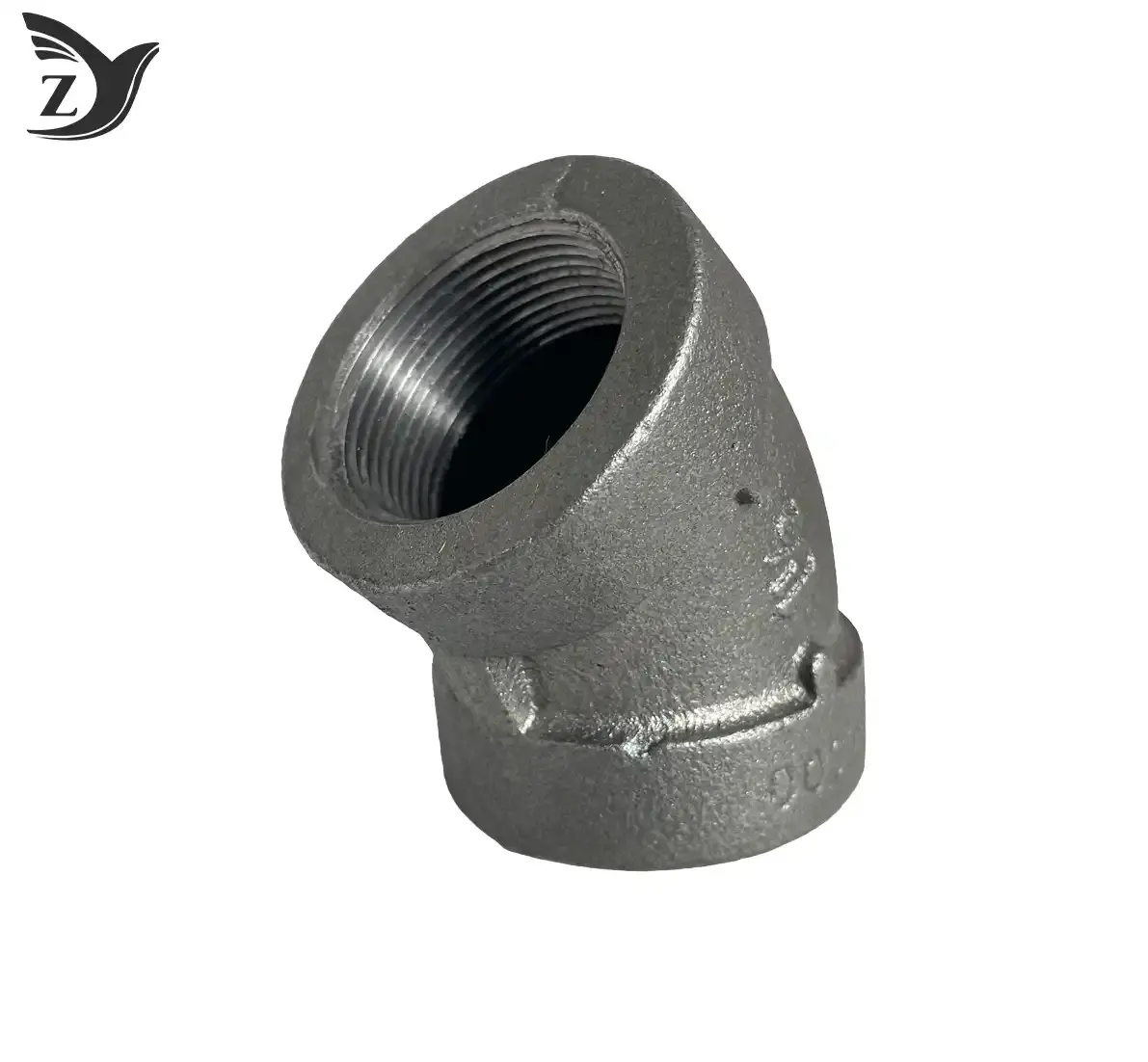
Understanding 45 Degree Elbow Pipe Fittings
A 45-degree elbow pipe fitting changes the direction of flow at a moderate angle, which is less abrupt than a 90-degree turn. Because of this shape, there is less noise and frictional resistance inside the tunnel. This saves energy and makes the system last longer.
Material Varieties and Design Types
You can get pipe joints made of brass, copper, PVC, CPVC, iron that can be shaped, and stainless steel. Every material works well in a different setting. Zhiyuan's NPT/BSPT Square-edge 45° galvanized malleable iron elbow is made of hot-dipped galvanized malleable iron, which is great at keeping water and gas pipes from rusting. Standard elbows have female threads on both ends, while street elbows have one male and one female end. There are also flanged and plain-end configurations.
45° vs. 90° Elbows: Choosing the Right Bend
The Hydraulic Institute's engineering data shows that a standard 45-degree elbow has a length resistance that is about 40% lower than a similar 90-degree elbow. This means that the fluid faces a lot less resistance. A 45 elbow maintains flow velocity and lessens wear on pipe walls where space allows for a gradual routing. A 90-degree fitting works well in small spaces but causes more pressure loss, which is an important choice that engineers have to think about when they create the system.
Step-by-Step Process: How to Fit a 45 Degree Elbow
Installing something correctly the first time protects other equipment and keeps you from having to do expensive repairs. The steps below work for most threaded fittings, but there are some notes that make them work better for galvanized malleable iron fittings in water and gas pipes for industry.
Tools, Safety, and Preparation
Get a pipe wrench (12"–18"), pipe dope or PTFE thread seal tape that is recommended for the material you are using, a thread gage, a pipe cutter or bandsaw, and a deburring tool. Turn off and depressurize the line completely before you start. For gas pipes, make sure the area has good airflow and no sources of fire. Before installation, check the 45 elbow for flaws in the casting, damaged threads, or uneven galvanizing. ASME B31.3 process piping rules say that all fittings must be looked at visually before they are put together.
Thread Engagement and Alignment
Wrap PTFE tape around the male threads in a clockwise direction. For NPT, use two to three layers, and for BSPT, use one to two layers. Tighten the elbow onto the pipe by hand, then use a wrench to make another 1.5 to 2 turns. Do not over-torque, as this can cause the casting to crack. Before the link sets, make sure that the elbow's exit points exactly where you want the flow to go. If this step isn't done right, it puts stress on the parts next to it, which raises the risk of a break over time. For example, Zhiyuan's hot-dipped galvanized 45° fittings have galvanized malleable iron threads that are machined to exact tolerances and seat cleanly and reliably hold alignment.
Gas Line and High-Pressure Considerations
When installing a gas line, the joints must be checked for leaks. Once everything is put together, put an approved leak-detection solution on each joint and slowly increase the pressure. Any bubbles that form mean that the threads are not fully engaged. For high-pressure systems, make sure that the fitting's pressure rating is higher than the pipeline's maximum allowable operating pressure (MAOP). The industrial-grade 45° malleable iron elbows from Zhiyuan can withstand pressures that meet ASTM A197 and BS EN 10242 standards. This means they can be used in harsh environments.
Choosing the Right 45 Degree Elbow for Your Project
The two choices that have the most direct effect on long-term dependability are the material choice and the pressure grade matching. Either choice made quickly leads to ongoing maintenance costs that are much higher than the initial savings from a cheaper fitting.
Corrosion Resistance, Temperature, and Chemical Compatibility
Hot-dipped galvanized malleable iron protects water and gas pipes from corrosion for a long time in fairly harsh settings. According to ISO 1461, the galvanizing process adds a zinc layer that is about 45 to 85 µm thick and protects against rusting. Grades of stainless steel like SS304 or SS316 are better for places that are chemically aggressive or have temperatures above 300°F. PVC and CPVC elbows work well for low-pressure plumbing and chemical drainage, but they can't handle gas or steam at high temperatures.
Schedule Rating and Sizing
The wall thickness and, by extension, the pressure capacity are directly controlled by the pipe schedule. Most commercial and light industrial uses can be met by Schedule 40 malleable iron fittings, while Schedule 80 fittings are better for higher-pressure service. To keep the joint from having step gaps, which ASME B16.3 says is a major cause of localized turbulence and early wear, make sure that the 45-degree elbow's nominal pipe size (NPS) is exactly the same as the pipe that it is connecting to. Always check the thread standard of the fitting—NPT for North American systems and BSPT for foreign markets—to make sure that it will work with other parts.
Procurement Guide: Where and How to Buy Quality 45 Degree Elbows
When procurement teams buy from a verified manufacturer instead of a multi-tier distributor, they can directly access quality documentation and save money on each unit. Suppliers with a good reputation have ISO 9001 certification, give material test reports (MTRs), and share data on how well their products meet ASME B16.3 or similar standards for dimensions.
Procurement managers should give the following factors the highest priority when evaluating a 45 elbow supplier for bulk purchases:
- Thread precision verification: Ask for sample units and check NPT/BSPT threads against ASME B1.20.1 or BS 21 go/no-go gages. Zhiyuan's machine workshop has 156 processing units that are solely focused on thread accuracy. This lowers the number of orders that are out of spec by a large amount.
- Galvanizing uniformity: Check the supplier's test reports to see how thick the zinc coating is. According to ISO 1461, hot-dip galvanizing protects against rust longer than electro-galvanizing. This is especially true for pipelines that are outside or in wet places.
- Packaging integrity: Export-standard woven bags and wooden boxes keep goods safe during long ocean freight by stopping damage and water from getting in. As a norm for exports, Zhiyuan uses double-layer cardboard boxes.
- Lead time and inventory buffer: Stable delivery windows help downstream distributors keep track of inventory without having too much on hand. Zhiyuan keeps a lot of finished goods in stock; basic items are shipped within two hours of an order being confirmed.
Benefits and Applications of Using 45 Degree Elbows in Industrial Piping
There are many more useful benefits of the 45-degree elbow than just changing directions. Its smooth angular change lowers the equivalent length resistance in a network of pipes, which means the pump uses less energy over the life of the system. According to studies in the Journal of Fluids Engineering, replacing 90-degree elbows with 45-degree pairs in long-run pipelines lowers head loss by 15–25% when flow conditions are the same.
Municipal water delivery, natural gas transfer, HVAC chilled-water circuits, chemical processing plants, and oil field gathering lines are all industries that depend on this fitting. In every case, the high-strength and anti-corrosion features of hot-dipped galvanized malleable iron make repair intervals longer and cut down on unexpected downtime.
Routine maintenance is easy: check thread joints once a year for seepage stains or zinc layer degradation, and retighten or replace any fitting that has visible thread wear. The controlled annealing described in ASTM A197 gives malleable iron a flexible microstructure that is less likely to break into brittle pieces when it is vibrated or heated and cooled. This makes it better than gray cast iron options.
Conclusion
Thread contact, alignment, and material suitability must all be considered when fitting a 45 elbow correctly. If you choose a hot-dipped galvanized malleable iron fitting with precise NPT/BSPT threads and proven corrosion resistance, it will work well in water and gas pipelines for a long time. Since 2006, Zhiyuan Malleable Steel has been selling industrial-grade threaded pipe fittings. They can make 30,000 tons of these fittings every year and have more than 1,000 different product specifications. Verified quality paperwork and consistent dimensional standards are important to protect your downstream business, no matter if you are looking for a single container or running a program that constantly restocks.
FAQ
1. Can a 45-degree elbow replace a 90-degree elbow?
When there is room in the routing, two 45-degree elbows can usually be used instead of one 90-degree elbow. This setup lowers the pressure drop and turbulence, which is good for systems that need a lot of flow or that are sensitive to energy use. But two fittings mean two more joints, so managing leak points is important.
2. What is the difference between a standard elbow and a street elbow?
In general, an elbow has female threads on both ends. A street elbow has both a male and a female threaded end, so it can connect directly to another fitting without a short nipple. In small groups, street elbows save room, but they aren't used as much in heavy industrial pipes.
3. Are galvanized malleable iron elbows suitable for gas lines?
Most of the time, hot-dipped galvanized malleable iron fittings with NPT or BSPT threads are fine for natural gas and LP gas delivery pipes. Make sure that the fitting's pressure rating meets or exceeds the system's MAOP and that it is in line with local codes, like NFPA 54 in the US, before installing it.
4. What thread standard should I specify for export orders?
For markets in North America, you should use NPT (ASME B1.20.1), and for most international markets, like those in the Middle East, Southeast Asia, and Africa, you should use BSPT (BS 21). Zhiyuan makes both standards and can name or package them based on the market they are going to.
Get a Competitive Quote on 45 Elbow Fittings — Zhiyuan Malleable Steel
Industrial 45 elbow fittings, such as hot-dipped galvanized NPT/BSPT malleable iron elbows in more than 1,000 specs, are available from Zhiyuan Malleable Steel at factory-direct prices. Our goods meet high standards around the world because they are certified by ISO 9001, CE, UL, and FM. To get a tiered bulk price list, samples, and confirmation of lead time, email our procurement team at q1236800000@gmail.com. 20GP or 40HQ containers can be used for shipping in bulk.
References
1. Hydraulic Institute. (2020). Pipe Friction Manual. Hydraulic Institute.
2. American Society of Mechanical Engineers. (2022). ASME B31.3: Process Piping.
3. American Society of Mechanical Engineers. (2021). ASME B1.20.1: Pipe Threads, General Purpose (Inch).
4. American Society of Mechanical Engineers. (2021). ASME B16.3: Malleable Iron Threaded Fittings.
5. Ito, H. (1960). Pressure losses in smooth pipe bends.
6. International Organization for Standardization. (2009).
Online Message