
Sep 23, 2026
How to connect a 90 degree elbow?
Connecting an NPT black round face 90° elbow pipe fitting correctly determines whether your pipeline holds pressure or fails at the worst possible moment. The process starts with selecting the right fitting—such as an NPT black round face 90° elbow pipe fitting—then cleaning the pipe threads, applying thread sealant (PTFE tape plus pipe dope), and engaging the tapered NPT threads by hand before tightening 2–3 turns past hand-tight with a pipe wrench. Proper torque prevents both under-tightening leaks and over-tightening cracks in NPT black round face 90° elbow pipe fittings. Every step matters, especially in fire protection, gas, or industrial water systems where a failed joint carries serious consequences.
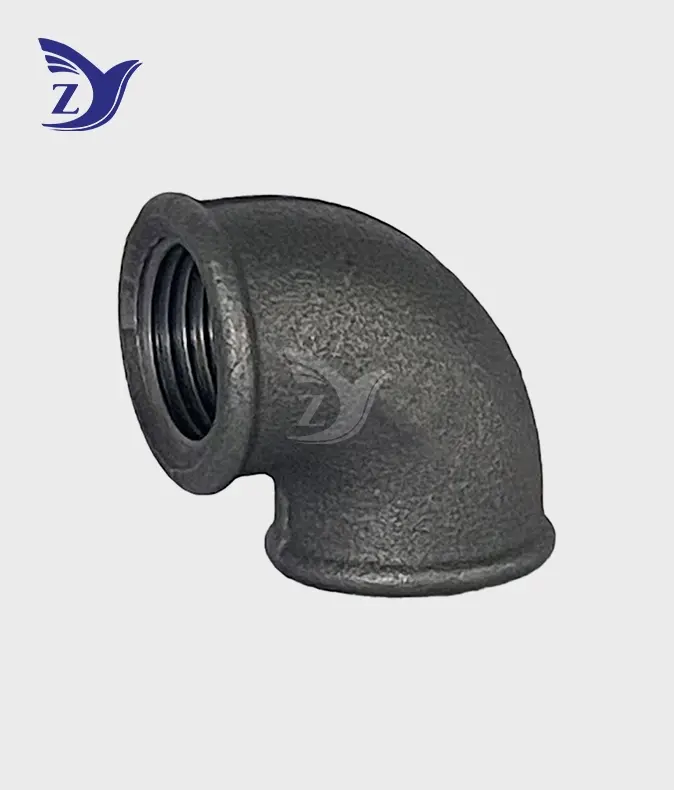
Understanding NPT Black Round Face 90° Elbow Fittings
It is helpful to know exactly what you are working with before you pick up a wrench. Not every 90° elbow is the same, and putting the wrong NPT black round face 90° elbow pipe fitting on a fire control line can cost a lot more than the difference in price.
What "NPT," "Black," and "Round Face" Each Mean
ANSI/ASME B1.20.1 sets the rules for the NPT (National Pipe Taper) thread. NPT joints don't need a gasket because the curved shape (60° thread angle) makes a mechanical interference seal as the fitting gets tighter. "Black" refers to an oil or lacquer covering that is put on malleable iron after it has been made. This coating stops rusting. The black finish is better than galvanized zinc coatings because it won't flake into downstream valves or react with gas lines. This is a very important difference for fire suppression and gas distribution headers. The smooth, thickened bead that supports the port opening is called the "round face" or "beaded." That bead adds tensile strength right where the wrench jaws press down during installation. This keeps the bolts from breaking, which can happen with thinner walls when torque is high.
Material Specs and Size Standards You Should Know
These parts must be made of ASTM A197 malleable iron, which has a minimum tensile strength of 40,000 psi and a yield strength of 30,000 psi. Class 150 fittings have a 300 psi WOG rating at room temperature and a 150 psi rating for full steam. These values are more than enough to meet the pressure needs of an NFPA 13 fire sprinkler system. ASME B16.3 is used for dimensional compliance. The sizes that are usually available are ¼ inch to 4 inches NPT, which is the standard pipe size. Always use a measured NPT ring gage to check the thread engagement length. Threads that are cut too shallow don't contact properly, and threads that are cut too deep bottom out before a good seal forms.
How to Connect and Install a 90 Degree Elbow with NPT Black Round Face Fittings
Once it is known that the part is correct, installation is easy, as long as each step is done carefully. Using the correct NPT black round face 90° elbow pipe fittings ensures the longevity of the connection.
Tools, Prep, and Surface Cleaning
One pipe wrench should hold the pipe while the other turns the fitting. You will also need calibrated NPT ring gages, PTFE tape, "pipe dope" (anaerobic pipe thread sealant), a wire brush, and clean rags. Make sure the end of the pipe is square and free of burrs. Use the wire brush to clean the outside threads of any scale, chips, or cutting oil that is still there. Micro-leaks that only show up during pressure testing are most often caused by foreign objects getting stuck in the thread valley. This was a painful discovery on a fire protection job site an hour before the inspection.
Step-by-Step Thread Connection Process
In industrial pipeline work, this is the order that always results in joints that don't leak:
- Inspect the threads: Make sure that the threads on both the pipe and the fitting are clean, not broken, and that they meet the gage. Cross-threading can't be seen at this point until the hydrostatic test.
- Apply PTFE tape: Wrap two or three layers clockwise around the thread end so that the tape doesn't come apart when the thread is engaged. Then, put a thin, even layer of pipe thread glue on top of the tape to cover it on two levels.
- Hand-engage the fitting: Thread the black iron elbow onto the pipe by hand until there is more resistance. On clean NPT threads, you can usually do 3–4 full hand turns.
- Wrench-tighten 2–3 turns past hand-tight: For Class 150 NPT fittings, the ASME recommends that you wrench-tighten two to three turns past hand-tight. If you tighten it more than this, the casting could crack at the bead.
- Orientation before final tightening: Plan the final exit position before the last half-turn. This is because NPT threads can only tighten in one way. The thread sealant film is broken when you move back to adjust.
Troubleshooting Leaks and Stuck Fittings
If seepage shows up at the joint after pressure testing, don't just tighten it too much. Fully take apart the joint, check the threads for damage, apply new sealant, and put it back together. Galling is often indicated by a fitting that won't come loose during maintenance. The round face bead can be kept from deforming by using penetrating oil and a strap wrench instead of a pipe jaw wrench.
Advantages and Industrial Applications of NPT Black Round Face 90° Elbow Fittings
Precision-threaded, NPT/BSPT-compatible elbows are often made of KTH330-08 or KTH350-10 malleable iron, which is very durable. These types give the fittings a longer life than cast iron. The controlled annealing process of malleable iron turns the brittle white iron casting into a ductile structure that can handle shocks without breaking.
Fire safety (NFPA 13 sprinkler networks), oil and gas distribution pipes, HVAC hydronic systems, and industrial water treatment plants are all industries that count on this performance. Many gas lines and closed-loop steam systems use NPT black round face 90° elbow pipe fittings because they are black and don't have metal coatings, which can get dirty. On the other hand, galvanized round-face elbows are best used outside or in corrosive environments where moisture is the main danger.
Procurement Considerations for NPT Black Round Face 90° Elbow Pipe Fittings
Finding the wrong size costs money and causes projects to take longer than planned. Three things always set providers who are trusted apart from those who aren't: the level of certification, the production capacity, and a clear quality guarantee for every NPT black round face 90° elbow pipe fitting.
Records from the ISO 9001 quality management system should be included in the certification paperwork. Depending on the market, UL listing, FM approval, or CE marking should also be included. Pressure-test reports, especially "air under water" pneumatic tests that show casting porosity that can't be seen, are a solid sign of how well a manufacturer controls quality. For big fire protection contracts, annual production ability is important. A supplier that can make 30,000 tons a year can handle extra orders without affecting wait times. When a project needs a unique size in small amounts, minimum order quantity flexibility is just as useful.
Making the Right Choice: Comparing Solutions and Ensuring Long-Term Value
For extreme service, forged steel elbows can handle higher pressures, but for Class 150 and Class 300 fire and water pipeline work, malleable iron threaded elbows are the best choice because they are the most cost-effective, easy to machine, and strong. By customizing OEM and ODM NPT black round face 90° elbow pipe fittings with things like custom thread forms, special coatings, or private-label packaging, project engineers can meet the code requirements of their specific state without having to buy from multiple sellers.
A medium-sized fire protection company that works on projects for the Gulf Cooperation Council agreed on using only black round-face bendable elbows from a single ISO 9001-certified source. By combining the supply chain, thread-gauge differences between batches from different sources were no longer present. These differences had been caused by mixing parts from unreliable sources, which had led to rework on two previous contracts.
Conclusion
To connect a 90° elbow properly, you need to know about the product, prepare the surface, make sure the threads contact correctly, and test the pressure. Building NPT black round face 90° elbow pipe fittings to ASME B16.3 and ASTM A197 standards gives fire safety and industrial gas systems the tensile strength, rust resistance, and thread perfection they need. A common part can become a reliable system asset by choosing a manufacturer with clear certifications, enough production capacity, and quick customer service after the sale.
FAQ
1. What is the difference between NPT and BSPT threads on a 90° elbow?
The US standard for threads is NPT (National Pipe Taper, ANSI B1.20.1), which has a 60° angle. A 55° Whitworth thread angle is used for BSPT (British Standard Pipe Taper, BS 21). The two are not compatible in terms of dimensions; mixing them leads to cross-threading and leakage. Before you buy an NPT black round face 90° elbow pipe fitting, you should always check that the thread standard listed in your project plans is correct.
2. Can black malleable iron elbows handle high-temperature steam lines?
Fittings made of Class 150 malleable iron can handle 150 psi of saturated steam. They can be used to distribute low-pressure steam, but not when the steam is over 450°F; for those uses, forged steel fittings are the only ones that are code-compliant.
3. How many turns past hand-tight should an NPT elbow be tightened?
For standard NPT threaded joints on malleable iron fittings, ASME B16.3 guidelines say to go two or three turns past hand-tight. If you go over this range, the casting could crack at the bead; if you don't go over it, the threads won't connect enough to make a leak-proof seal.
4. Why choose the black finish over galvanized on a fire sprinkler system?
Galvanized coatings can flake off, which can happen in high-velocity water systems. Black fittings don't have this problem. NFPA 13 allows both finishes, but many builders choose black for internal dry and wet pipe systems so that zinc debris can't get stuck in sprinkler holes.
Connect with Zhiyuan Malleable Steel — Your Trusted NPT Black Round Face 90° Elbow Pipe Fittings Supplier
Since 2006, Zhiyuan Malleable Steel has been making precision-threaded malleable iron pipe fittings. They can make 30,000 tons of them each year and are fully certified by ISO 9001, UL, FM, and CE. When you place a regular order, our NPT black round face 90° elbow pipe fittings will ship within two hours from stock. ODM/OEM services meet the needs of each individual project. To get a bulk price right away, email our expert team at q1236800000@gmail.com.
References
1. American Society of Mechanical Engineers. ASME B16.3: Malleable Iron Threaded Fittings. ASME, 2021.
2. American Society for Testing and Materials. ASTM A197: Standard Specification for Cupola Malleable Iron. ASTM International, 2020.
3. American National Standards Institute. ANSI/ASME B1.20.1: Pipe Threads, General Purpose (Inch). ASME, 2013.
4. National Fire Protection Association. NFPA 13: Standard for the Installation of Sprinkler Systems. NFPA, 2022.
5. Nayyar, Mohinder L. Piping Handbook, 7th ed. McGraw-Hill, 2000.
6. Frankel, Michael. Facility Piping Systems Handbook, 3rd ed. McGraw-Hill, 2010.
Online Message