
Oct 12, 2026
How Much Pressure Can a Galvanized 90° Reducing Elbow Handle?
A standard hot-dipped galvanized 90° reducing elbow made from malleable iron is rated at 300 PSI WOG (Water, Oil, Gas) under Class 150 specifications, and some Class 300 fittings reach 600 PSI. These ratings follow ASTM A197 for malleable iron and ASME B1.20.1 for NPT thread standards. The actual pressure capacity depends on wall thickness, reducing ratio, thread precision, and zinc coating integrity. When properly installed with PTFE tape on NPT/BSPT threads, a quality galvanized 90° reducing elbow holds steady under sustained industrial pressure across water, gas, and oil pipeline systems.
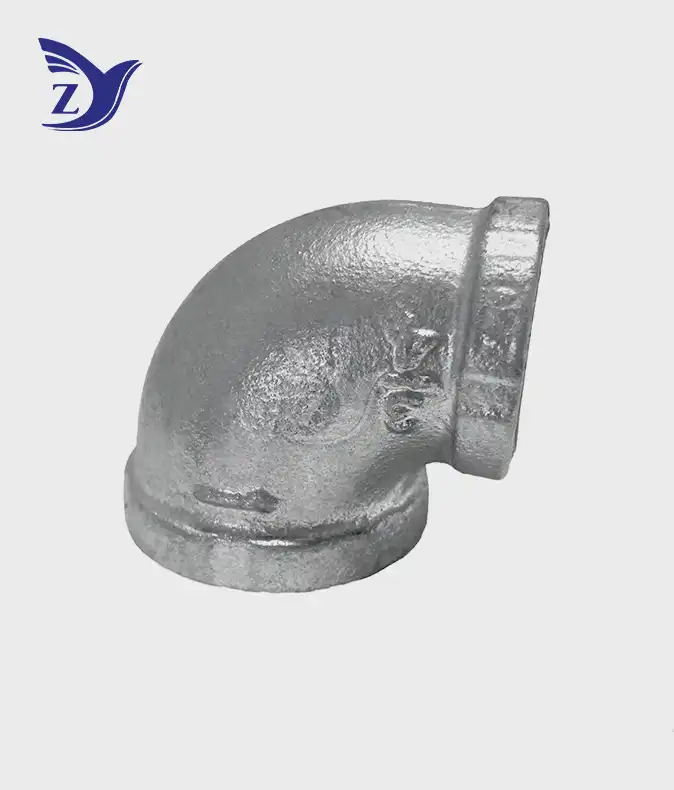
Understanding Galvanized 90° Reducing Elbows and Their Pressure Limits
If sellers know what limits pressure capacity, they can avoid failures and returns from customers further down the line that cost a lot of money.
What This Fitting Actually Does
A metal 90-degree reducing elbow turns two pipes with different widths into one straight line. It changes the flow direction and pipe size all in one fitting. This two-threaded, 90° reduction pipe connection gets rid of the need for a separate bushing, which cuts down on places where leaks could happen. When you combine male and female NPT/BSPT threads, you get a curved mechanical seal that can hold pressure without any extra hardware.
Factors That Govern Pressure Capacity
There are three things that directly affect how much pressure the galvanized 90° reducing elbow can handle inside. First, the structure's resistance to hoop stress depends on the width of the walls. Walls that are larger can handle more pressure. Second, the reducing ratio is important. A 1" × ¾" step-down makes less stress concentration and turbulence than a 1½" × ½" transition. Third, the strength of the hot-dipped galvanized covering keeps the pliable iron base from shrinking over time due to oxidation, which would happen otherwise.
Industry Standards and Typical Ratings
The quality of malleable iron casting is controlled by ASTM A197. For hot-dip galvanized fittings, ASTM A153 says that the zinc coating must be at least 85 microns thick. The shape of NPT threads is controlled by ASME B1.20.1. Based on these rules, Class 150 fittings can handle up to 300 PSI WOG and Class 300 fittings can handle up to 600 PSI. These rates are for water, oil, and gas service at room temperature. rates for steam are lower and are released separately.
Comparative Analysis: Galvanized Reducing Elbow vs Other Pipe Fittings Under Pressure
One of the main reasons buyers get complaints from builders and fitters is that they chose the wrong fitting material for a pressure application.
Galvanized Malleable Iron vs Stainless Steel
Elbows made of stainless steel can handle more pressure and are better at resisting chloride corrosion in harsh chemical environments. But they cost 3–5 more per unit than hot-dipped galvanized malleable iron joints. The corrosion-proof, industrial-grade malleable elbow works well for standard water and gas pipeline applications in industrial and commercial buildings. It also has a much lower landed cost, which is why high-volume B2B distributors who are looking to make money choose it.
Galvanized Malleable Iron vs Black Iron
The pressure values for black malleable iron are the same as those for coated iron, but the surface is not protected. Ungalvanized black iron breaks down faster at threaded joints in places that are outside, have a lot of moisture, or are slightly corrosive. The hot-dip zinc coating on the anti-rust elbow works as a protective barrier, adding 10 to 15 years to the service life in similar weather circumstances. When coated and black iron are mixed in water systems, the black iron can experience faster galvanic rusting. This is why it is important that the materials used throughout a system are consistent.
Galvanized Malleable Iron vs PVC
Even though PVC elbows are cheap and won't rust, their pressure ratings drop sharply above 60°C and they can't be used with gas. A high-strength galvanized 90° reducing elbow can handle gas, oil, and steam, but PVC can't. It keeps its Class 150 or Class 300 grade over a higher temperature range. Galvanized malleable iron is still the best choice for projects that need to change the size of industrial water and gas pipelines.
Installation and Maintenance Impact on Pressure Handling
Even a well-made fitting will break soon if it is put in incorrectly or not checked. When done right, the pressure rating is kept safe for the whole service life.
Correct Thread Assembly Procedure
Before putting together NPT/BSPT compatible fittings, each part must have PTFE tape or pipe dope applied to it. When the taper thread seats, it makes a mechanical lock. The sealant, on the other hand, fills in tiny holes on the surface that would let air leak during pressure cycling. Put it on by hand first, then add two or three wrench turns. If you tighten a size-reducing male-female connection too much, the casting at the reduced-side socket can crack. This lowers the pressure rating right away. Don't torque upstream joints; instead, use a spare wrench on the pipe next to it.
Routine Maintenance Practices
Every year, check threaded joints that are outside or in places with a lot of humidity. Look for white zinc oxide crystals at the thread opening. These show that water is getting in. Use a flashlight to look for microcracks near the reducing shoulder. This is where casting flaws that show up under stress show up first. If you can see that the zinc covering is getting thin or flaking, it should be replaced before rust gets to the iron underneath. If you notice these signs early, you can avoid a full joint failure and the costs that come with it.
Leak Detection and Long-Term Reliability
Casting porosity can be found before a system goes live by testing it under 1.5 times its working pressure during commissioning. As per the rules in ASME B31.3, industrial gas and water systems usually go through hydrostatic testing. Any fitting that leaks during this test should be thrown away and a new one should be installed instead of being tightened again. If a threaded joint keeps leaking, it's likely because of a thread gage nonconformance that can't be fixed with sealant.
Procurement Considerations for High-Pressure Galvanized Reducing Elbows
It costs a lot to buy the wrong goods in large quantities. Dozens of downstream customers can all send back the same batch of out-of-tolerance fittings at the same time.
Before committing to a supplier, these are the main things that procurement managers with a lot of experience look at:
- Thread certification: Confirm the supplier uses L1 ring gauges to verify NPT taper and depth on every production batch. Uncertified threads are the leading cause of field leaks.
- Zinc coating thickness documentation: Request magnetic thickness gauge test reports showing a minimum of 85 microns per ASTM A153. Thin coatings fail within 2–3 years in outdoor exposure.
- Hydrostatic test sampling: Reputable factories test random samples at 1.5× rated working pressure and document the results. Ask for batch test certificates before shipment.
- Full specification range: A supplier offering 1,000+ SKUs across NPT/BSPT reducing elbows, couplings, tees, bushings, and plugs allows one-container procurement without sourcing gaps.
- Export packaging: Look for double-layer cardboard and moisture-barrier polybag inner packaging. Galvanized 90° reducing elbow arriving with rust stains from transit moisture create immediate quality disputes.
These standards directly protect your relationships with customers further down the line and your selling profit margin.
Manufacturing Process and Material Science Behind Pressure Capacity
The amount of pressure that a malleable iron reduction elbow can handle starts in the forge, not on the specs page.
Hot-Dip vs Electro-Galvanizing
In hot-dip galvanizing, the finished casting is put into liquid zinc that is about 450°C hot. This creates an alloy bond layer and an upper layer of pure zinc that is usually more than 85 microns thick. This link is built into the surface of the iron. Electrochemical plating is used to put down thinner coatings, often less than 25 microns. Electro-galvanized coatings don't last nearly as long as hot-dipped coatings when used outside or in high-humidity industrial settings. The galvanizing workshop in Zhiyuan uses electric heating environmental-protection galvanizing furnaces to make uniform coatings that can be checked with a magnetic thickness gage.
Casting Quality and Defect Control
Weak walls caused by trapped gasses during casting are porous and break when the pressure is lower than the rated value. Companies that are responsible test samples of their products under hydrostatic pressure and use standard checking procedures to look for zinc dross inside the fitting hole. Dross particles block flow and can hurt valve seats further downstream. In Zhiyuan's casting workshop, 8 sets of SN KGDX-35003T medium-frequency electric furnaces keep the melt temperature under tight control. This lowers the rate of porosity, which lowers the pressure ratings.
Thread Precision and Its Effect on Rated Pressure
As per ASME B1.20.1, a 60° NPT thread angle makes the wedging action that seals against pressure. If the thread curve is off by more than 0.5°, the fitting will either cross-thread when it's put together or not sit all the way, creating a spiraling path for leaks. The only reliable way to keep this tolerance over large production runs is to use precise CNC thread machining and check each batch with an L1 gage.
Conclusion
As long as the galvanized 90° reducing elbow meets ASTM A197, ASTM A153, and ASME B1.20.1 standards, a galvanized 90-degree reducing elbow that was made correctly can handle up to 600 PSI at Class 300 and 300 PSI WOG at Class 150. How well the pressure works relies on the quality of the casting, the thickness of the zinc covering, the accuracy of the threads, and how well they are installed. For B2B sellers, the risk to their bottom line is not the cost of fitting, but the returns and relationship damage that come from selling bad goods. You can protect your inventory value and your customer base by buying from a verified producer of malleable iron with recorded quality controls.
FAQs
Can I use a galvanized reducing elbow for natural gas service?
Yes. Hot-dipped galvanized malleable iron fittings are approved for natural gas service under standard Class 150 and Class 300 pressure ratings. Always verify local code compliance and use an approved thread sealant rated for gas.
What thread standard should I specify for US projects?
Specify NPT (National Pipe Taper) per ASME B1.20.1 for North American installations. BSPT is the correct choice for UK, Middle East, and many Southeast Asian markets. Many suppliers stock both; confirm before ordering.
Does the zinc coating affect thread fit?
Hot-dip coating applied after threading can slightly thicken thread flanks. Quality manufacturers account for this in machining tolerances so the finished fitting still passes L1 gauge verification. Always request gauge test documentation.
How do I confirm pressure rating before a bulk order?
Ask the supplier for batch hydrostatic test certificates. Samples tested at 1.5× rated working pressure with no leakage confirm the production batch meets specification. This is standard practice for serious malleable iron pipe fitting manufacturers.
What is the shelf life of a hot-dipped galvanized fitting in storage?
When stored dry with moisture-barrier packaging, hot-dipped galvanized fittings remain serviceable for 5–10 years. Inspect for white rust on the zinc surface before installation; surface zinc oxide is cosmetic, but deep rust reaching the iron substrate requires rejection.
Get Bulk Pricing on Certified Galvanized Reducing Elbows — Contact Zhiyuan Malleable Steel
Since 2006, Zhiyuan Malleable Steel has been making pipe parts out of malleable iron. They can make up to 30,000 tons of them each year and have more than 1,000 different product specs. Our NPT/BSPT reducing male-female 90° galvanized elbows are certified by CE, UL, and FM, and they come with full paper work from hydrostatic tests. Wholesale buyers and wholesalers can get OEM/ODM services and different levels of price. Products that are broken are always replaced. Need a quote for a galvanized 90-degree reducing elbow? Email us at q1236800000@gmail.com or go to zymalleablepipefitting.com right now.
References
- ASTM International. ASTM A197: Standard Specification for Cupola Malleable Iron. ASTM International, 2023.
- ASTM International. ASTM A153: Standard Specification for Zinc Coating (Hot-Dip) on Iron and Steel Hardware. ASTM International, 2022.
- American Society of Mechanical Engineers. ASME B1.20.1: Pipe Threads, General Purpose (Inch). ASME, 2020.
- American Society of Mechanical Engineers. ASME B31.3: Process Piping Code. ASME, 2022.
- Brandes, E.A., & Brook, G.B. (Eds.). Smithells Metals Reference Book, 7th Edition. Butterworth-Heinemann, 1998.
- Schweitzer, Philip A. Corrosion Engineering Handbook: Fundamentals of Metallic Corrosion in Atmospheric and Media Corrosion. CRC Press, 2006.
Online Message