
Aug 10, 2026
High Strength Precision Threaded NPT BSPT Compatible Pipe Diameter Transition Coupling
The BSPT square face galvanized square edge reducing coupling pipe fittings are the best when industrial systems need a safe way to switch between pipe sizes with different diameters. The British Standard Pipe Taper threading and hot-dip galvanization on these precision-engineered parts make sure that joints are safe for use with water, gas, and steam. The construction is made of malleable iron, which gives it a tensile strength of more than 350 MPa. The strengthened square edge design keeps the wrench from slipping during installation. Because these connections work with both NPT and BSPT threaded systems, they solve important problems in fire safety networks, public works infrastructure, and industrial process pipes where thread compatibility and corrosion resistance decide how long a system lasts.
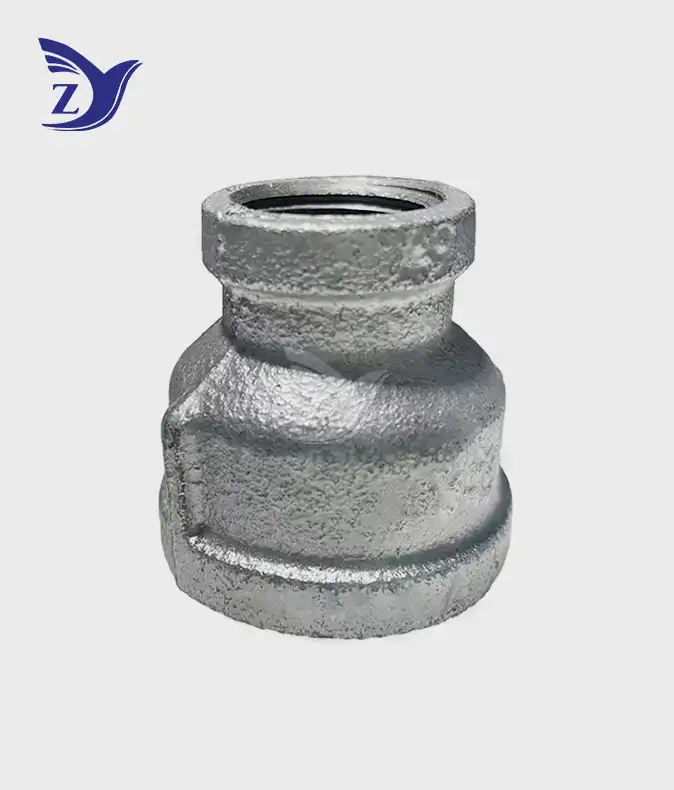
Understanding High Strength Threaded NPT BSPT Compatible Transition Couplings
Core Design and Functionality
Connecting pipes of different sizes while keeping the pressure integrity is one of the biggest problems in pipeline building. These transition couplings solve this problem. The BSPT thread profile has a 55-degree angle and a 1:16 taper ratio. This makes the link self-sealing as the fitting force tightens it. This is very different from parallel threads, where seals or O-rings are used for all closing. When pipe tools apply rotating force during assembly, the square edge reinforcement adds about 15% more material to the hole of the coupling than beaded designs. This spreads the stress more equally.
We saw how the galvanization layer changes simple iron that can be shaped into a strong metal that doesn't rust. During the hot-dip process, a zinc covering of more than 500 g/m² is applied, which provides security of about 70 microns. Because of this coating's dual role as a shield and a substitute anode, the zinc corrodes more quickly than the base iron. In places with a lot of humidity, like pump houses and underground installs, this protection makes the product last 20 to 30 years longer than options that aren't galvanized.
Thread Profile Distinctions
Knowing the technical differences between BSPT and NPT threading helps you avoid mistakes that cost a lot of money during installation. BSPT square face galvanized square edge reducing coupling pipe fittings have 19 threads per inch for 1/8" fittings, while NPT threads have 27 threads per inch for the same size. Despite these differences, modern manufacturing tolerances allow cross-compatibility when the right sealants are used. The square face variant we make at our Taigu facility uses precision CNC thread cutting that meets ISO 7-2 gauge verification standards. This level of attention to detail means that whether your project calls for NPT male pipes or BSPT configurations, our reducing couplings can accommodate both without compromising seal integrity.
Pressure and Temperature Specifications
These galvanized reducing couplings can reliably handle pressures up to 25 bar (about 362 psi) at room temperature, but their pressure ratings drop proportionally as temperatures rise above 300°F. The malleable iron metallurgy meets ISO 5922 standards, usually W400-05 grade, which means it stays flexible even when temperatures change quickly. This is very useful in steam systems where sudden temperature changes could break brittle cast iron. Our testing procedures include hydrostatic pressure trials at 20+ bar to find any holes in the casting before galvanization, making sure that every coupling that leaves our 50,000 square meter production facility meets these strict requirements.
How to Select the Right BSPT Square Face Galvanized Reducing Coupling for Your Application?
Material Quality Assessment
When purchasing BSPT square face galvanized square edge reducing coupling pipe fittings, procurement teams should make sure that the materials are properly checked. Real malleable iron goes through a controlled annealing process—we use Blue Sky HTL-1 type 100-ton natural gas kilns just for this—which changes the carbon structure from cementite to graphite nodules. This gives the material its strength and flexibility. Low-quality manufacturers skip or shorten annealing to save money, which makes fittings that look the same but crack under stress. Ask for material certifications showing tensile strength between 350–400 MPa and elongation percentages above 5%. These numbers directly relate to a coupling's ability to absorb vibration in mechanical systems without developing stress fractures.
The zinc coating quality is what sets industrial-grade products apart from hardware store alternatives. ASTM A153 compliance ensures a minimum coating thickness, but better manufacturers go above and beyond these standards. We apply galvanization through complete immersion, covering both the outside and the inside of the threads evenly. Other methods, like spraying or electroplating, leave thin spots in the thread valleys where corrosion starts. When evaluating samples, look at the thread roots under a microscope to make sure they have even silver-gray coverage and no bare iron can be seen through.
Application-Specific Selection Criteria
Different industries have different needs when it comes to pipe fittings. For example, fire protection systems need UL or FM certification to prove that couplings stay together when they're exposed to heat from nearby fires. As part of our manufacturing process, we include certification pathways for these standards, as well as CE marking for export markets in Europe. Municipal water systems put lead-free compliance and NSF-61 approval for potable water contact at the top of the list. These certifications aren't just paperwork; they're the result of rigorous third-party testing of leachate chemicals and material composition.
When choosing a BSPT square face galvanized square edge reducing coupling pipe fittings, the size transition ratio is important. Most couplings can only handle one or two nominal pipe size steps, like connecting 1" to 3/4" pipe instead of 2" to 1/2". This is because larger transitions cause turbulence and pressure drops that make the system less efficient. For projects that need to make more than one size change, we suggest using sequential couplings instead of forcing extreme diameter mismatches through a single fitting. This keeps the flow smooth and stops erosion at the transition point.
Supplier Credibility and Certification Verification
Your supply chain is safer when you work with manufacturers who provide clear quality documentation. For example, we have ISO 9001 certification that covers our whole production process, from receiving raw materials to packaging them up at the end. This system requires batch traceability, which means that every shipment comes with paperwork that connects specific couplings to the raw iron melt, annealing cycle temperatures, and galvanization bath chemistry on production dates. This makes it easy to trace any problems in the field back to manufacturing variables, which speeds up the resolution process.
Our 30,000-ton annual capacity can handle both large-volume standard orders and specialized runs for non-standard thread configurations. Our OEM services are useful for projects with international specifications, like British Standard Pipe Parallel (BSPP) threads for equipment brought in from the UK. We've created custom thread-cutting programs for over 200 specialized profiles, which shows the flexibility that sets full-service manufacturers apart from simple distributors.
Purchasing and Procurement Strategies for BSPT Transition Couplings
Sourcing and Supplier Evaluation
Finding BSPT square face galvanized square edge reducing coupling pipe fittings has changed a lot thanks to B2B procurement platforms, but comparing suppliers isn't just about price. You should also ask to see certifications for the production facility—ISO 9001 quality management, environmental compliance documentation, and safety certifications all show that the operation is mature. Our Taigu facility welcomes audit visits, which give visitors a look at our eight 3-ton medium frequency electric furnaces, annealing kilns, and galvanizing operations. Suppliers who don't want to talk about their manufacturing processes often don't have quality controls, which shows in inconsistent product performance.
When you buy in bulk, you save a lot of money and make sure you always have supplies. Our wholesale programs offer tiered pricing that lowers unit costs by 12–18% for annual commitment contracts. These arrangements also prioritize your orders during capacity constraints, making sure they get delivered when market demand is high. We keep over 1,000 SKU variations in stock, which lets us ship standard configurations in two hours, which is a huge help when project schedules are tight.
Cost-Benefit Analysis Framework
When you look at the total cost of ownership, you can find hidden value in high-end fittings. For example, a coupling that costs 30% more but lasts twice as long is a better deal, especially when you consider the cost of installation labor. Replacing a fitting means shutting down the system, draining it, taking it apart, and putting it back together again, which can cost 5–10 times as much as the fitting itself. When choosing fittings, don’t just look at the price; think about how long they are supposed to last and how often they should be serviced.
Lead time plays a big role in how you buy things. For example, standard galvanized reducing couplings can be shipped right away from our warehouse stock, but custom thread configurations need 15–25 days for production runs, depending on the quantity. Smart buyers keep an inventory of commonly used sizes and order specialized parts with enough lead time buffers. We offer demand forecasting consulting based on project specifications, which helps them get the most out of their inventory investment.
Conclusion
It's important to find the right high-strength precision threaded transition couplings by weighing technical specifications, material quality, and supplier reliability. The galvanized BSPT square edge design is great for resisting corrosion and is easy to install in a wide range of industrial settings. Knowing how threads work with BSPT and NPT systems, checking material certifications, and using the right installation methods will ensure leak-free performance for decades to come. As manufacturing technology improves and global standards change, working with certified manufacturers like Zhiyuan Malleable Steel gives modern industrial projects the quality assurance and customization options they need.
FAQ
Are BSPT threads compatible with NPT pipe systems?
BSPT and NPT threads work together even though they are slightly different in size. They both have tapered shapes that seal through thread interference instead of gaskets alone. The 55-degree BSPT angle compared to the NPT profile allows cross-application when installers use the right PTFE tape or paste sealants. Pressure testing confirms reliable sealing up to 20 bar in mixed-thread assemblies, but critical applications should keep thread consistency throughout systems to increase safety margins.
What pressure ratings should I expect from reducing couplings?
Standard galvanized malleable iron reducing couplings can handle working pressures up to 25 bar (362 psi) at room temperature. As the temperature rises, the pressure capacity decreases proportionally—at 250°F, you can expect about 18 bar ratings. Specific ratings depend on size, with smaller diameter fittings usually being able to handle higher pressures due to wall thickness ratios. Always check the manufacturer's specifications and any applicable code requirements for your specific installation conditions and media being sent.
How can I ensure maximum durability in corrosive environments?
However, marine or chemical exposure may require extra coating with zinc-rich paint after installation. Regular inspection to tell the difference between white rust (normal zinc oxidation) and red rust (coating failure) allows for proactive maintenance. Cathodic protection systems offer extra defense in buried or submerged applications. Proper initial installation that avoids thread damage and ensures full engagement maximizes the galvanized layer's protective effectiveness throughout the fitting's service life.
Partner With Zhiyuan Malleable Steel for Your Pipeline Solutions
Upgrading your industrial systems demands a trusted BSPT square face galvanized square edge reducing coupling pipe fittings supplier delivering quality without compromise. Zhiyuan Malleable Steel brings 26 years of casting expertise and 30,000-ton annual production capacity to your procurement needs. Our ISO 9001 certified facility in Shanxi Province combines precision CNC threading, hot-dip galvanization exceeding 70-micron thickness, and rigorous hydrostatic testing protocols ensuring every coupling meets international standards including CE, UL, and FM certifications. Whether you require bulk wholesale quantities with two-hour dispatch from our extensive inventory or customized OEM solutions for specialized thread configurations, our engineering team provides responsive technical support. Contact our procurement specialists at q1236800000@gmail.com to discuss volume pricing, certification documentation, and tailored solutions for your fire protection, municipal infrastructure, or industrial process applications. Visit zymalleablepipefitting.com to explore our complete product range and discover why leading contractors across North America trust Zhiyuan Malleable Steel for reliable, corrosion-resistant pipe connections.
References
- American Society for Testing and Materials. (2019). ASTM A153: Standard Specification for Zinc Coating (Hot-Dip) on Iron and Steel Hardware. ASTM International, West Conshohocken, PA.
- British Standards Institution. (2017). BS EN 10242: Threaded Pipe Fittings in Malleable Cast Iron. BSI Standards Publication, London.
- International Organization for Standardization. (2018). ISO 7-2: Pipe Threads Where Pressure-Tight Joints Are Made on the Threads—Part 2: Verification by Means of Limit Gauges. ISO Central Secretariat, Geneva.
- International Organization for Standardization. (2021). ISO 5922: Malleable Cast Iron—Designation and Material Specifications. ISO Central Secretariat, Geneva.
- National Fire Protection Association. (2020). NFPA 13: Standard for the Installation of Sprinkler Systems—Pipe and Fittings Requirements. NFPA Publications, Quincy, MA.
- Underwriters Laboratories. (2022). UL 213: Standard for Rubber Gasketed Fittings for Fire Protection Service—Malleable Iron Components Testing. UL Standards & Engagement, Northbrook, IL.
Online Message