
Aug 21, 2026
Galvanized Pipe Cap Fittings for Protecting and Sealing Pipe Ends
Galvanized pipe cap pipe fittings are threaded closure components manufactured from high-strength malleable iron and coated with a hot-dipped zinc layer to terminate pipe ends permanently or temporarily in fluid and gas distribution systems. These industrial-grade fittings feature NPT or BSPT threading standards, providing secure metal-to-metal sealing that prevents contamination, leakage, and system pressure loss. Designed to withstand corrosive environments, these caps protect exposed pipe threads during maintenance, storage, or system expansion while ensuring structural integrity across water supply, gas distribution, fire protection, and HVAC applications in commercial and industrial settings.
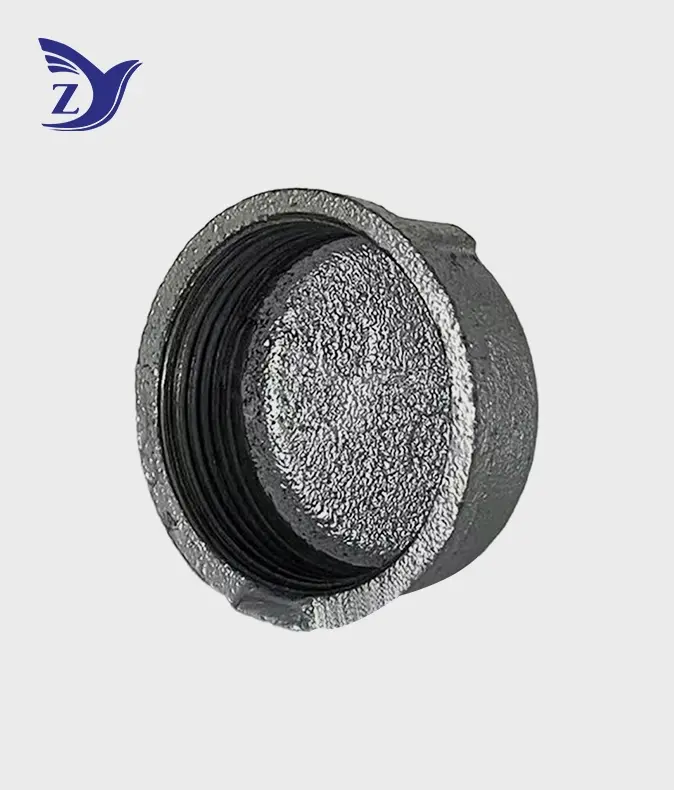
Understanding Galvanized Pipe Cap Fittings
When working with complicated piping networks, keeping open pipe ends safe is a very important job that has a direct effect on the safety and longevity of the system. Galvanized pipe caps protect pipe ends from debris, moisture, and thread wear by sealing them off. Galvanized pipe cap pipe fittings keep connections clean and free of corrosion on building sites, in city water systems, and in factories. They protect infrastructure investments and are ready for instant service or future growth.
Primary Functions and Industry Applications
When you need both mechanical strength and rust protection, ductile iron pipe caps are the best choice. In fire safety systems, these fittings keep the system ready for emergencies by keeping outside materials from getting in the way of the sprinklers and standpipe outlets. Threaded pipeline seals are used by municipal water distribution networks to protect open branches during phased construction. This makes sure that neighborhoods can connect to supply mains without any contamination. These corrosion-resistant caps are used to safely close off branch lines on gas transmission lines. They meet strict safety standards and stop leaks in volatile environments.
Chemicals and high humidity speed up the breakdown of metal in process water loops, cooling towers, and wastewater treatment systems, which is why industrial facilities use sturdy pipeline caps. The hot-dipped galvanized coating works as a protective shield, making the steel last decades longer than steel that isn't protected when it's installed outside where it will be exposed to rain, snow, and changes in temperature.
Threaded Types and Sizing Standards
Knowing about threads compatibility makes sure that the closing works right and keeps expensive installation delays from happening. NPT (National Pipe Taper) valves meet the requirements of ANSI/ASME B1.20.1. They have a 60-degree thread angle and a 1:16 taper ratio that are commonly used in North American markets. BSPT (British Standard Pipe Taper) versions follow ISO 7-1 standards and have a Whitworth thread angle of 55 degrees. These are common in international projects and systems that were built in places where British engineering practices were common.
Key Factors in Choosing Galvanized Pipe Cap Fittings
To choose the right pipe end seal, you need to carefully look at the operating conditions, legal standards, and supply chain issues. When people make decisions, they use organized criteria to make the buying process easier. This makes installation easier and ensures long-term stability in a variety of settings.
Material Quality and Standards Compliance
Certifications that check the composition of materials make sure that galvanized pipe cap pipe fittings meet structural and safety standards. According to ASTM A197 standards, malleable iron is flexible enough to handle shock loads without breaking. This is very important for pipe systems that are subject to water hammer or thermal expansion cycles. Fittings that can survive installation stresses and operating pressures are made using processes that include annealing, which is a series of heat treatment cycles that turn brittle white cast iron into flexible black heart structures.
Quality certifications like ISO 9001, UL, and FM approvals show that strict production controls are being followed. When buying fire safety equipment, these references are especially important because UL and FM listings show that the fittings have been tested for pressure and size, which is needed by building codes and insurance companies.
Environmental Conditions and Coating Durability
The installation environment determines the coating thickness needed and other protection strategies. Facilities near the coast are more likely to rust because the air is salty, so they need thicker zinc coatings and regular checks. When acidic fumes are too much for zinc alone to protect against, chemical processing plants may need to put epoxy topcoats on top of galvanizing surfaces.
Hot-dipped galvanizing according to ASTM A153 standards makes coatings that are about 3.9 mils (100 microns) thick, which is thick enough to last for decades in normal weather. This process metallurgically bonds zinc to the base iron, making a stacked structure that is stronger than electroplated options that can break when put under stress.
Supplier Evaluation and Procurement Best Practices
Setting up trustworthy relationships with suppliers protects project schedules and quality standards. When looking at potential partners, you should check their production capacity, inventory depth, and ability to meet specific needs. Suppliers who keep standard sizes in stock can quickly fill orders for emergency repairs, and those who offer OEM/ODM services can meet special threading needs or make changes to dimensions so that specialized equipment can be integrated.
When planning bulk purchases with building plans, it's important to know how long the lead time is. Manufacturers with various production lines can increase output to meet high demand without lowering quality. On the other hand, manufacturers with only one plant may have trouble during busy times. Before placing a big order, asking for sample amounts lets you check the thread accuracy, coating uniformity, and dimensional consistency in a way that specs alone can't.
Advantages and Application Scenarios of Galvanized Pipe Caps
Understanding how products work and how they are used in the real world helps procurement workers match product features to practical needs and show stakeholders the value of the product.
Performance Benefits in Harsh Environments
When industrial water systems are outside, they are constantly exposed to changes in temperature, rain, and air pollutants that eat away at metals that aren't protected. Hot-dipped galvanizing makes a multilayered defense with an iron-zinc alloy layer bonded to pure zinc layers on the outside. This structure can handle being handled and put together, and it will still provide sacrificial protection even if cuts on the top reveal layers below.
Test results from accelerated rust tanks show that in marine settings, galvanized fittings last 15-20 years longer than black iron options. In moderate climates, the zinc coating corrodes at a rate of 1 mil every 7–10 years, so it won't need to be fixed for decades. Because it lasts longer, it costs less over its entire life because it doesn't need to be replaced as often and doesn't need as much downtime for maintenance.
Sealing Reliability in Critical Systems
In an emergency, when the system has to be activated right away, fire defense networks need to be completely reliable. The tapered thread geometry in NPT and BSPT designs makes metal-to-metal contact that gets tighter under pressure. This makes the seal stronger as the system demands more. This mechanical benefit is better than elastomeric seals, which can break down over time from being exposed to chemicals or high temperatures.
This sealing ability is used in gas distribution to meet strict safety codes that don't allow detectable leaks. The stiff connection stays strong even when the ground moves and the temperature changes, which would damage compression joints or flanged connections that aren't properly maintained.
Emerging Technological Developments
Advanced coating formulas now include rust inhibitors directly in zinc matrices, which increases protection in places where stainless steel solutions were needed before. Nanotechnology-enhanced galvanizing processes are being worked on to make coatings that are thicker than those made with traditional methods while still being flexible. This could double the service life in harsh conditions.
Sustainable manufacturing programs focus on annealing methods that use less energy and zinc recovery programs that are better for the earth. Natural gas annealing furnaces, like the Blue Sky HTL-1 systems used by forward-thinking companies like Zhiyuan Malleable Steel, reduce carbon emissions compared to coal-fired furnaces while also making temperature control more accurate, which improves the consistency of the metal.
Conclusion
To choose the right galvanized pipe cap pipe fittings, you have to balance technical needs, environmental issues, and the practicalities of buying them so that you can protect your system reliably at a price that you can afford. When you combine high-strength, malleable iron with a hot-dipped zinc coating, you get corrosion resistance and mechanical durability that are important for water, gas, and industrial uses that range from city infrastructure to commercial buildings. When engineers and procurement professionals know about threading standards, material certifications, and the best ways to install things, they can choose fittings that keep systems intact over long service lives and help projects run smoothly by working with reliable suppliers.
FAQs
How do galvanized caps compare to black pipe caps in corrosion resistance?
Because of their zinc coating, which serves as a sacrificial barrier preventing oxidation of the base metal, galvanized pipe cap pipe fittings outperform black iron alternatives. Galvanized pipe caps can withstand the weather for decades without needing any extra treatments, while black ones need to be painted right away or replaced often when used outside.
Are threaded galvanized caps suitable for high-pressure water systems?
When they are the right size and installed according to the manufacturer's instructions, NPT and BSPT threaded caps can handle water pressures up to 300 psi. These fittings are good for city water mains, fire suppression stairs, and industrial process loops that work within normal pressure ranges because the tapered thread geometry makes metal-to-metal seals that get stronger under pressure.
What considerations matter when ordering custom caps in bulk?
Early communication of thread standards, minimum sizes, and coating needs keeps output from being held up. For large orders, it's helpful to ask for pre-production models to make sure the dimensions are correct and the finish is good before starting full production runs. Making packing choices clear, like using export-grade double-layer cardboard protection, helps make sure that goods arrive unharmed when they are shipped internationally.
Partner with Zhiyuan Malleable Steel for Quality Galvanized Pipe Cap Solutions
Zhiyuan Malleable Steel has been casting for 26 years and has advanced production skills that can help buying teams that need reliable, approved galvanized pipe cap pipe fittings. Our annual production capacity of 30,000 tons and inventory depth of over 1,000 specifications allow for quick fulfillment. For urgent projects, standard products ship within two hours. Galvanized pipe cap pipe fittings are made by a company with ISO 9001, UL, and FM certifications. We make sure the quality of every unit by testing its airtightness with a pneumatic system and checking its threads carefully. Customization through ODM/OEM allows for special threads, changes to dimensions, and better coatings for specific uses. Contact our engineering team at q1236800000@gmail.com to talk about your needs, get technical specs, or set up a visit to our headquarters in Shanxi. Learn how our guarantee for replacing defective products and export-standard packaging protect your investment from the time you place your order until it is installed. You can see all of our products at zymalleablepipefitting.com and be sure that you'll have enough for your next project.
References
- American Society of Mechanical Engineers. (2020). ASME B1.20.1: Pipe Threads, General Purpose (Inch). New York: ASME Standards Press.
- International Organization for Standardization. (2018). ISO 7-1: Pipe Threads Where Pressure-Tight Joints Are Made on the Threads - Part 1: Dimensions, Tolerances and Designation. Geneva: ISO Publications.
- American Society for Testing and Materials. (2019). ASTM A197: Standard Specification for Cupola Malleable Iron. West Conshohocken: ASTM International.
- American Society for Testing and Materials. (2017). ASTM A153: Standard Specification for Zinc Coating (Hot-Dip) on Iron and Steel Hardware. West Conshohocken: ASTM International.
- National Fire Protection Association. (2021). NFPA 13: Standard for the Installation of Sprinkler Systems. Quincy: NFPA Publications.
- British Standards Institution. (2016). BS 21: Specification for Pipe Threads for Tubes and Fittings Where Pressure-Tight Joints Are Made on the Threads (Metric Dimensions). London: BSI Standards Limited.
Online Message