
Aug 5, 2026
Galvanized Male Female NPT Threaded Union Fig 341 vs Regular Couplings: Which Fits Your Project
Knowing the differences between normal couplings and NPT galvanized male female threaded union 341 pipe fittings can save you time, keep your pipes from leaking, and lower your repair costs. The Fig 341 union is a precision-engineered connection that can be taken off and put back on. It is made for systems that need to be accessed or inspected often, while regular couplings are easier to install and stay in place. Which of these choices you choose will rely on the pressure needs of your project, how often it needs upkeep, the environment, and the limitations of the installation. Both play important roles, but their long-term performance, closing systems, and structural designs are very different, which has a direct effect on how they are bought and how reliable they are in use.
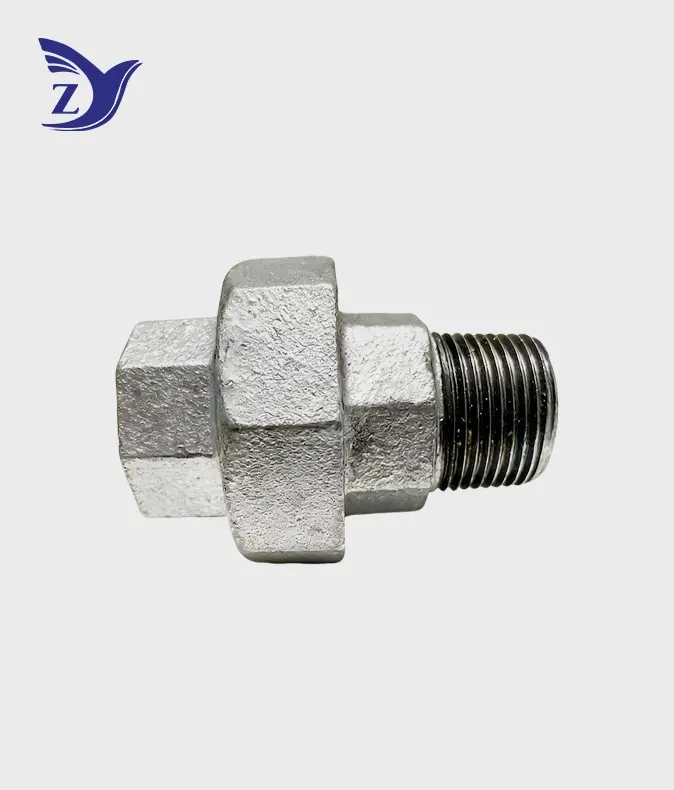
Galvanized Male Female NPT Threaded Union Fig 341
The Fig 341 union is a special type of dual-threaded, detachable pipe joints that were made to solve a problem that has been around for a long time in industrial piping: how to separate pipes without turning them around. This male-female pipe joiner is made up of three precision-machined parts: a male threaded end, a female threaded end, and a union nut that holds the link in place. The fitting meets the standards of ASME B16.39 for unions and ASME B1.20.1 for NPT threads. This makes sure that the dimensions are correct and that threads from different makers can be used together.
Material Composition and Galvanization Process
These fittings are made from high-strength, anti-rust, malleable iron that meets ASTM A197 standards. They have a minimum tensile strength of 40,000 psi (276 MPa) with 5% expansion. When annealing is done, brittle cast iron is turned into flexible, moldable metal that doesn't break easily when force is applied or pressure rises. Hot-dipped galvanized surfaces meet ASTM A153 standards by covering them with zinc coats that are more than 85 microns thick. This protects against both air corrosion and rust caused by fluids. This treatment for the NPT galvanized male female threaded union 341 pipe fittings makes it much more resistant to rust. It also makes the fitting last a lot longer in places like chemical plants, outdoor installations, and places with a lot of moisture where painted or black steel fittings break down quickly.
Thread Design and Sealing Mechanism
The NPT thread shape has a flank angle of 60 degrees and a 1:16 taper. This makes a wedging action that seals the connection mechanically when pressure is applied. The Fig 341 doesn't use plastic gaskets, which can break down over time. Instead, it uses a precision-machined metal-to-metal spherical-to-coronal seat that stays intact at high temperatures and can handle thermal cycles without the seal failing. This fitting for an industrial water or gas pipeline can handle a small amount of displacement during installation while still keeping its leak-proof performance up to Class 150 ratings (300 psi at water, oil, or gas service conditions). The easy disassembly feature that works with both NPT and BSPT connections lets repair teams get to valve parts or change pipeline sections without messing up connections next to them, which is something that regular couplings can't do.
Galvanized Male Female NPT Threaded Union Fig 341 vs Regular Couplings: Core Differences
The structural differences between these types of fittings make them completely unsuitable for some uses. By knowing these differences, procurement professionals can make decisions that save money on both the original costs and the costs over the course of the product's life.
Reversibility and Maintenance Access
Regular couplings make lasting connections by fitting onto male pipe ends from both sides. When installing or removing them, the pipe has to be fully rotated. When workers need to fix a valve or instrument that is between two pipe runs, they have to cut pipes or take apart large parts. This problem is solved by the NPT galvanized male female threaded union 341 pipe fittings. The union nut on this part can freely move around the male threaded piece. To disconnect, just back off the nut—no need to turn the pipe. This feature greatly lowers downtime in fire safety systems, process control installations, and public water networks where entry to equipment decides how well maintenance is done.
Corrosion Resistance and Environmental Suitability
Both types of fittings can have galvanized finishes, but the electroplated zinc coats on normal couplings are usually only 8 to 12 microns thick, while quality unions are usually hot-dip galvanized. When you hot-dip galvanize something, a mechanical bond is formed that keeps it from flaking or breaking while it's being handled or installed. This is especially important when threading, which can damage thinner coats. Precision-threaded, hot-dipped galvanized unions offer better safety for outdoor uses in coastal areas, wastewater treatment plants, and chemical processing plants. They keep their structural integrity over decades of exposure.
Pressure Capacity and Safety Factors
When made correctly, both valves meet Class 150 pressure rates, which means they can handle 300 psi at room temperature for use with water, oil, and gas. But the Fig 341's metal-to-metal binding surface is useful in steam situations where rubber parts break down. The lack of seals gets rid of a common way for things to fail, and the building of malleable iron protects against shocks, which stops catastrophic cracks. Regular couplings work well for fixed setups with low risk, but union designs are better for systems that need to be very reliable when temperatures change or when they are vibrated.
How to Choose the Right Pipe Fitting for Your Project?
To choose between these fitting configurations, you need to carefully consider your working needs, the surroundings, and the total cost of ownership. The choice process should take into account a number of factors that affect the success of the project right away as well as the long-term performance of the system.
Pressure and Temperature Requirements
Class 150 fittings can handle most business and light industrial tasks. They can handle 150 psi of steam service and 300 psi of cold working pressure. In industrial plants or power plants with high-pressure systems, Class 300 unions with a 600 psi working pressure rating may be needed. Temperature is very important. Galvanized surfaces can handle temperatures up to 392°F (200°C) before the zinc starts to evaporate, but being exposed to temps above 300°F for a long time speeds up the coating's breakdown. For projects that need to be used at high temperatures all the time, makers should be consulted about special coats or other materials. Regular connections are enough to distribute water at room temperature, but union fittings are worth the extra cost for important systems that need to be able to be inspected.
Maintenance Frequency and Accessibility
Companies that work with fire safety engineering know that NPT galvanized male female threaded union 341 pipe fittings make it possible to quickly change parts without having to disturb underground mains or riser pipes when building sprinkler systems around valves, backflow preventers, and test connections. Municipal water companies that have to deal with old infrastructure put an emphasis on links that work and don't cost a lot to dig. On the other hand, permanent underground placements in new building projects where entry will not be needed in the future may prefer cost-effective couplings that do away with the need for three-piece assemblies. Find the present value of the upkeep costs that will not be paid over a 20-year service life. Systems that need to be inspected or parts replaced every two years can often support higher-cost fittings by saving money on work.
Environmental Exposure and Corrosion Risk
Chloride, hydrogen sulfide, and acidic condensates can speed up rusting in coastal sites, wastewater treatment plants, and chemical processing plants. When compared to electroplated options, hot-dip galvanized unions offer significantly better protection. The thickness of the coating acts as a usage limit that extends the time until failure. Inside buildings that have temperature control and cleaned water have less severe conditions where standard galvanized connections work well. Use the ISO 9223 classification or NACE standards to find out how corrosive the environment is so that you can match the right protective coatings. Environments with middling corrosivity (C3) can handle normal fittings, but environments with high corrosivity (C4–C5) need special hot-dip protection.
Supplier Capabilities and Certification Compliance
Strategies for buying things should stress that companies keep their ISO 9001 quality management systems up to date and show proof that they follow ASTM and ASME standards for dimensions and materials. For use in potable water, products must have NSF/ANSI 61 approval that says they are lead-free and don't leach harmful chemicals into the water. For fire safety systems, UL or FM approval is needed to make sure that the pressure values and thread correctness are correct. Supply chain disruptions can be lessened by building relationships with providers who offer technical help, the ability to make products to specific sizes, and regular inventory availability. When you arrange bulk buying deals with certified makers like Zhiyuan Malleable Steel, you can save money and make sure that all of your multinational projects follow the rules.
Conclusion
Picking between Fig 341 unions and regular connections depends on how often you need to maintain them, how much pressure they can handle, and the situations where they will be used. The NPT galvanized male female threaded union 341 pipe fittings' detachable form is useful for systems that need to be accessed on a frequent basis, while regular couplings are better for fixed setups that value simplicity. When made to accepted standards and fitted properly, both choices work consistently, but hot-dip galvanized unions last longer in harsh settings because they are more resistant to corrosion. Total cost of ownership is minimized over many years of system use by focusing on strategic buying that includes certified sources, full expert support, and good business terms.
FAQs
What distinguishes NPT from BSPT thread standards?
National Pipe Taper (NPT) threads follow ASME B1.20.1 and have a 1:16 taper and a 60-degree side angle. These threads are most common in North American markets. The BSPT (British Standard Pipe Taper) has a 55-degree Whitworth thread form that is standard in ISO 7-1 and is popular in installations in Asia and Europe. Both make tapered seals, but they can't be switched out for each other. Doing so will cause leaks and damage to the threads. When buying, be sure to specify the thread type to make sure it works with the current pipe system.
How does galvanization enhance union longevity?
Hot-dip galvanization makes a layer of industrial zinc-iron mixture that corrodes before the base metal is exposed. If the coating is thicker than 85 microns, it will protect against the elements for decades, while painting or electroplated surfaces will break after 5 to 10 years of the same circumstances. The method meets the requirements of ASTM A153 and provides even covering, including thread roots that spray treatments often miss.
Are Fig 341 unions suitable for high-pressure systems?
Class 150 unions can handle 150 psi of steam service and 300 psi of cold working pressure, which is enough for most business needs. For systems with higher pressures than these, you need Class 300 fittings that can handle 600 psi. Before selecting unions for important systems, check the pressure embossments made by the manufacturer and ask for material certificates that prove the mechanical properties.
Partner with Zhiyuan Malleable Steel for Premium NPT Galvanized Male Female Threaded Union 341 Pipe Fittings
Zhiyuan Malleable Steel can help you with your industrial pipe needs with its 26 years of casting experience and 30,000-ton yearly capacity. Our NPT galvanized male female threaded union 341 pipe fittings are made to strict ISO 9001, UL, and FM standards. They give your projects the rust protection and exact measurements they need. We keep a lot of stock on hand, so we can give standard specifications within two hours. Our customization options meet the special needs of OEMs. You can email our technical team at q1236800000@gmail.com to get customized quotes, bulk deals, and free samples to make sure the quality before you sign. As a top provider of NPT galvanized male female threaded union 341 pipe fittings, we offer low prices, flexible payment options, and focused support to make sure your purchase goes smoothly.
References
- American Society of Mechanical Engineers. (2018). ASME B16.39: Malleable Iron Threaded Pipe Unions Classes 150, 250, and 300. ASME International.
- American Society of Mechanical Engineers. (2013). ASME B1.20.1: Pipe Threads, General Purpose (Inch). ASME Standards Committee B1.
- ASTM International. (2017). ASTM A197: Standard Specification for Cupola Malleable Iron. ASTM Material Standards.
- ASTM International. (2016). ASTM A153: Standard Specification for Zinc Coating (Hot-Dip) on Iron and Steel Hardware. ASTM Coating Standards.
- National Fire Protection Association. (2019). NFPA 13: Standard for the Installation of Sprinkler Systems. NFPA Codes and Standards.
- NSF International. (2020). NSF/ANSI 61: Drinking Water System Components – Health Effects. NSF Certification Standards.
Online Message