
Aug 20, 2026
Galvanized Bushing Pipe Fittings for Industrial and Plumbing Applications
Galvanized bushing pipe fittings are precision-engineered connectors designed to transition between pipes of differing diameters while delivering superior corrosion protection through hot-dip zinc coating. These threaded reducers serve as critical components in industrial water systems, gas distribution networks, HVAC installations, and fire protection infrastructure. Manufactured from malleable iron or forged carbon steel and conforming to ANSI/ASME B1.20.1 and ASTM A153 standards, these fittings address essential challenges: enabling space-efficient size adaptation, preventing galvanic corrosion in demanding environments, and ensuring leak-proof transitions across complex piping networks.
Understanding Galvanized Bushing Pipe Fittings
What Makes These Fittings Essential for System Integration
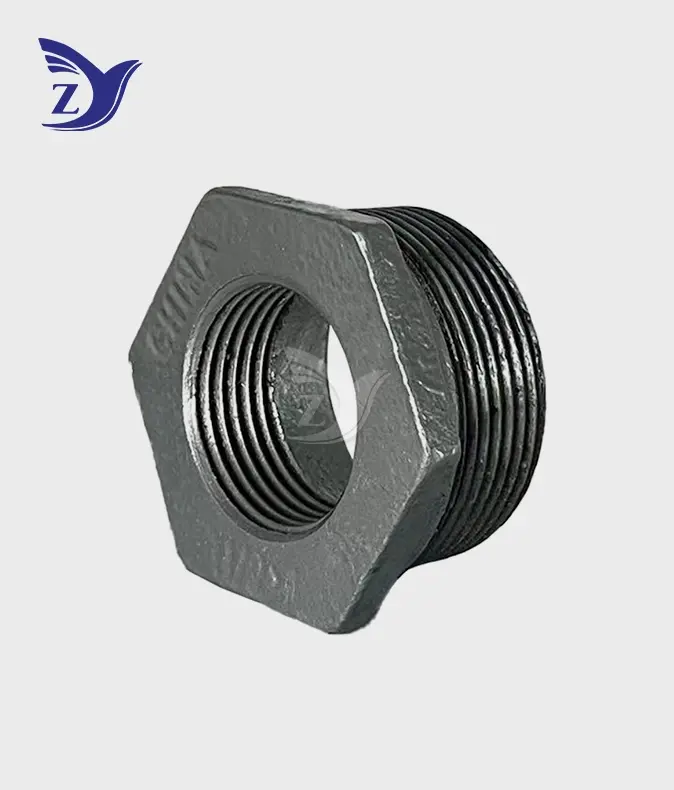
Galvanized bushing pipe fittings are a special kind of pipe adapter that has smaller male threads on the outside and female threads on the inside. During the hot-dip galvanization process, a protective zinc layer of about 85 microns is added to the base metal. This turns ordinary galvanized bushing pipe fittings into corrosion-resistant parts that can withstand salt spray exposure for more than 500 hours. This treatment is necessary for outdoor city pipelines, chemical processing plants, and sites near the coast, where water speeds up the rusting process.
Either NPT (National Pipe Taper) or BSPT (British Standard Pipe Taper) standards are used for the threading setup. Each has its own closing properties. NPT threads have a side angle of 60 degrees and a taper ratio of 1:16. This makes metal-to-metal interference fits that are better when thread protectors are used. BSPT versions use 55-degree Whitworth angles that meet ISO 7-1 standards, so they offer the same level of sealing integrity in all kinds of international situations. Both types can handle Class 150 pressures (300 psi at water-oil-gas service), and for high-demand situations, they can be updated to Class 300.
Technical Specifications That Define Performance
The makeup of the material directly affects how well the galvanized bushing pipe fittings work. As per ASTM A197, malleable iron has a minimum tensile strength of 40,000 psi and a maximum extension of 5%. It is a good balance between mechanical robustness and machinability. The galvanizing layer acts as a sacrifice anode—zinc corrodes more slowly to protect the iron below, making the material last a lot longer than black steel alternatives. Temperature stability runs from -20°F to 350°F to suit a wide range of working conditions. However, proper installation methods are needed because of thermal expansion issues.
Dimensional compliance with ASME B16.14 makes sure that galvanized bushing pipe fittings from different manufacturers can be used together. Some of the options that are available are hexagonal heads for engaging wrenches and flush face versions for tight areas. Precision in the thread is still very important—machining limits of less than 0.002 inches ensure proper contact and stop cross-threading during installation, which greatly lowers the rate of field rejection.
How to Choose the Right Galvanized Bushing Pipe Fittings for Your Project?
Material Selection and Compatibility Considerations
The first step in making a procurement decision is to look at the system fluid's properties and its exposure to the environment. When the pH level stays between 6.5 and 8.5, galvanized bushing pipe fittings work great in natural gas, compressed air, rainwater, and light chemical environments. Caution is needed around chlorinated water systems because long-term exposure can speed up zinc loss, so upkeep plans need to be changed to fit the water chemistry in the area. The coating's chemical inertness is good for oil applications, but hydrogen sulfide means that stainless steel needs to be upgraded.
Comparing options makes value statements clearer. Black steel costs 15–20 percent less at first, but in wet places, it needs to be coated with a protection layer or replaced every three to five years. Stainless steel bushings don't rust at all, but they cost a lot more than galvanized bushing pipe fittings—usually three to four times as much—and should only be used in pharmacy, food processing, or naval settings. Brass pipe fittings look nice and don't rust too badly, but they're not strong enough for high-pressure industrial systems, so they can only be used in home plumbing.
Certification Requirements and Quality Verification
Real suppliers give full records that show where the galvanized bushing pipe fittings came from and how they were made. Quality management systems are approved by ISO 9001 certification, and material test reports (MTRs) use spectrographic analysis to confirm chemical composition and mechanical properties. Third-party inspection certificates from groups like UL or FM prove that fire prevention is appropriate, which is very important for city water systems and business building rules.
Checking the thread size during the receiving check stops installation problems before they happen. GO/NO-GO gauges make sure that the measurements of the galvanized bushing pipe fittings are correct; GO gauges should thread smoothly, while NO-GO gauges should stop within three threads. Coating flaws can be seen with the naked eye: a uniform gray color without any bare spots, blisters, or too much roughness means the galvanizing is done right. Using magnetic scales to measure the thickness of the coating makes sure that it meets the minimum requirements, which are usually between 2 and 3 mils for the best security.
Procurement and Sourcing of Galvanized Bushing Pipe Fittings
Wholesale Versus Project-Based Purchasing Models
Distributors that serve regional markets put a high value on having a wide range of galvanized bushing pipe fittings in stock. Keeping full size ranges from 1/8" to 4" in stock lets them fill orders right away for both routine and emergency repairs. Most volume agreements start at 1,000 pieces per size, which means you can save 15–25% off of regular prices. Consignment inventory arrangements let providers handle holding costs while ensuring availability. This is especially helpful for public services that have to deal with unpredictable changes in demand.
Buyers who are focused on the project put more value on on-time delivery than on cost per unit. When engineering firms define systems for business building, they need certified material documentation to go with each shipment lot of galvanized bushing pipe fittings. This makes it possible to track the materials throughout the installation process. Phased delivery schedules line up the arrival of fittings with construction milestones, which cuts down on the need for on-site storage and the risk of theft. When unexpected needs come up, expedited shipping options, like two-hour fulfillment for standard sizes from strategically located warehouses, keep projects from being held up and costing a lot of money.
Evaluating Manufacturers and Building Supply Partnerships
Over the past 18 years, Zhiyuan Malleable Steel has improved its manufacturing processes so that it can offer consistent quality and quick service. We keep a deep stockpile of more than 1,000 product specs and run 8 medium-frequency electric furnaces that produce 30,000 tons of galvanized bushing pipe fittings every year. Our factory in Shanxi Province is close to sources of raw materials and has easy access to transportation. It's only 40 kilometers from Taiyuan and 30 minutes from the airport, so we can quickly ship goods to other countries and distribute them in the United States.
Our quality control system uses ISO 9001 rules in four stages of production that work together: precision casting, heat treatment in 100-ton natural gas annealing kilns, hot-dip galvanizing in electric environmental furnaces, and CNC machining through 156 dedicated processing units. Certifications from CE, UL, and FM show that the galvanized bushing pipe fittings meet international standards for fire safety and pressure equipment. Standard goods are shipped within two hours of receiving an order. ODM/OEM customization options can be used for non-standard requirements that need engineers to work together.
Conclusion
To choose the right galvanized bushing pipe fittings, you have to weigh the technical requirements, licensing needs, and lifetime costs against the needs of the application. Because they are made to be corrosion-resistant and to exact measurements, these threaded adapters have been used successfully in industrial water systems, local gas distribution, fire protection networks, and HVAC installs. Procurement professionals can improve system reliability while keeping total cost of ownership low by learning about material properties, best installation practices, and maintenance protocols. Strategic relationships with qualified makers guarantee consistent quality, a steady supply chain, and expert support throughout the lifetime of a project.
FAQs
What primary advantages do galvanized bushings offer industrial applications?
When used outside in humid conditions, hot-dip zinc coating protects against corrosion by sacrificing itself, making the galvanized bushing pipe fittings last 3–5 times longer than black steel alternatives. The iron substrate can be shaped and can handle mechanical shock and changing temperatures while keeping its pressure integrity. Cost-effectiveness comes from using less expensive materials than stainless steel alternatives, without sacrificing performance in the right working circumstances.
Can galvanized fittings integrate with stainless steel piping systems?
When there is a direct link between galvanized bushing pipe fittings and stainless steel, galvanic cell conditions are created, which make zinc rust more quickly. Dielectric unions or insulating gaskets stop electricity from flowing between metals that are not the same, which slows down the breakdown process. Bronze bushings, on the other hand, can be used as transitional parts that work with both materials.
What lifespan should buyers expect under normal operating conditions?
When put correctly, galvanized bushing pipe fittings that are used in freshwater or natural gas service usually last between 15 and 25 years before they need to be replaced. Service life depends on the nature of the water, how often the temperature changes, and how well the system is maintained. Depending on how bad the exposure is, coastal structures or filtered water systems may need to be replaced every 10 to 15 years.
Partner with a Trusted Galvanized Bushing Pipe Fittings Manufacturer
Zhiyuan Malleable Steel can help you with your industrial and plumbing projects by combining high-quality manufacturing with customer-focused service. We have a huge selection of products, including NPT and BSPT threaded reducers, corrosion-resistant adapters, and precision-machined galvanized bushing pipe fittings in a range of sizes that meet ASTM, ISO, and ASME standards. Take advantage of our ability to produce 30,000 tons of goods every year, our normal shipping time of two hours, and our ODM/OEM customization options, all backed by CE, UL, and FM certifications. Email our technical team at q1236800000@gmail.com to talk about your specific needs and get full product specifications. You can look at our full selection of galvanized bushing pipe fittings for sale at zymalleablepipefitting.com. You'll also learn how our dedication to quality and quick service create long-lasting value for fire protection contractors, municipal engineers, and industrial procurement professionals all over North America.
References
- American Society of Mechanical Engineers. "ASME B16.14: Ferrous Pipe Plugs, Bushings, and Locknuts with Pipe Threads." ASME Standards Committee, 2021.
- ASTM International. "ASTM A153: Standard Specification for Zinc Coating (Hot-Dip) on Iron and Steel Hardware." ASTM Volume 01.06 Coated Steel Products, 2020.
- National Fire Protection Association. "NFPA 13: Standard for the Installation of Sprinkler Systems." NFPA Codes and Standards, 2022 Edition.
- International Organization for Standardization. "ISO 7-1: Pipe Threads Where Pressure-Tight Joints Are Made on the Threads." ISO Technical Committee 5, 2019.
- American Water Works Association. "AWWA Manual M11: Steel Pipe—A Guide for Design and Installation." AWWA Publications, 5th Edition, 2020.
- Zinc Coating Manufacturers Association. "Lifecycle Performance of Hot-Dip Galvanized Steel in Municipal Infrastructure Applications." Technical Research Report, 2021.
Online Message