
Oct 19, 2026
Galvanized 90° Reducing Elbow Buying Guide for Industrial Projects
If you work in industrial procurement or pipe distribution, you already know how much one wrong fitting can cost a project. This guide walks through everything you need to know about selecting a galvanized 90° reducing elbow — from material specs and thread standards to installation tips and supplier selection. Whether you're sourcing for plumbing, HVAC, gas pipelines, or water distribution systems, the right reducing elbow keeps flow moving efficiently while protecting your margins and your reputation downstream.
Understanding Galvanized 90° Reducing Elbows
It's helpful to know exactly what you're getting before you place a large order. That's not what a lowering elbow is—it does two things at once.
What It Is and How It Works?
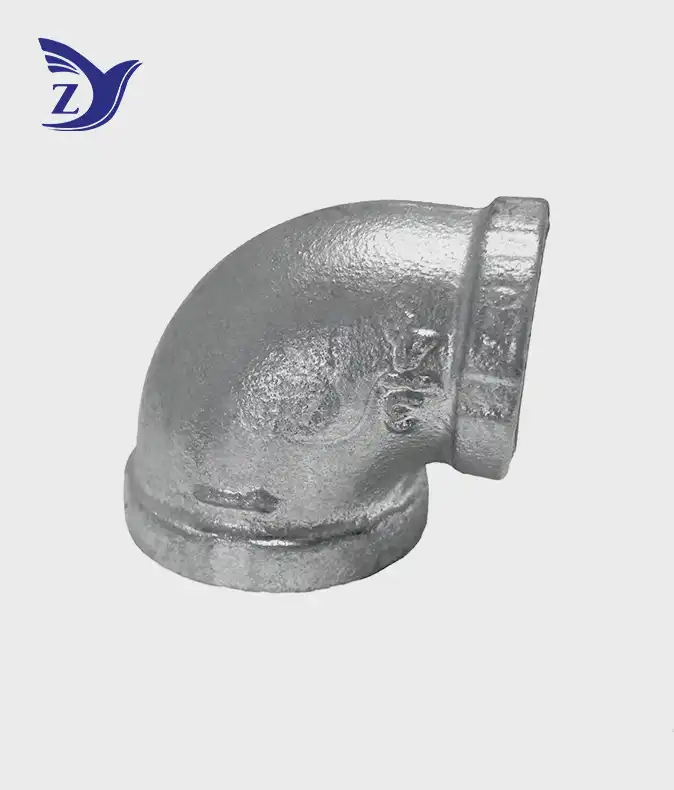
The 90-reducing elbow is a flexible iron pipe fitting that changes the direction of flow by 90 degrees and also changes from a larger pipe diameter to a smaller one at the same time. The fitting is rust-free since it is galvanized in the hot dip process, often with zinc at a thickness of more than 85 microns as per ASTM A153. Male-female NPT/BSPT dual-threaded design for direct connection without the need for additional bushings. That means less time spent setting up, and fewer spots where leaks may happen.
Material and Manufacturing Standards
Most industrial-grade galvanized 90° reducing elbows are made from malleable iron that meets ASTM A197 standards, and the threads are carefully cut to meet ASME B1.20.1 (NPT) or BS 21 (BSPT) standards. The 60-degree thread angle makes a mechanical taper lock that keeps pressure in oil, gas, and water lines. For instance, Zhiyuan Malleable Steel uses medium-frequency electric furnaces and special galvanizing equipment to make sure that all of its hot-dipped galvanized, precision-threaded malleable iron fittings stick to each other the same way.
Size Range and Customization
Standard reduction elbows are available with NPT and BSPT threads in a wide range of diameters from 1/4″ × 1/8″ to 2″ × 1-1/2″. For distributors serving a broad variety of downstream customers, having access to 1,000+ SKUs from a single source is a huge assistance. You may use ODM and OEM services to label your own or adjust the size to suit a certain country’s project.
Comparing Galvanized 90° Reducing Elbow with Other Types
Not all projects need coated iron that can be shaped. Purchasing managers can make better choices about what to buy when they know how it compares to other options.
Galvanized vs. Black Iron
Black iron, which can be sculpted, is cheaper initially but has no surface protection. Dry indoor areas are fine for this. Black iron rusts fast if it is exposed to excessive humidity, the weather or substances that react with it. Galvanized and black iron should not be used together in the same water system because it might accelerate the galvanic corrosion of black iron parts hence it is crucial that the materials used throughout a pipeline system are consistent .
Galvanized vs. Stainless Steel
Stainless steel does not rust as quickly in particularly acidic or chlorine environments but it costs significantly more per fitting - generally 3-5 times more than galvanized malleable iron. In most conventional industrial water and gas distribution systems, the zinc coating on a hot-dip galvanized elbow will offer enough protection at a fraction of the cost. This makes it the logical option for big volume distribution projects where cost management is vital.
Galvanized vs. PVC or CPVC
Malleable iron fittings can withstand more pressure, but plastic fittings are lighter and cheaper to produce. Class 150 galvanized fittings can withstand 300 psi WOG (water, oil and gas) which is more than plastic can manage in industrial situations with high temperatures or pressures.
How to Choose the Right Galvanized 90° Reducing Elbow for Your Needs?
It takes more than matching pipe diameters to choose the right fitting. During the buying process, you should pay attention to a number of technical and business factors.
Match Thread Standards to Your Market
People in North America mostly use NPT, while people in the UK, Southeast Asia, and some parts of the Middle East use BSPT. When working with clients from different markets, a galvanized 90° reducing elbow with two threads that works with both standards gives wholesalers more options. Before placing a container order, you should always make sure that the thread standard is compatible.
Verify Zinc Coating Thickness
Request test reports confirming that the zinc coating thickness complies with ASTM A153. A good technique to assess the field is to use a magnetic thickness gage on sample fittings to measure thicknesses of 85 microns or more. If the coating is too thin, or uneven, it will rust fast, and have to be returned. That rapidly eats into wholesale margins.
Evaluate Supplier Reliability and Certifications
Work together with the galvanized 90 degree reduction elbow suppliers that have ISO 9001, CE, UL or FM certifications and are famous all over the globe. These show control on manufacturing process and performance of the outcome. Zhiyuan Malleable Steel is ISO 9001 certified, and has been following the manufacturing requirements since 2006. They manufacture 30,000 tons of steel a year and have regular supply schedules to accommodate container-load requests from wholesalers across the globe.
Installation Guide and Best Practices
When installed wrong, even the best fitting doesn't work as well as it should. If you follow the right steps, you can protect both the fitting and the tubing that is related to it.
Pre-Installation Checks
Inspect all fittings for zinc dross in the bore, sand in the casting or damage to the thread before threading any fitting. A fast check with an L1 ring gage on parts from each batch verifies the NPT taper depth and thread integrity. Any batch which is not properly lined up on the 90-degree axis by more than 0.5 degrees should be thrown away.
Correct Assembly Technique
Before you connect the pieces together, wrap the male threads with PTFE tape or pipe thread sealant. This lubricates the joint, repairs small imperfections in the thread and makes the seal airtight and leak-proof. Tighten by hand first, then carefully apply pressure with a wrench. For NPT connections this is normally two to three full turns beyond hand-tight. With larger sizes of lowering, overtightening might result in cracking of the body of the fitting.
Ongoing Maintenance
Regularly check outdoor or high humidity fittings for early indicators of depletion of zinc. White zinc oxide coatings are natural, protective. Red rust shows the basic iron is exposed. Fix something that’s not operating right before system leaks occur.
Conclusion
To pick the best galvanized 90-degree reducing elbow, you need to check the material standards, make sure the threads work with your market, and find a provider that can provide stable quality on a large scale. In most industrial settings, ductile iron with a good hot-dip zinc coating works better than bare iron and plastic options. Its built-in size-reducing feature also saves time and money on fittings count for every installation. Locking in a direct factory connection with documented quality controls is the clearest way for wholesalers who handle big amounts to protect margins and keep clients happy with galvanized 90° reducing elbow.
FAQ
What sizes are typically available for a galvanized reducing elbow?
Standard sizes run from 1/4" × 1/8" up to 2" × 1-1/2", covering most industrial plumbing and gas pipeline size adaptation needs. Custom dimensions are available through OEM arrangements with manufacturers.
Can I weld a galvanized malleable iron elbow?
No. Welding a galvanized fitting produces toxic zinc oxide fumes and destroys the protective coating at the weld zone. All connections should be made through precision-threaded assembly only.
Is NPT thread sealant required even on tapered threads?
Yes. NPT threads are tapered to create a mechanical seal, but PTFE tape or pipe dope fills microscopic surface gaps and lubricates assembly. Skipping sealant increases the risk of slow leaks in pressurized gas or water systems.
How do I verify galvanization quality before a bulk order?
Request a zinc coating thickness test report and inspect sample fittings with a magnetic gauge. Minimum 85 microns per ASTM A153 is the accepted benchmark for industrial-grade corrosion protection.
Can these fittings handle both water and gas service?
Yes. Class 150 malleable iron reducing elbows are rated at 300 psi WOG — meaning water, oil, and gas service — making them appropriate for both plumbing and gas distribution applications.
Request a Quote from Zhiyuan Malleable Steel
Industrial-grade galvanized 90-degree reduction elbows have been sold by Zhiyuan Malleable Steel to wholesalers in Southeast Asia, the Middle East, Africa, and other places since 2006. We can support full container sales with stable wait times because we have ISO 9001, CE, UL, and FM certifications, a capacity of 30,000 tons per year, and more than 1,000 product specifications to choose from. You can email our team at q1236800000@gmail.com or go to zymalleablepipefitting.com to get samples or a price list for galvanized 90° reducing elbow from a reputable company that makes zinc 90-degree lower elbows.
References
- American Society of Mechanical Engineers. ASME B1.20.1: Pipe Threads, General Purpose (Inch). ASME, 2013.
- ASTM International. ASTM A153: Standard Specification for Zinc Coating (Hot-Dip) on Iron and Steel Hardware. ASTM, 2016.
- ASTM International. ASTM A197: Standard Specification for Cupola Malleable Iron. ASTM, 2000.
- Nayyar, Mohinder L. Piping Handbook, 7th ed. McGraw-Hill, 2000.
- American Galvanizers Association. Hot-Dip Galvanizing for Corrosion Protection: A Specifier's Guide. AGA, 2019.
- Frankel, G.S. "Corrosion of Galvanized Steel in Atmospheric and Aqueous Environments." Corrosion Science, Vol. 42, 2000.
Online Message