
Aug 17, 2026
Do malleable iron elbows come in 1/2, 3/4, 1, 2, and 3 sizes?
Malleable iron elbows are easily accessible in 1/2", 3/4", 1", 2", and 3" diameters, and many more. These standard sizes suit the various requirements of fire protection, gas distribution, and building MEP systems globally. Sand-cast malleable iron 90 degree elbows are made from sand-cast blackheart malleable iron, providing outstanding toughness and shock resistance. These fittings have threaded female-to-female couplings, manufactured in accordance with EN10242, ASME B16.3, and GB/T3287 standards, ensuring dependable operation for water, gas, and fire-protection pipelines.
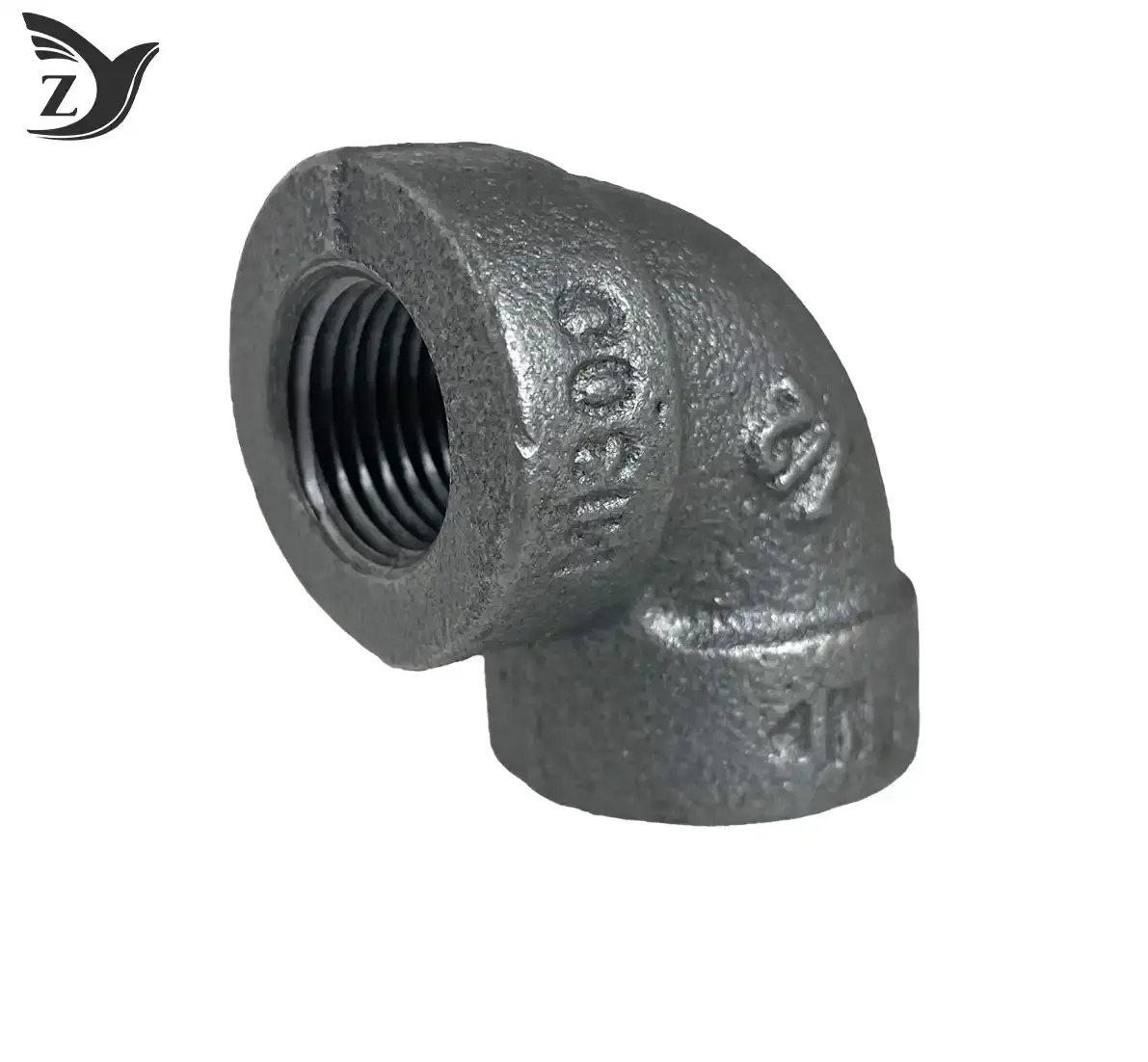
Understanding Malleable Iron 90-Degree Elbows and Their Common Sizes
Modern pipe networks make use of a lot of inexpensive, sturdy malleable iron fittings. These fittings are created by annealing white cast iron, which converts brittle carbides into nodular graphite. This results in a more flexible and more impact-resistant material than common grey iron. This shift is significant when systems are exposed to heat cycling or mechanical vibration, which may exist in commercial HVAC installations and municipal gas networks.
What Are Malleable Iron 90-Degree Elbows?
A malleable iron 90-degree elbow is a pipe fitting used to join two threaded steel pipes or nipples at a right angle. They are female-to-female threaded, thus simple to connect together with no special welding skills. This makes them ideal for field installations where speed and reliability are of great importance.
Malleable iron 90 degree elbows are appropriate for a wide range of low to medium pressure applications with a temperature range of -20°C to 300°C and a pressure range of PN16 to PN25 (1.6 to 2.5 MPa).
Standard Size Range and Industry Standards
These fittings may be 1/8” to 6”, and are compatible with tiny monitoring lines to big distribution pipes. The most popular diameters are 1/2", 3/4", 1", 2", and 3", which are the same sizes as gas pipes used in homes, companies, and offices. EN10242, ASME B16.3, and GB/T3287 all suggest the sizes should be quite similar to what they are. This means the hydraulics will always function the same way since they employ the same parts.
If you are responsible for the procurement of a lot of products, normal measurements are quite crucial. A 1” elbow from North America or Asia must have the same thread pitch, shoulder width, and center-to-end distance so the assembly doesn’t leak. These requirements are often cited by technical directors who screen suppliers to make sure that parts that don’t operate together are not jumbled together.
Key Physical and Chemical Properties
These elbows are built of black-heart malleable iron, which has been subjected to regulated cooling and annealing cycles to provide a microstructure rich in temper carbon. The material has a tensile strength exceeding 350 MPa and an elongation rate of around 10%, which is substantially greater than brittle cast iron alternatives. This mechanical resiliency results in less catastrophic failure from abrupt pressure surges, which is vital in fire prevention systems where dependability cannot be compromised.
Things with finishes on the exterior last even longer. Black finishes are attractive and are not readily rusted inside, but hot-dip galvanized coatings will provide years of protection against corrosion in severe chemical or outdoor environments. Galvanized elbows are salt spray tested and may typically last over 500 hours without red rust appearing. This is perfect for tough conditions in the Middle East and coastal installations.
Benefits and Specifications of Malleable Iron 90-Degree Elbows for B2B Procurement
When buying managers are purchasing threaded fittings, they look at three things: how long they survive when they’re loaded and unloaded numerous times, how resistant they are to electrochemical corrosion, and how excellent the paperwork is for project compliance. Malleable iron 90-degree elbows suit all three of these demands and are an excellent value, balancing the initial cost with long-term performance.
Superior Durability and Mechanical Resilience
The annealing process makes malleable iron from a substance that can sustain pressure without breaking. Installation pressures may cause strains to break hard fittings by over-torquing of threaded connections or incorrect alignment of these connections.
The additional advantage is that neither metal is adversely affected by temperature variations. When steam or chilled water is carried in pipes, the coefficient of thermal expansion of a malleable iron 90 degree elbow is very nearly that of the steel pipe. That implies the stress at the threaded interface is reduced; thus, the joint lasts longer and weeping leaks are less likely, which is what happens when materials aren't matched appropriately.
Corrosion Resistance Through Surface Engineering
Hot-dip galvanizing adds a zinc layer on top. This coating works as a barrier and a sacrificial anode. If the coating is damaged in handling, the zinc around the scratch will corrode off more rapidly, protecting the iron below. This electrochemical protection is extremely critical in fire sprinkler systems because stagnant water and uneven flow easily allow localized pitting to occur. Galvanized elbows meeting ASTM A153 requirements under these circumstances may endure for decades with minimal maintenance and longer periods between system recertifications.
If you do not believe that galvanizing is as protective, you may still use black finishes for gas distribution networks. This is because hydrocarbons prevent moisture and oxidation. And the sleek black surface is also easier to see, allowing maintenance staff to see thread galling or installation errors before the system is energized.
Comprehensive Certification and Quality Assurance
B2B customers acquire some crucial infrastructure that involves a lot of paperwork. Material test certificates (MTC 3.1) provide confidence that each manufacturing batch is produced to the appropriate chemical composition and mechanical qualities so individuals may trace the cause of issues. Thread geometry is verified by dimensional inspection reports and pressure test certifications. Project audits are the sole means for government authorities and consultants to verify supplier qualifications.
Fittings that are FM and UL approved have been third-party evaluated for fire safety applications. This offers specifiers the assurance that the product will do what it says on the tin in an emergency situation. The production plant is ISO 9001 certified, showing the application of process control and continuous improvement techniques. That reduces the likelihood of batch-to-batch variability affecting how quickly or slow building timelines move.
Comparing Malleable Iron 90 Degree Elbows to Alternative Fittings
The best material for the job is the one whose fitting qualities fit your budget and the needs of the job the best. For threaded systems, malleable iron 90-degree elbows are the most common material, but some materials are worth the extra money because of how well they work.
Carbon Steel Butt-Weld Elbows
Butt-weld fittings are better for high-pressure applications over 25 MPa, like petrochemical process lines, because their seamless weld joint doesn't concentrate stress like threaded connections do. This means they can be used in cyclic fatigue environments. However, field welding requires certified welders and radiographic inspection, which increases the time and cost of installation. A threaded malleable iron 90 degree elbow, on the other hand, can be put together faster and is easier to change during system commissioning, which makes it better for projects that value schedule certainty over maximum pressure capacity.
PVC and CPVC Plastic Fittings
Plastic fittings are lighter, easier to move, and don't react to electrochemical attacks. However, they can only handle temperatures up to 80°C for PVC and 100°C for CPVC, so they can't be used in systems that use steam or hot water. Malleable iron, on the other hand, can handle temperatures up to 300°C, which keeps it in its place in industrial heating and power generation.
Stainless Steel Threaded Elbows
If you work in a marine or pharmaceutical environment, where even galvanised coatings break down quickly, 304 or 316 stainless steel fittings will resist corrosion the best. They also look good on exposed piping in buildings. However, because they are so expensive—often three to five times as much as malleable iron—stainless steel can only be used in places where it is necessary for hygiene, looks good, or is resistant to extreme corrosion. For fire protection contractors on projects with limited funds, malleable iron is a much cheaper alternative that will still protect against corrosion.
Brass Fittings
Brass doesn't lose its zinc in drinking water systems, so it's still used a lot in home plumbing. It can be machined to very precise sizes, which makes it good for making instruments. But brass cracks easily when exposed to ammonia, and it's not as tough as malleable iron when it comes to impact damage. In industrial settings, where fittings are likely to break during installation and service, flexible iron's toughness keeps fittings from breaking.
Conclusion
Malleable iron 90 degree elbow in 1/2", 3/4", 1", 2", and 3" sizes form the backbone of reliable pipe systems used for fire safety, gas distribution, and building services. They are a good choice for people who are in charge of getting things for big projects because they are cheap, strong, and won't rust. Customers can be sure that the parts they buy will be up to code and arrive on time if they only deal with certified manufacturers who provide full paperwork and quick customer service. To make sure the system works well and protects people and property for a long time, it is important to choose the right materials, carefully check out sources, and carefully follow the steps for installation.
FAQ
1. Are malleable iron elbows compatible with stainless steel pipes?
If the thread standards are the same (NPT or BSPT), you can connect threaded malleable iron 90-degree elbows to lines made of stainless steel. It can happen when it's wet, though, because the electrical potential between the materials changes. If you put dielectric unions or washers that shield at the joint, this risk comes down. This way, the pipe and elbow won't break.
2. What is the difference between black and galvanised malleable iron elbows?
Black elbows have a simple finish that can be oil or paint and are good for dry indoor use. When you use galvanised elbows, they don't rust for a long time, even if they get wet or are used outside, because they are covered in hot-dip zinc. Galvanising gas lines and fire alarm systems that are outside is done for a reason. When things are rough, it costs more but makes them last longer.
3. Can malleable iron elbows handle steam applications?
Since the fittings are made of malleable iron, they can be used with low- to medium-pressure steam lines as long as the temperature is up to 300°F. If the fitting is done right and the right thread sealants and temperature expansion limits are used, there will be no leaks. For harder jobs, you usually need high-pressure steam that is over 2.5 MPa when making cast steel parts.
Partner with Zhiyuan Malleable Steel for Reliable Malleable Iron 90 Degree Elbow Supply
Precision-engineered parts that meet EN10242, ASME B16.3, and GB/T3287 standards are produced by Zhiyuan Malleable Steel, a reputable producer of malleable iron 90 degree elbow. Customize a small amount of goods or buy a lot of them. We have over 1,000 SKUs that can be shipped right away. We can handle 30,000 tonnes per year. Each fitting comes with an MTC 3.1 certificate, a record of measurements, and proof that it has been put through a pressure test. This makes certain that all of your projects pass the strictest tests. We care about quality because we have ISO 9001, CE, UL, and FM certifications. When you use our ODM and OEM services, you can change our goods to meet your exact needs for thread and finish. Send our team an email at q1236800000@gmail.com to talk about delivery times and prices for your gas, MEP, or fire protection projects.
References
1. American Society of Mechanical Engineers. (2020). ASME B16.3: Malleable Iron Threaded Fittings - Classes 150 and 300. New York: ASME Press.
2. ASTM International. (2019). ASTM A197/A197M: Standard Specification for Cupola Malleable Iron. West Conshohocken: ASTM International.
3. European Committee for Standardisation. (2018). EN 10242: Threaded Pipe Fittings in Malleable Cast Iron. Brussels: CEN Publications.
4. National Fire Protection Association. (2021). NFPA 13: Standard for the Installation of Sprinkler Systems. Quincy: NFPA.
5. Smith, R. J., & Chen, L. (2022). Corrosion Resistance of Galvanised Pipe Fittings in Municipal Water Systems. Journal of Materials Engineering and Performance, 31(4), 2847-2859.
6. Zhang, H., & Patel, M. (2021). Comparative Analysis of Threaded Versus Welded Pipe Joints in Industrial Applications. International Journal of Pressure Vessels and Piping, 193, 104471.
Online Message