
Aug 7, 2026
Core Technical Points Of NPT Compatible Square Edge Galvanized Malleable Iron Cross Fittings
NPT square face galvanized square edge cross pipe fittings are used as important junction parts in systems with multiple directions of pipes, where four different pipe runs meet at a single connection point. These 4-way threaded connections have precision-machined NPT or BSPT threads and high-strength, malleable iron bodies that are hot-dipped galvanized. They work well in water, gas, and steam transportation networks without rusting. The square edge design makes them stronger during high-torque installation and keeps the same size across production runs. This makes them perfect for industrial-grade uses that need reliable pipe branching solutions.
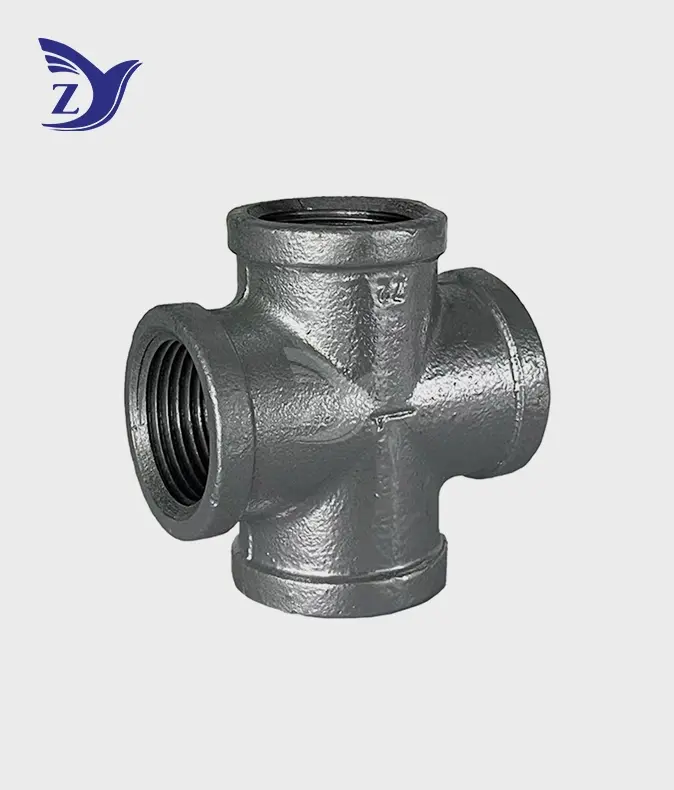
Understanding NPT Square Face Galvanized Square Edge Cross Pipe Fittings
Core Material Composition and Manufacturing Standards
The main material of NPT square face galvanized square edge cross pipe fittings is malleable iron, which meets the requirements of ASTM A197 for a minimum tensile strength of 40,000 psi and a 10% extension. This controlled annealing process turns white cast iron that is easily broken into a material that can bend and handle sudden changes in temperature and pressure without breaking. Sand casting in precise molds is the first step in the manufacturing process. Next come heat treatment processes that last 48 to 72 hours at controlled temperatures. Fittings are hot-dipped galvanized according to ASTM A153 after the threads and wrench flats are machined. Immersion in molten zinc at 840°F forms a covering that is metallurgically bound and about 85 microns thick.
The "square edge" name comes from the reinforced bead shape at each outlet hole. This adds extra metal thickness that keeps the pipes from deforming when they are being put together with normal pipe wrenches. This feature is especially useful in fire safety systems where overtightening can damage the fitting but still needs the right amount of pressure to make links that won't leak.
Threading Standards and Compatibility
North American markets are mostly made up of NPT threading, which has a 1°47' taper and 60-degree thread angles according to ANSI/ASME B1.20.1. When used with the right thread sealants, this curved shape makes interference fits that close without gaskets. BSPT (British Standard Pipe Taper) compatibility opens up the market to areas that follow ISO 7-1 norms. However, it is still important to check the dimensions when mixing threading systems. Using L1 plug gauges and L3 ring gauges for thread gaging makes sure that measurements are accurate within error zones, stops cross-threading, and makes sure that the contact depth is right.
We make cross fittings with standard sizes from 1/8" to 6" and Class 150 pressure values that can handle 300 psi at room temperature. When the temperature is high, temperature derating applies. According to ASME B16.3 rules, the pressure drops to 150 psi at 350°F.
Industrial Application Scenarios
Fire protection engineering firms put NPT square face galvanized square edge cross pipe fittings into sprinkler pipes, which are places where centralized distribution lines split off to reach different zones. The galvanized finish keeps rust scale from blocking the flood system's nozzles, and the bendable iron base can handle pressure spikes when the system is turned on. These parts are used in municipal water supply projects at places where home distribution networks meet. The anti-rust qualities make them last longer than 30 years in underground applications.
When dealing with water that is full of fertilizer, agricultural irrigation systems benefit from the resistance to rust. This is especially true in pivot point assemblies where four side pipes meet. These fittings are used by HVAC workers on steam heating return lines, because the acidity of the condensate and the changing of temperatures would quickly corrode steel that isn't protected. They are used in process water cooling loops and utility air distribution systems by petrochemical plants that like how strong they are and how well they don't wear out from vibrations.
Installation and Maintenance Guide for NPT Square Face Galvanized Cross Pipe Fittings
Step-by-Step Assembly Protocol
First, check the threads on both the pipes and the NPT square face galvanized square edge cross pipe fittings. Use wire brushes and liquid cleaners to get rid of any dirt, old sealant residue, or shipping protection oils. Check thread contact by hand-threading parts together without sealant to make sure they fit right and find any cross-threading habits. Follow the manufacturer's instructions for applying PTFE tape or liquid thread sealer and make sure the coverage starts on the second thread to stop material from pushing into the flow path.
Thread pipes into the cross fitting by hand until there is more resistance. Then, use two pipe wrenches that are facing opposite directions to turn the pipe while one holds the fitting body steady. Tighten to the suggested torque level based on the size of the pipe. Usually, 3–4 full threads should be visible past the fitting face. When tightening links next to each other, don't use the cross body as a lever point. Lateral forces can crack the pliable iron where the stress is highest.
Protective Measures During Handling
Even though galvanized coatings can handle standard handling, they can still be damaged by hard strikes or rough touch with steel tools. When working on projects that will be seen by a lot of people and where looks are important, use pipe wrenches with smooth jaw faces or cover contact points with leather or rubber shims. Before installing, keep parts in a dry place away from acids and bases that could damage the zinc layer.
When cutting threaded pipe to length, make sure all burrs are gone so that the seal surface doesn't get damaged during assembly. Instead of dry-cutting, use cutting oils to make dies last longer and keep thread quality high. Re-galvanizing damaged areas with zinc-rich patch paints protects against small scratches well enough, but coats that are seriously damaged need to be replaced.
Maintenance Best Practices
Visual checks should be done once a year to record any white rust (zinc oxide) or breakthrough weathering that shows the base iron. While white rust doesn't look good, it means that the galvanic protection is working, and red-brown iron oxide means that the coating is failing and needs to be fixed. Tighten up any joints that are letting water out right away, because even small amounts of water can speed up localized rusting through cracks.
Cleaning methods depend on the type of service media. For example, mild soap solutions can be used on drinkable water systems, but chemical process lines may need specific compatibility checks. Chlorinated cleaners are bad for zinc coats, so stay away from them. Over several heating seasons, thermal growth in HVAC systems can make joints loosen, which needs to be fixed every so often during maintenance shutdowns.
Advantages and Performance Benefits of Galvanized Malleable Iron Cross Fittings
Through the hot-dip galvanizing process, a zinc-iron alloy covering is made that acts as both a barrier and a sacrificial rust barrier. When small damage to the coating reveals the base metal, the zinc corrodes more quickly to protect the iron core through galvanic action. This ability to fix itself makes the product last 3–5 times longer than painted or uncoated options in underground or outdoor installations.
Here are the main ways that these fittings improve performance in tough pipe applications:
- Superior Ductility: The softened microstructure of malleable iron can take impact loads without breaking easily, which is very important during freeze-thaw cycles or water hammer events that send shock waves through pipes. The 10% minimum stretch requirement makes sure that fittings can handle small pipe displacement during assembly without breaking.
- Temperature Versatility: It can work in temperatures ranging from -20°F to 400°F, which is enough for most water, steam, and gas transport needs. The zinc layer stays stable below 390°F, and the iron base, which is malleable, keeps its mechanical qualities throughout this range without becoming weak.
- Installation Efficiency: Installing threaded connections is faster because you only need basic hand tools and knowledge of how to work with pipes. You don't need to buy expensive special tools or be a licensed welder. In most fire sprinkler layouts, a two-person crew can install 40 to 60 cross fittings per shift, but only 15 to 20 welded parts need skilled workers.
- Lifecycle Cost Optimization: The starting cost of the materials is 30–45 percent higher than those of black iron, but over a 20-year project span, the total ownership costs drop by 55–70 percent because of less coating upkeep and longer replacement cycles. Avoiding downtime in important systems like the fire alarms in hospitals or the water supply for cities adds a lot of secondary value.
Conclusion
NPT square face galvanized square edge cross pipe fittings are a tried-and-true method that combines excellent metalworking with surface engineering that prevents rust. Their strong construction can handle the environmental problems and mechanical stresses that come with using them for fire protection, city infrastructure, and industrial process pipes. Procurement experts can safely select these parts for a wide range of projects if they know the technical details, comparative benefits, and correct installation methods. Quality-made steel crosses are widely used in safety-critical and building systems around the world because they are reliable and cost-effective over the long term.
FAQ
What Distinguishes Square Edge Galvanized Cross Fittings from Standard Beveled Models?
The square edge design adds more material thickness to each outlet hole, making a stronger collar that doesn't bend when high installation pressure is applied. This geometric feature comes in handy when workers don't have accurate torque measuring tools. It gives them a safety cushion against damaging the part by tightening it too much. Beveled ends look nicer and make it a little easier to thread, but they lose this structural support. When tightening a wrench, the biggest changes in performance are seen when the size is 1.5 inches or more and the leverage forces are at their highest.
Can These Fittings Perform Reliably in Outdoor Corrosive Environments?
Hot-dip galvanization according to ASTM A153 is a great way to protect metals from corrosion in the air, saltwater spray, and dirt contact in underground uses. The 85-micron zinc covering will usually last more than 30 years in an industrial setting and more than 50 years in a country setting before it starts to corrode the base metal significantly. Soils with a pH below 5.0 or places that stay above 12.5 for a long time may speed up the breakdown of zinc, so extra cathodic protection or different materials like stainless steel may be needed.
How Do I Verify Supplier Certification and Product Quality?
Ask for copies of the ISO 9001 quality management system certificates and any product-specific approvals, like UL listing for fire safety parts or FM approval for materials used in alarm systems. Ask for approved mill test records that show that the materials meet ASTM A197 standards by showing results from tensile tests and chemical analyses. Manufacturers with a good reputation give full tracking by connecting heat numbers to specific production runs. A physical check should be done to make sure that there are no casting flaws like porosity or cold shuts, thread gaging marks, and uneven galvanization.
Partner with Zhiyuan Malleable Steel for Premium Galvanized Cross Fittings
Zhiyuan Malleable Steel has been making specialized steel products for 18 years and sells them all over the world. From our ISO 9001-certified factory in Shanxi Province, we make over 30,000 tons of pipe fittings every year that meet more than 1,000 different standards. Our hot-dipped galvanized malleable iron cross fittings are made to strict ASTM A197 and ASME B16.3 standards and come with full quality paperwork as well as CE, UL, and FM certifications. We are a top company that makes NPT square face galvanized square edge cross pipe fittings. Our products are used by fire protection contractors, local engineering firms, and industrial plant owners on six countries. We guarantee consistent quality and on-time delivery.
To meet the individual needs of your project, our ODM/OEM services can handle custom threading, non-standard measurements, and special finishing needs. We have a large collection of standard goods that can be shipped within two hours. Our eight medium-frequency furnaces and 156 machining centers help us meet affordable wait times for custom orders as well. We stand behind our goods with guarantees that broken parts will be replaced and quick technical help at q1236800000@gmail.com. Get in touch with our team right away to talk about your sourcing needs and find out how our manufacturing scale, quality systems, and dedication to customer service can improve the stability of your supply chain while lowering the overall cost of the project.
References
- American Society of Mechanical Engineers. (2022). ASME B16.3: Malleable Iron Threaded Fittings—Classes 150 and 300. New York: ASME Press.
- ASTM International. (2021). ASTM A197/A197M: Standard Specification for Cupola Malleable Iron. West Coshohocken: ASTM International Standards Organization.
- ASTM International. (2020). ASTM A153/A153M: Standard Specification for Zinc Coating (Hot-Dip) on Iron and Steel Hardware. West Coshohocken: ASTM International Standards Organization.
- American National Standards Institute. (2019). ANSI/ASME B1.20.1: Pipe Threads, General Purpose (Inch). Washington: American National Standards Institute.
- Factory Mutual Research Corporation. (2023). Approval Guide: Pipe Fittings for Fire Protection Service. Johnston: FM Approvals LLC.
- National Fire Protection Association. (2022). NFPA 13: Standard for the Installation of Sprinkler Systems. Quincy: National Fire Protection Association.
Online Message