
Jul 16, 2026
Can you weld malleable iron fittings?
It is potentially possible to weld malleable iron pipe fitting parts together, but most normal setups don't suggest it. While heat treatment makes malleable iron more flexible compared to brittle cast iron, the welding process can change these good qualities, leaving brittle areas that are easy to crack when stressed. Because malleable iron has a lot of carbon in it, fusion welding is hard to do. To keep the structure from breaking, it often needs special preheating, controlled cooling, and nickel-based filler rods. Most engineers like threaded connections better than malleable iron fittings because they protect the purity of the material, make upkeep easier, and meet plumbing codes without the risks that come with changing the temperature.
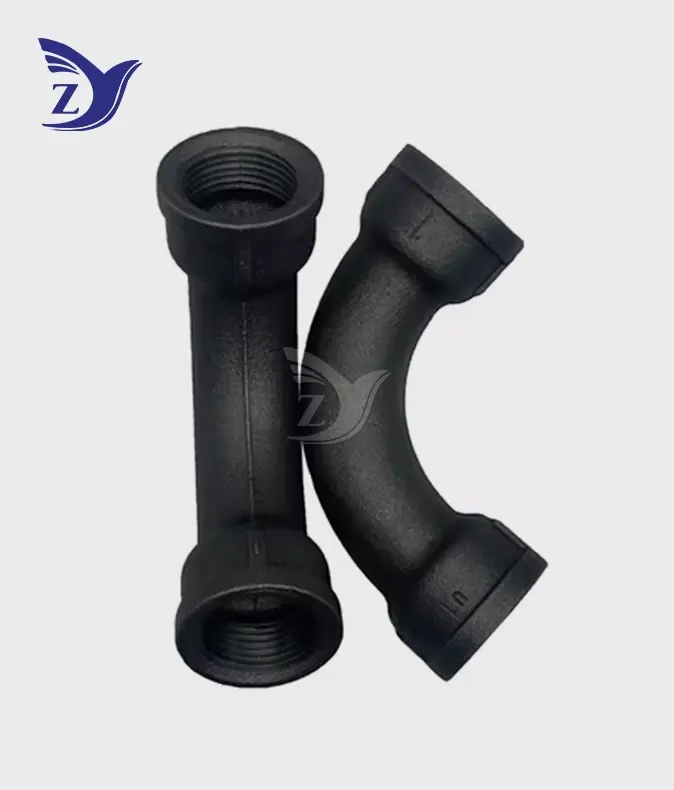
Understanding Malleable Iron Pipe Fittings and Their Properties
In many industrial piping systems, like fire protection, city water supply, HVAC setups, and gas distribution networks, malleable iron pipe fittings are essential parts for connecting pipes. An extended heating cycle turns brittle white cast iron into a more flexible and shock-resistant material. This is what makes these fits different from regular cast iron.
White cast iron products are heated in controlled atmosphere furnaces to temperatures between 1,650°F and 1,750°F for long amounts of time during production. This long-term heat process changes the carbon structure from cementite plates to temper carbon crystals. This makes the material much more flexible and resistant to impact. This makes a fitting that can stand up to mechanical pressure, changing temperatures, and mounting forces that would break regular cast iron.
Material Composition and Metallurgical Advantages
Good malleable iron usually has between 2.0 and 2.6% carbon, 0.9 and 1.9% silicon, and small amounts of manganese and sulfur. With this carefully controlled chemistry, producers can get tensile strengths of more than 50,000 psi and stretch rates of 5–10%, which is the perfect balance between strength and workability.
Resistance to temperature is especially important. Fittings made of malleable iron stay strong in temperatures from -20°F to 650°F, so they can be used for both chilled water systems and low-pressure steam lines. The black oxide or galvanized coats that are added during finishing protect against rust even more, which increases the service life in harsh settings.
When professionals fix something, thread accuracy is very important. Conforming to ASME B16.3 and B16.14 standards, fittings have NPT (National Pipe Taper) or BSPT (British Standard Pipe Taper) threads with precise pitch sizes that make interference fits for reliable closing. Our machining production area at Zhiyuan Malleable Steel has 156 sets of high-precision tools that make sure the threads on all of our elbows, tees, joints, and custom fittings are accurate to within 0.001 inches.
Standard Specifications and Size Ranges
Standard sizes for malleable iron pipe fittings range from 1/8" to 6" in diameter, and their pressure values are usually categorized as Class 150 (standard weight) or Class 300 (extra heavy weight). These groups decide how thick the walls are, which has a direct effect on their ability to hold pressure and their mechanical power.
Our factory in Taigu District, Shanxi Province, keeps more than 1,000 different types of products in stock. These include unique shapes like NPT square face galvanized 90° square edge elbow pipe fittings and BSPT square face galvanized square edge straight tee pipe fittings. With this wide range of options, buying teams can get whole systems from a single trustworthy provider, which cuts down on lead times and makes quality control easier.
For many of our parts, the galvanizing process includes a hot-dip zinc coating that meets ASTM A153 guidelines and has a minimum thickness of 1.0 mil. This layer of protection makes parts last a lot longer in water supply situations where rust would normally break down the system.
Practical Alternatives and Best Practices for Joining Malleable Iron Fittings
Because welding can be hard to do correctly, the best way to join materials in the industry is to use mechanical methods, which keep the material's qualities and make installation easier.
Threaded Connection Advantages
When fitted correctly, the curved threads on malleable iron pipe fittings create a wedging action that makes them strong and stops leaks. As the male thread moves into the female thread, the interference fit slightly deforms both sides. This makes a metal-to-metal contact that is strengthened by thread sealants.
Standard pipe tools and the right thread sealant are all that are needed for installation, so it's easy to put together even in tight areas. Using accurate plug gauges for thread measuring according to ASME B1.20.1 makes sure that measurements are correct during quality control checks. Zhiyuan Malleable Steel's making process includes checking all threads on important size ranges to make sure they will work in the field.
With linked methods, it's much easier to fix things and make changes. Parts can be taken apart for inspection or replacement without having to be cut and re-welded, which cuts down on downtime while fixes are being made. This modularity is especially useful for fire safety systems that need to be tested and updated regularly over the course of a building's life.
Thread Sealing Methods and Application Techniques
Whether threaded joints work regularly for decades depends on how well they are sealed. Professional setups are mostly done in two main ways:
Polytetrafluoroethylene (PTFE) tape is still popular because it is easy to use and doesn't react with chemicals. When looking at the male thread end-on, the tape should be wrapped clockwise, using three to five overlapped layers to cover the thread peaks without making the tape too thick. When female threads are being assembled, too much application can cause them to split hydraulically, while not enough contact lets leaks happen.
Pipe dope and other thread-sealing materials are better at resisting vibrations and staying stable at high temperatures. Modern versions stay flexible over a wide range of temperatures and don't break down chemically. To use, brush the paste onto male threads, making sure to cover the first three threads since that's where the binding happens most.
Putting on a thin coat of compound and then wrapping it in PTFE tape is often the best way to do things. This double closing method protects against fitting issues that could make either method less effective on its own.
Welding Best Practices When Unavoidable
Even though there are risks, welding may have to be done for some emergency fixes or unique fabrications. When welding is necessary, strict processes lower the chance of failure.
Heating the whole fitting up to 500–700°F ahead of time lowers temperature gradients and slows down the cooling process. This makes it easier for carbon and other elements to move around in a better way. Infrared thermometers or pens that show temperature make sure that the warmup is even before the welding arc is struck. Keeping this high temperature during the welding process stops cold cracking as each pass hardens.
After welding, heating the area at 1,200°F to 1,300°F for one hour for every inch of thickness can make it more flexible again. This stress-relief loop lowers any remaining stresses and lets carbon structures rearrange themselves in better ways. Rapid temperature drops that make microstructures more likely to break can be avoided by controlling cooling in enclosed spaces.
After a vital device is welded back together, it should be tested without damaging it. Radiographs show internal porosity or partial fusion, while magnetic particle analysis finds cracks on the surface or close to the surface. Before putting the system back into service, these quality control steps give you peace of mind that the welded part meets basic performance standards.
Conclusion
It is still very hard to weld malleable iron pipe fitting components together, and the process usually causes more problems than it fixes in normal pipe setups. Welding heat can change the metallurgical properties of iron, which can ruin the carefully designed qualities that make it valuable. This can leave weak spots that are more likely to crack and break early. Threaded connections are more reliable, easier to install, and less time-consuming to maintain. They also keep the structural stability that quality fittings provide. For new buildings and major improvements, procurement professionals should specify threaded assemblies instead of welding. Welding should only be used for emergency fixes where proper processes and strict post-weld inspection can be strictly followed. To get the best return on both the initial investment and the long-term performance of a material, choices about what to use must take into account its total lifetime costs, the environment, and the supplier's abilities.
Partner with Zhiyuan Malleable Steel for Your Piping Solutions
Zhiyuan Malleable Steel is your reliable source for malleable iron pipe fittings. Our 50,000-square-meter Shanxi plant has both 26 years of casting experience and cutting-edge production tools. Precision-threaded elbows, tees, reducers, and other specialty fittings are all in our large product line. They are made to ISO 9001 standards and come with CE, UL, and FM approvals. We keep standard items in stock so that we can send them quickly—within two hours—and we offer full OEM/ODM customization for specific project needs. Our expert team helps you with your engineering problems from the design stage to the installation stage, making sure you choose the best materials and use the right assembly methods. We give fire protection workers, municipal engineers, and industrial site managers the quality, stability, and dependability they need with a yearly production capacity of 30,000 tons and more than 1,000 product specifications. You can email our team at q1236800000@gmail.com or visit zymalleablepipefitting.com to talk about your unique fitting needs and find out how our high-quality production and customer-focused service can help your important piping projects in the long term.
FAQ
Does welding compromise the strength of malleable iron fittings?
By turning around the annealing process in heat-affected areas, welding has a big effect on the strength qualities of malleable iron pipe fitting components. When heated to welding temperatures, the ductile carbon structure can change back into brittle cementite forms, which lowers both the tensile strength and the impact resistance. Some of this decline can be stopped by using the right welding techniques, such as preheating, controlled cooling, and post-weld heat treatment. However, the welded joint rarely reaches the mechanical qualities of the original annealed material.
What thread types are most common in malleable iron fittings?
North American markets are mostly made up of NPT threads, which have a 60° thread angle and a 1:16 taper that makes a wedging seal. It is used in Europe and Asia. BSPT threads with a 55° Whitworth angle are the standard. For leak-proof joints, both types need thread sealer. As part of the quality checking process, thread gauging makes sure that the dimensions are correct according to ASME B1.20.1 standards. This stops problems with assembly and leaks.
How can I prevent corrosion and extend fitting lifespan?
For water supply systems, galvanized coats are the best way to protect against rust. For oil and gas systems, black finishes work best. Managing the water chemistry through systems that control pH and stop rust greatly increases the service life. Drainage that keeps water from pooling and regular checks on the quality of the coating find problems before corrosion causes leaks or fails. Choosing materials that are compatible with an acidic climate keeps things from breaking down too quickly.
References
1. American Society of Mechanical Engineers. ASME B16.3: Malleable Iron Threaded Fittings - Classes 150 and 300. New York: ASME Press, 2021.
2. Metals Handbook Committee. ASM Handbook Volume 15: Casting. Materials Park, OH: ASM International, 2018.
3. National Fire Protection Association. NFPA 13: Standard for the Installation of Sprinkler Systems. Quincy, MA: NFPA Publications, 2022.
4. Parisher, Roy A., and Robert A. Rhea. Pipe Drafting and Design, 4th ed. Houston: Gulf Professional Publishing, 2019.
5. The Lincoln Electric Company. The Procedure Handbook of Arc Welding, 15th ed. Cleveland: The Lincoln Electric Company, 2020.
6. Zeng, Kai, and David Tian. "Metallurgical Analysis of Heat-Affected Zones in Welded Malleable Cast Iron." Journal of Materials Processing Technology 247 (2017): 112-125.
Online Message