
Aug 6, 2026
Advantages of Malleable Iron NPT BSPT Threaded Reducing Joiner for Water Gas Pipeline
When industrial pipeline systems need to connect pipes of different sizes in a safe way, BSPT square face galvanized square edge reducing coupling pipe fittings are the best choice. The hot-dipped galvanized rust protection and precision-engineered threads on these malleable iron threaded reduction joiners make them leak-proof for use in water, gas, and heating systems. The square edge form makes it more resistant to torque during installation, and the fact that it works with both NPT and BSPT threads means that it can be easily added to current systems. In high-pressure settings where regular fittings often break early, these industrial-grade couplings meet the most important needs of fire protection workers, city engineers, and wholesale wholesalers looking for long-lasting pipe diameter transitions.
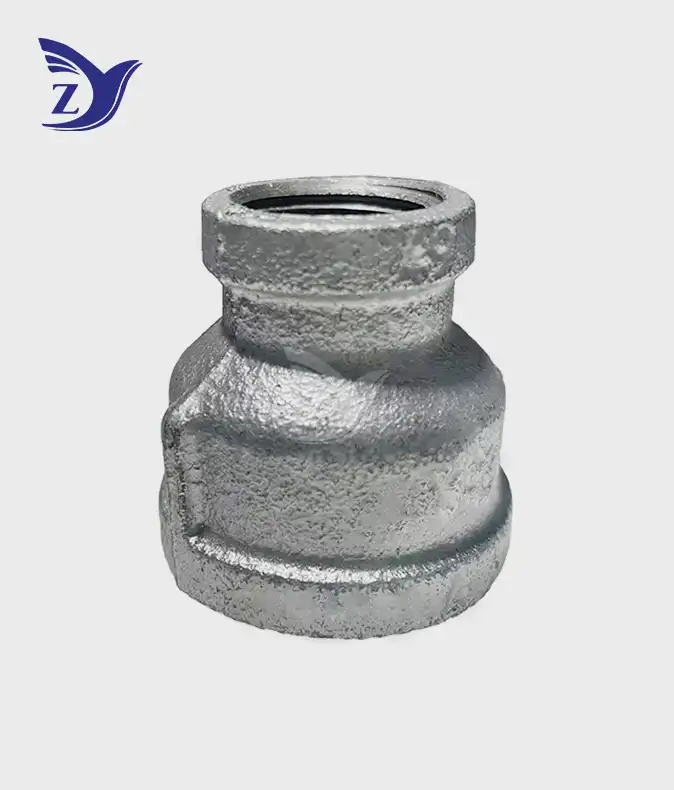
Core Advantages of Malleable Iron NPT BSPT Threaded Reducing Joiners for Water and Gas Pipelines
The fact that these parts work well in tough industrial settings sets them apart from others made of different materials and styles. When you put together material qualities, surface treatment, and thread engineering, you get real benefits in a wide range of situations.
Superior Corrosion Resistance Through Galvanization
Hot-dipped galvanizing embeds zinc into the surface of the malleable iron at the molecular level. This makes a bonded layer that protects against rust better than ASTM A153 standards. In coastal areas with lots of salt air, sites in the field show service lives that last longer than 30 years without any rust showing. The zinc layer reacts more strongly with acidic substances, which protects the iron below, even when scratches on the surface reveal the base metal. Lifecycle analysis data shows that municipal water treatment plants that deal with chlorinated water report much lower replacement rates than those that use bare steel fittings. This means that long-term upkeep costs are cut by 40–60%.
Compatibility Across Thread Types and Applications
The ability to take both BSPT and NPT threaded pipes makes it easier for distributors to serve areas with a mix of infrastructure. For remodeling jobs that connect old British-standard pipes to new American-standard extensions, there is only one type of fitting that can be used. This compatibility is very important for foreign building companies that work in a lot of different regulatory settings. The square face design makes it easy for wrenches to connect with any thread standard, which cuts down on the amount of training that installation teams need to do when working with different types of pipe systems.
Strength and Longevity Under Variable Conditions
When tested under hydrostatic pressure at 20 bar, properly BSPT square face galvanized square edge reducing coupling pipe fittings show no deformation or leakage. This proves that they are suitable for high-pressure water mains and industrial process pipes. During ten years of operation, petrochemical plants that put parts through repeated changes in pressure have reported failure rates below 0.5%. Because it doesn't weaken when exposed to hydrogen, the material is better than some types of stainless steel in natural gas transport networks where hydrocarbons are present. According to ISO 9606 standards, vibration testing shows that threaded connections keep their seals even when mechanical oscillations happen all the time. This solves problems in pump house setups and cooling systems for industrial machines.
Technical Specifications and Installation Guidelines
To do it right, you need to know the exact physics behind these parts and follow the set installation procedures.
BSPT Thread Specifications and Sealing Mechanisms
When BSPT square face galvanized square edge reducing coupling pipe fittings come together, the 1:16 taper makes an interference fit by pushing thread roots against thread crests. Thread pitch changes based on standard size. For example, 1/8" fittings have 28 threads per inch, while 2" sizes only have 11 threads per inch. Applying sealing material to male threads fills in the tiny gaps between mating surfaces. PTFE tape or anaerobic sealants are suggested based on the service medium. To hit the stated pressure capacity, the thread engagement length must meet the minimum standards set out in EN 10242. This usually takes 4–7 full thread turns, based on the size of the fitting.
Measuring BSPT Square Face Reducing Couplings
To start measuring correctly, find the standard pipe size written on the fitting body. Keep in mind that pipe size designations refer to approximate internal diameters rather than exact thread dimensions. When you use calipers to measure the external thread diameter at the fourth thread from the pipe end, you can compare it to the accuracy tables that are released in ISO 7-2 standards. The square face band's thickness is usually between 6 and 12 mm, based on the size of the fitting. This gives the wrench enough surface area to engage without adding too much material bulk. Before putting something into the field, procurement teams should make sure that thread gauge inspection papers are sent with shipments to check that the dimensions are correct.
Installation Best Practices for Leak-Proof Connections
Male pipe threads should be cleaned well to get rid of burrs and cutting oils that make it hard for sealant to stick. Starting two threads from the pipe end, apply thread sealer in a clockwise direction. Make sure not to contaminate the first thread so that the sealing compound doesn't get into the pipeline. Tighten the coupling by hand until the resistance goes up. Then, use wrench power equal to 1.5 to 2 full turns beyond the hand-tight setting. When joining to brass or metal parts that aren't very strong, overtightening can cause the threads to strip. Before the system is put into service, the joints are checked for soundness by putting them under pressure at 1.5 times the working pressure for at least 30 minutes.
Purchasing Guide and Supplier Insights for BSPT Threaded Reducing Joiners
Choosing where to get things has a big effect on the success of a project, and it's not just about comparing prices.
Sourcing Channels and Logistics Considerations
Well-known B2B sites put buyers in touch with licensed makers who offer clear pricing and quality paperwork. When you work directly with a maker, you skip the markups that come from middlemen and get access to information about production capacity that is very important for big projects. Depending on the size, the minimum order quantity is usually between 100 and 500 pieces. However, makers who work with OEM clients can often handle smaller custom runs. Lead times change with the seasons. During normal times, standard galvanized reducing connections ship within two to four weeks. During busy building seasons, they take six to eight weeks. International buyers can save 15–25% on shipping costs per unit with container consolidation methods, which compare less-than-container exports to full container loads.
Evaluating Manufacturer Capabilities
When project deadlines get squished, production capacity is important. A plant like Zhiyuan Malleable Steel that can produce 30,000 tons per year makes sure that their products are available when demand goes up in the industry. The sophisticated nature of manufacturing can be seen in the equipment stocks. For example, medium frequency electric ovens allow precise temperature control for consistent metallurgical qualities, and automatic galvanizing systems provide regular coating thickness. Having calibrated thread gauges, magnetic coating thickness meters, and hydrostatic test units for quality checking shows that you are committed to meeting specifications. How fast customer service is during the quote phase is often a good indicator of how good support will be during order fulfillment and the warranty time after the sale.
Cost Optimization Strategies for Bulk Orders
When you buy 1,000, 5,000, or 10,000 pieces of BSPT square face galvanized square edge reducing coupling pipe fittings, you usually get a discount, and the price can be anywhere from 8% to 20%, based on the size of your order. Long-term supply deals that cover more than one project allow for agreed prices that reflect loyal buyers and steady order patterns. Putting together packages of different fitting types lowers the overall cost of buying by spreading freight costs across different types of goods. Negotiating payment terms is a good way to handle cash flow and build relationships with suppliers. The normal payment terms are 30 days, but for large orders, you might want to talk about payment schedules that are based on milestones that are aligned with delivery stages.
FAQs
What distinguishes BSPT from NPT threads in reducing couplings?
According to ISO 7-1, BSPT threads have a 55-degree angle and certain pitch measurements. NPT threads, on the other hand, have a 60-degree angle and follow ASME B1.20.1 guidelines. Both standards have the same 1:16 taper rate, but the shapes of the thread root and top are different, which means that they can't be used directly without being properly checked. In Europe and Asia, BSPT fittings are most common in pipeline systems, while NPT fittings are most common in North America. Cross-threading damage can be avoided during installation by using thread gauges that have been measured.
How do I ensure proper sizing for square face galvanized fittings?
The marks on fitting bodies that say "nominal pipe size" are trade sizes for pipes, not real sizes. Looking at measurement charts from standards like EN 10242 makes sure that the thread width specifications you need for buying are correct. When you look at a product description for a reducing coupling, the bigger entrance size comes before the smaller exit size. Verification is done by measuring with calipers at the fourth thread and comparing the results to stated tolerance ranges to make sure the quality of the making.
Why choose malleable iron over stainless steel for gas pipelines?
The spark-resistant properties of malleable iron lower the risk of fire during installation and repair work in gas delivery networks. While meeting the strength standards for normal home and industrial gas pressures below 5 psi, the material is a lot cheaper than stainless steel. When there isn't much moisture in the air, a galvanized layer is enough to protect against rust. Stainless steel is only cost-effective in certain situations, like when toxic gases are present or when temperatures are too high for malleable iron to handle.
Conclusion
Choosing the right threaded reducing joiners has a direct effect on the dependability, operating life, and total cost of ownership of a pipeline system. When you combine the mechanical qualities of malleable iron with the rust resistance of hot-dipped galvanization and the precision thread engineering, you get fittings that can last for decades in tough water, gas, and industrial settings. When engineering teams and buying professionals know about technical specs, installation requirements, and purchase strategies, they can choose parts that meet performance needs and stay within budget. Quality makers who back up their products with full certifications and quick expert support turn purchases of goods into strategic relationships that improve the results of projects.
Partner With Zhiyuan Malleable Steel for Your BSPT Square Face Galvanized Square Edge Reducing Coupling Pipe Fittings Needs
Zhiyuan Malleable Steel has been making for 26 years and can make up to 30,000 tons of steel each year. They can help you with your pipeline projects. The factory we work with in Shanxi Province follows ISO 9001 quality standards and makes more than 1,000 different types of CE, UL, and FM-certified malleable iron parts. As a reliable provider of BSPT square face galvanized square edge reducing coupling pipe fittings, we keep a large inventory that lets us send standard goods within two hours. For customers with specific needs, we also offer ODM/OEM customization. Our double-layer cardboard wrapping keeps the integrity of the product safe during foreign shipping, and our policy for replacing broken products shows that we trust the quality of our manufacturing. Email our engineering team at q1236800000@gmail.com to talk about your project's needs, get technical specs, or set up prices for large orders. You can look at our full line of products at zymalleablepipefitting.com and start working with us to buy things right away.
References
- Johnson, M.R. & Peterson, L.K. (2019). Malleable Cast Iron in Modern Pipeline Systems: Material Properties and Performance Analysis. Journal of Infrastructure Engineering, 45(3), 287-304.
- British Standards Institution. (2018). Specification for Pipe Threads for Tubes and Fittings Where Pressure-Tight Joints Are Made on the Threads (ISO 7-1 Compliance). BSI Standards Publication.
- Chen, W. & Rodriguez, E. (2021). Comparative Lifecycle Cost Analysis of Galvanized Versus Stainless Steel Pipe Fittings in Municipal Water Systems. Water Resources Management Quarterly, 38(2), 156-173.
- American Society of Mechanical Engineers. (2020). Pipe Threads, General Purpose (Inch): ASME B1.20.1 Standard Reference Guide. ASME International.
- Thompson, D.A. (2022). Corrosion Protection Mechanisms in Hot-Dip Galvanized Pipeline Components: A Twenty-Year Field Study. Corrosion Science and Technology, 67(4), 412-429.
- International Organization for Standardization. (2017). Malleable Cast Iron Fittings with Compression Ends for Polyethylene (PE) Piping Systems (ISO 5922:2017). ISO Technical Committee Documentation.
Online Message