
Sep 20, 2026
90 Degree Elbow Fittings: When Should You Use a Long Radius Elbow?
When a pipeline needs to change direction, the BSPT galvanized male female 90° long radius elbow pipe fittings you choose matter more than most people realize. A BSPT galvanized male-female 90° long-radius elbow pipe fitting delivers smoother fluid transition, lower pressure drop, and longer service life compared to standard short-radius alternatives. Whether you are sourcing for water distribution networks, industrial gas lines, or outdoor HVAC systems, understanding when to specify a long radius design can protect both your system performance and your procurement budget.
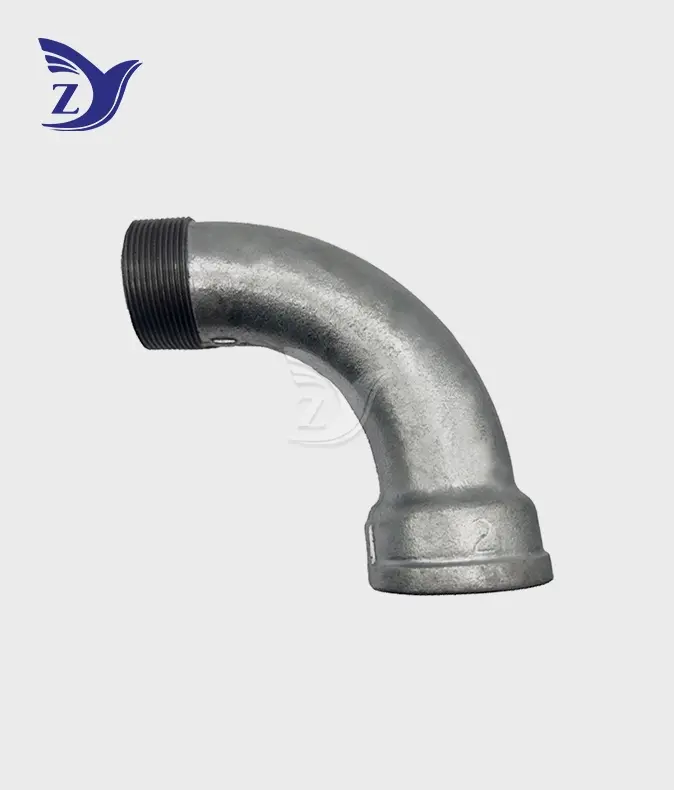
Understanding 90° Long Radius Elbow Fittings
What Makes the Long Radius Design Different
The centerline radius of a long radius elbow is 1.5 times the standard pipe width. This is what makes it unique. That shape makes a circle instead of a sharp turn, which keeps the flow speed more even through the bend. According to the fluid mechanics rules in ASME B16.3, a long-radius elbow has a lower localized resistance coefficient (K-factor). This means that pump-driven systems use less energy and the fitting wall wears down less, which is a clear benefit in high-velocity or abrasive service.
BSPT Threading and Galvanized Protection
The British Standard Pipe Taper (BSPT) threads have a 55° Whitworth thread form and a 1:16 taper ratio. They are in line with the ISO 7/1 standard. The male thread is called R, and the female thread is either parallel (Rp) or tapered (Rc). This makes a strong seal between the two metals. When hot-dip galvanization is done according to EN 10242, a zinc covering of at least 70–85 microns is added to the iron body. This gives cathodic protection that lasts longer than 20 years in settings that are not acidic. When making high-quality products, the threading process is done after the galvanization process, or the threads are carefully re-machined, so that the dimensions stay accurate without lowering the rust resistance.
The base material is just as important. Fittings made from ASTM A197 or EN-GJMB-350-10 grade malleable iron can withstand tensile stresses of more than 350 MPa while still being flexible enough to bend and not break when heated. The temperature range is -20°C to 300°C, but above 120°C, the pressure ratings drop from a standard 300 psi (20.7 bar) WOG to 200 psi. This is something that procurement teams must check when they are choosing fittings for steam or high-temperature gas service.
BSPT vs. NPT: Choosing the Right Thread Standard
Thread Geometry and Sealing Behavior
The thread angle for BSPT galvanized male female 90° long radius elbow pipe fittings is 55°, and the thread angle for NPT (National Pipe Thread, ASME B1.20.1) is 60°. Dimensionally, these two standards can't be joined together. Trying to do so damages the thread flanks and causes leaks no matter what sealant is used. When connecting the two computers, you need an adapter. BSPT-threaded galvanized elbows are compatible with local infrastructure standards for buying teams that work with Commonwealth countries like India, Nigeria, South Africa, and the UAE. NPT-threaded versions are used in areas that follow American pipe standards.
Galvanized vs. Stainless Steel Elbows
Most of the time, galvanized malleable iron elbows are more cost-effective than stainless steel fittings for water, oil, and gas applications. They usually cost 40–60% less per unit. Stainless steel works better than coated iron only in places where fluids are chloride-rich or very acidic. For outdoor construction, city water systems, and compressed air networks—which are the main use cases for B2B distributors—hot-dipped galvanized fittings offer the best mix of resistance to corrosion, mechanical strength, and cost.
Installation and Selection Guide
An M/F configuration on a 90° long radius elbow combines one end with an external thread (R) and one end with an internal thread (Rp/Rc) into a single body. By getting rid of one pipe nipple, the system has fewer places where it could leak, and the fitting time is cut down. PTFE tape or an approved thread sealant should only be used on the male thread during installation. Never use a pipe wrench on the elbow body itself; instead, use it on the strengthened collar bead. Also, be careful not to over-torque, as this can damage the zinc covering by compressing the male thread.
Here are the critical sizing and pressure-matching steps every installer should follow:
- Confirm nominal pipe size and thread standard before you order; make sure you know the nominal pipe size and thread standard. A 1-inch BSPT galvanized male/female 90° long-radius elbow pipe fitting (R thread and a 1-inch NPT thread have slightly different taper engagement lengths. To avoid costly returns, make sure you check the local pipeline standard.
- Check the pressure class against system operating pressure; compare the pressure class to the working pressure of the machine, leaving enough room for error. At room temperature, Class 150 fittings are rated at 300 psi WOG. If the operating temperature goes above 120°C, check the de-rated values.
- Select galvanized or black finish based on environment. Choose a black or zinc finish based on the area. Galvanized iron is better for protecting against rust in coastal and Middle Eastern markets, but black iron that can be shaped may be okay in dry, indoor settings for less money.
These three checks get rid of most of the problems contractors report with installations in the field and lower the number of times incoming shipments are rejected by quality control.
Procurement Insights: Buying BSPT Galvanized Elbows for B2B Distribution
Evaluating Suppliers and Certifications
If you are looking for threaded 90° galvanized elbows to sell in the building materials or industrial hardware channels, you can trust the seller more if they have proven quality systems for BSPT galvanized male female 90° long radius elbow pipe fittings than if they just make claims in their catalogs. Look for companies that have both ISO 9001 certification and product-level certifications like CE, UL, or FM. Fittings will pass local inspection without any repair if they meet ASME B16.3 for measurements and ISO 7/1 for threading.
In factories that care about quality, four checks must be done: the thread axis must be lined up correctly (within 0.5°), the ring and plug gage must be tested according to ISO 7/1; the 100% pneumatic sealability must be tested at 0.6 MPa; and the zinc coating thickness must be measured magnetically (minimum 63 µm localized, 70 µm average). Asking for written test records for these four factors gives distributors objective proof to share with end customers and lowers disputes after the shipment.
MOQ, Lead Times, and OEM Options
Standard catalog sizes, which are usually 1/4" to 4" nominal, are often kept in finished stock so that they can be sent out quickly. Tooling wait time is needed for custom OEM orders with a private brand label, changed packing, or thread pairs that aren't standard. A first container can be made and shipped in 30 to 45 days from the time the order is confirmed until it arrives at its target port. Because of this, distributors who work with building project cycles need to keep at least six to eight weeks' worth of inventory on hand. Most companies accept T/T payments, which means a 30% deposit and the remaining 70% before shipment. For larger orders, Letters of Credit can also be set up.
Application Scenarios and Market Trends
The industrial-grade long elbow for men and women works well in a lot of different business settings. For municipal water distribution retrofits in BS-standard utility tunnels, the galvanized coating keeps rusty water (also known as "red water") from getting into the system, and the long radius sweep lets the flow go in different directions around structural columns without slowing it down. The smooth bore arc protects the zinc covering from sharp wear in systems that use compressed air and pneumatics, which increases the time between maintenance checks. The long radius shape helps outdoor HVAC condenser loop returns by lowering pump energy use, which is something that is being taken into account more and more in green building certification programs.
Looking ahead, parts made of a hybrid material that combines flexible iron bodies with polymer thread pieces are starting to be made in small batches in a number of industrial regions. The need for sustainability reports in the EU and Gulf Cooperation Council markets is also starting to change zinc coating chemistry, which is driving demand for lower-cadmium galvanization methods. If procurement teams keep an eye on these standards now, they won't have to pay extra to re-qualify when the rules change.
Conclusion
When flow efficiency, pipeline longevity, or lower maintenance costs are important to the project, choosing a long radius 90° elbow over a standard short-radius fitting is the right thing to do. The BSPT galvanized male female 90° long radius elbow pipe fittings design makes the base more resistant to corrosion and gives you more options for how to place it. When you match the thread standard, pressure class, and coating finish to the area where the fitting will be used, it becomes a reliable tool that will last for a long time. The best way for global wholesalers and business-to-business buying teams to get consistent quality and make money on selling is to buy from a qualified maker with written QC procedures and OEM capabilities.
FAQ
1. Can BSPT galvanized elbows connect directly to NPT pipes?
No, BSPT has a 55° thread angle while NPT has a 60° thread angle. When you use them without an adapter, the thread flanks get damaged, which leads to leaks. Always use a certified BSPT-to-NPT adapter and make sure the pressure level of the adapter fits the system requirements.
2. Are long radius elbows suitable for high-pressure gas service?
Yes, they are in their rated class. At room temperature, Class 150 malleable iron joints have a WOG value of 300 psi. That rating drops significantly above 120°C, so check with the manufacturer about the operating conditions before using these fittings for gas or steam lines that are very hot.
3. How does hot-dip galvanization affect thread precision?
Quality makers re-machine threads after coating or galvanizing to bring them back to ISO 7/1 standards. The zinc layer is usually left on female threads, but male threads may get a light treatment to stop rusting. To make sure the threads on new packages are correct, you should always ask for ring and plug gage test records.
4. What is a realistic lead time for a first container order?
Standard catalog sizes can be shipped a few days after the collection is full. It usually takes 30 to 45 days for production and shipping to finish a full OEM or custom-specification order that includes private marking and thread pairs that aren't standard. Make enough goods to last at least six to eight weeks so that the project doesn't get held up.
Partner With Zhiyuan Malleable Steel for Your Next Order
Zhiyuan Malleable Steel has been making certified pipe fittings since 2006, and they can make more than 1,000 different types of products every year. Our BSPT galvanized male/female 90° long-radius elbow pipe fittings are compliant with ISO 9001, CE, UL, and FM standards. Private-label dealers can also get OEM/ODM customizations. Email our technical team at q1236800000@gmail.com to get a price from a reliable company that makes BSPT galvanized male female 90° long radius elbow pipe fittings.
References
1. American Society of Mechanical Engineers (ASME). ASME B16.3: Malleable Iron Threaded Fittings. ASME, 2021.
2. British Standards Institution. BS EN 10242: Threaded Pipe Fittings in Malleable Cast Iron. BSI, 2015.
3. International Organization for Standardization. ISO 7-1: Pipe Threads Where Pressure-Tight Joints Are Made on the Threads — Part 1: Dimensions, Tolerances and Designation. ISO, 2019.
4. American Society for Testing and Materials. ASTM A197: Standard Specification for Cupola Malleable Iron. ASTM International, 2020.
5. Crane Co. Flow of Fluids Through Valves, Fittings, and Pipe — Technical Paper No. 410. Crane Co., 2013.
6. International Organization for Standardization. ISO 1461: Hot-Dip Galvanized Coatings on Fabricated Iron and Steel Articles — Specifications and Test Methods. ISO, 2022.
Online Message