
Jul 29, 2026
3 4 Long Radius Elbow Dimensions
If you're looking for pipe fittings for commercial use, knowing the exact specs can make or break your job. For fire safety systems, HVAC installs, and public pipes, the 3/4 inch long radius of the elbow is very important. NPT galvanized male female 90° long radius elbow pipe fittings are a unique answer that combines accurate threading, protection to corrosion, and improved flow characteristics. The curve radius of these fittings is about 1.5 times the normal pipe diameter. This makes them less likely to cause turbulence and pressure loss than standard short radius options. The male-female configuration, which is also known as a "street elbow," lets you connect directly without any extra nipples. This saves installation space in mechanical rooms and outdoor pump stations that are already full. The hot-dip galvanization provides strong zinc protection, and the NPT threading ensures leak-resistant seals in line with ANSI/ASME B1.20.1 standards. These components solve the main problems that procurement workers face, which are durability, compatibility, and system efficiency.
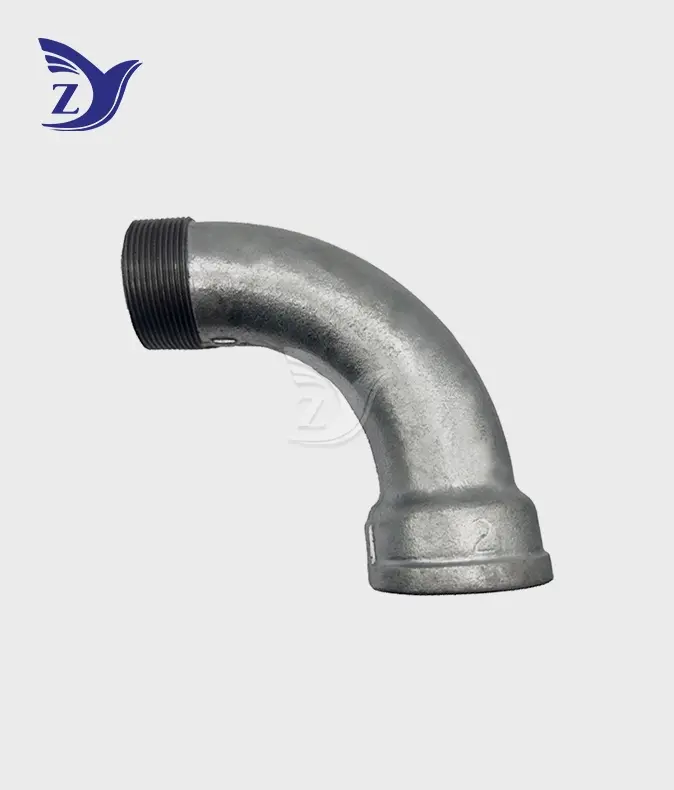
3/4" NPT Galvanized Male Female 90° Long Radius Elbow Dimensions
The success of installation and long-term dependability depend on how accurately the dimensions of threaded pipe fittings are met. We make our fittings in strict accordance with established industry standards, which allows them to fit seamlessly into a wide range of piping networks.
National Pipe Taper (NPT) Threading Standards
The 3/4 inch NPT specification follows ANSI/ASME B1.20.1 standards and has a flank angle of 60 degrees and a taper of 1 inch per 16 inches of thread length. The male end tapers outward and the female port tapers inward, creating interference that tightens progressively during installation. This design works especially well in gas and liquid systems where fugitive emissions must stay below regulatory thresholds. Thread gauging using calibrated L1 and L2 plug and ring gauges confirms conformance,
Defining Long Radius Geometry
NPT galvanized male female 90° long radius elbow pipe fittings are different from short radius elbows because they have a wider sweep. In a long radius 90-degree elbow, the radius of curvature is about 1.5 times the nominal pipe diameter. For a 3/4 inch fitting, this means the centerline radius is about 1.125 inches (28.6 mm), and the center-to-end dimension—the distance from the fitting's center point to the end of each threaded connection—is usually about 1.5 inches (38 mm). This wider path reduces changes in flow velocity, which keeps erosion to a minimum in slurry applications and stops steam hammer in condensate return lines. The geometry also lowers pressure drop by 30–40% compared to short radius designs at equivalent flow rates, which makes pumps more efficient and lowers operational energy costs over the lifecycle of the system.
Male-Female Configuration Advantages
The dual-threaded design has external threads on one end (male) and internal threads on the other end (female), so there is no need for separate nipples or couplings. This configuration is very useful for retrofitting existing systems where standard elbow and nipple assemblies can't be used because of lack of space. In fire sprinkler drop installations, the male-female elbow connects directly to branch line tees while accommodating sprinkler head threading, reducing the number of joints and pote
Material Composition and Benefits of Galvanized Pipe Fittings for Industrial Use
The choice of material affects both the original cost of purchase and the total cost over the product's lifetime. For most industrial piping uses, galvanized malleable iron strikes a good mix between strength, resistance to corrosion, and cost.
Black Heart Malleable Iron Foundation
Our NPT galvanized male female 90° long radius elbow pipe fittings are made from black malleable iron that meets ASTM A197 standards. This material has a tensile strength of more than 300 MPa and an elongation greater than 6%, which means it can withstand physical impacts and thermal expansion cycles without breaking. The annealing process, which is done in our Blue Sky HTL-1 natural gas kilns, changes white cast iron into a matrix containing ferrite and temper carbon nodules. This microstructure absorbs shock loads that would crack standard
Hot-Dip Galvanization Process
Hot-dip galvanization immerses cleaned fittings in molten zinc at approximately 840°F (449°C), creating a metallurgically bonded coating. The resulting zinc layer, typically exceeding 70 microns (500 g/m²) thickness per ASTM A153 standards, provides barrier protection plus cathodic protection. When scratches expose the underlying iron, the zinc preferentially corrodes, protecting the base metal until the coating regenerates through zinc oxidation products. This sacrificial anode effect proves particularly valuable in coastal environments, agricultural settings with corrosive fertilizers, and petrochemical facilities with atmospheric contaminants. We carefully control galvanizing parameters to prevent zinc clogging in thread valleys—a common defect that prevents proper thread engagement. Magnetic thickness testing during our quality control process verifies uniform coverage, including the challenging interior surfaces of female threads where inadequate coating often goes undetected until field failures occur.
Performance Comparison with Alternative Materials
While stainless steel fittings are more resistant to corrosion, they cost three to four times more than galvanized malleable iron. This price difference is usually not worth it unless the fittings will be exposed to certain chemicals. Black iron pipe fittings don't have a protective coating, so they need to be painted or wrapped in outdoor applications, which costs a lot of money in maintenance. Galvanized fittings offer corrosion protection that is equivalent to stainless steel in most environments and cost about forty percent less. A municipal water authority installing outdoor pump station piping can expect galvanized fittings to last 25 to 30 years, compared to eight to twelve years for bare black iron. This is a big difference in terms of system downtime and replacement labour.
How to Measure and Verify Pipe Fitting Dimensions Accurately?
Procurement experts and receiving inspectors need accurate measurement methods to make sure that parts meet specifications before they are put in stock or sent to job sites.
Essential Measurement Tools
NPT thread plug gauges (L1 gauge for hand-tight engagement, L2 gauge for maximum engagement) and ring gauges are needed for thread verification. Digital calipers with 0.001-inch resolution are used to measure overall dimensions, center-to-end distances, and wall thickness at multiple points. Optical comparators compare fitting profiles against standard templates, showing angular deviations in the 90-degree bend. Magnetic coating thickness gauges check the uniformity of the zinc layer without dam
Step-by-Step Inspection Protocol
Visual inspection finds surface flaws like pitting, flaking zinc, casting porosity, or thread damage. The L1 plug gauge should thread smoothly into female connections and engage male threads without force. The stand-off distance between the gauge face and fitting face must fall within the tolerance ranges listed in ANSI B1.20.1, which is usually 0.250 to 0.312 inches for 3/4 inch NPT. An optical comparator or precision square is used to make sure the 90-degree bend measures within 0.5 degrees—d
Common Measurement Errors and Prevention
It's very easy to make costly specification mistakes when you don't check the markings on NPT galvanized male female 90° long radius elbow pipe fittings and reference drawings to make sure you have the right thread gauges. Measuring the outside diameter instead of the taper and pitch diameter gives you wrong measurements; thread dimensions depend on the taper and pitch diameter, not the major diameter visible at the thread crest. For example, if you don't clean the galvanizing residue off of the threads before gauging, you might think they are unde
Conclusion
To choose the right 3/4 inch long radius elbow measures, you need to know how threading standards, material traits, and application-specific needs affect each other. NPT galvanized male female 90° long radius elbow pipe fittings offer better flow features, installation that takes up less space, and security against corrosion. They can be used in fire alarm systems, HVAC networks, public works infrastructure, and industrial process lines. The two-threaded design gets rid of parts that aren't needed, and the wider radius lowers pressure loss and erosion. Hot-dip galvanization lasts for decades and works well in harsh outdoor and corrosive conditions. To be successful in procurement, you need to work with certified producers who can consistently show high quality, specialised knowledge, and helpful customer service. By using the methods for checking dimensions, comparing materials, and following the specification advice in this article, engineering and purchasing teams can be sure to find fittings that meet both short-term project needs and long-term operational performance expectations.
FAQs
What distinguishes long radius from short radius 90-degree elbows?
This difference is shown by the radius of curve. The centerline radius of a long radius elbow is about 1.5 times the standard pipe diameter, and the centerline radius of a short radius elbow is about 1 time the diameter. This longer sweep in long radius designs lowers flow turbulence and pressure drop by 30–40%. This makes them better for energy-efficient systems and high-velocity uses where erosion is a concern.
How does galvanization enhance fitting durability?
The zinc covering that is made by hot-dip galvanizing acts as both a shield and a cathode protector. The zinc shell keeps water and other things that can damage the base metal from getting to it. When there are scratches, zinc corrodes faster than iron, giving up its own protection. Fittings that are properly galvanized according to ASTM A153 standards will last 25 to 30 years outside, while black iron that isn't protected will only last 8 to 12 years.
Are these fittings suitable for high-pressure applications?
Temperatures range from -20°F to 150°F, and Class 150 malleable iron fittings can handle up to 300 psi of pressure. The tensile strength of the material is over 300 MPa, and when it is properly threaded, it works reliably in most business and industrial systems. Applications that need higher ratings should mention Class 300 fittings or talk to technical support to make sure they are right for the pressure and temperature combinations they need.
Partner with Zhiyuan Malleable Steel for Reliable NPT Galvanized Male Female 90° Long Radius Elbow Pipe Fittings Supply
With 26 years of experience making threaded fittings, Zhiyuan Malleable Steel is ready to meet your needs. Our ISO 9001-certified factory in Shanxi Province makes more than 1,000 specifications and has a yearly capacity of more than 30,000 tonnes. This means that we are always available, whether you need something right away from our large collection or something made to order for a specific use. We keep our certifications up to date, such as CE, UL, and FM, which means we meet international standards for fire protection, HVAC, and industrial piping systems. Before they are shipped, our NPT galvanized male female 90° long radius elbow pipe fittings go through a series of strict checking steps. These include thread gauging, angle verification, zinc coating thickness testing, and hydraulic pressure testing. As one of the biggest companies that makes malleable steel pipe fittings, we can customise our products to meet your specific needs and help you brand them. Our technical team can help you with application building and choosing the best settings for your operating environment. Email us at q1236800000@gmail.com to talk about your needs, get specific quotes, or set up tours of our facilities. We welcome foreign buyers, project contractors, and bulk distributors who are looking for a reliable NPT galvanized male female 90° long radius elbow pipe fittings source that cares about quality, service, and price. You can look at our full line of products at zymalleablepipefitting.com and learn how our production skills can help you make your supply chain more reliable.
References
American Society of Mechanical Engineers. (2020). ASME B1.20.1: Pipe Threads, General Purpose (Inch). New York: ASME Standards.
ASTM International. (2019). ASTM A153/A153M: Standard Specification for Zinc Coating (Hot-Dip) on Iron and Steel Hardware. West Conshohocken: ASTM.
ASTM International. (2018). ASTM A197: Standard Specification for Cupola Malleable Iron. West Conshohocken: ASTM.
Crane Co. (2018). Flow of Fluids Through Valves, Fittings, and Pipe. Technical Paper No. 410. Stamford: Crane Company.
National Fire Protection Association. (2021). NFPA 13: Standard for the Installation of Sprinkler Systems. Quincy: NFPA.
Smith, R.L. & Henderson, J.M. (2017). Piping and Pipeline Engineering: Design, Construction, Maintenance, Integrity, and Repair. Boca Raton: CRC Press.
Online Message